


- List Of Common 3-Letter Words Starting With E
- More 3-Letter ‘E’-Words
- 3-Letter Action Words That Start With E
- 3-Letter Everyday Objects That Start With E
- Three-Letter Animal Names That Start With E
- Positive Three-Letter Words That Begin With E
- Three-Letter Nouns Beginning With E
- 3-Letter Adjectives Starting With E
- Sentences Using Three-Letter E Words
- Activities To Teach 3-Letter Words Starting With E For Kids
- FAQs
Last Updated on November 3, 2026
A ringing ear, an egg cracked for breakfast, an ewe grazing in a field 3-letter words that start with E show up constantly in everyday life, giving young readers plenty of genuinely useful vocabulary to work through.
Thank you for reading this post, don't forget to subscribe!
This guide covers three-letter words starting with E for students, with a full word list, grouped tables, example sentences and hands-on activities built around E.
List Of Common 3-Letter Words Starting With E
From body parts to farm animals, these 3-letter words beginning with E cover a wide, practical range that children meet early in their reading.
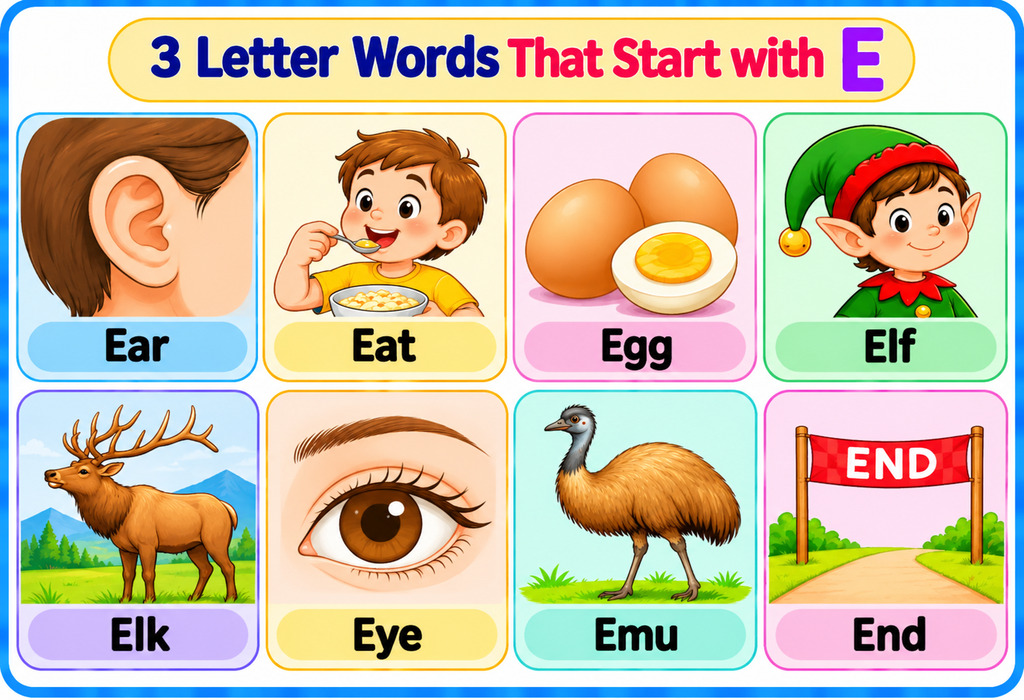
- Ear – The part of the body used for hearing.
- Eat – To put food in the mouth and swallow it.
- Egg – An oval object laid by birds, often eaten as food.
- Elf – A small, magical creature from folklore and stories.
- Elk – A large deer found in forests and mountains.
- Elm – A tall tree with broad leaves.
- End – The final part of something.
- Era – A long period of time in history.
- Err – To make a mistake.
- Eve – The evening or day before an event.
- Ewe – A female sheep.
- Eye – The part of the body used for seeing.
- Ego – A person’s sense of self-importance.
- Eel – A long, snake-like fish.
- Emu – A large, flightless bird from Australia.
More 3-Letter ‘E’-Words
“Eft,” an old word for a young newt, is one further genuine word children may come across once they’re reading confidently.
| Eft |
3-Letter Action Words That Start With E
Eating a meal and making a mistake both get genuine three-letter homes here, two E words tied to things that happen rather than things that sit still.
| Eat | Err |
3-Letter Everyday Objects That Start With E
A boiled egg on a plate is the clearest genuine object this list can offer among 3-letter E words.
| Egg |
Three-Letter Animal Names That Start With E
A towering elk, a woolly ewe, a slippery eel and Australia’s famous flightless bird all earn their place here, a genuinely strong set for E.
| Elk | Ewe |
| Eel | Emu |
Positive Three-Letter Words That Begin With E
The night before a birthday or holiday carries real excitement, which makes “eve” a fitting, hopeful choice for E’s positive word.
| Eve |
Three-Letter Nouns Beginning With E
An ear, an egg, a magical elf from a story — these nouns each name something real enough for a child to picture or point to.
| Ear | Egg |
| Elf | Elk |
| Elm | Eye |
| Ego | Eel |
3-Letter Adjectives Starting With E
Genuine describing words are thin on the ground for E at exactly three letters, so young readers won’t find an example here — but there’s still plenty to explore in the word lists and activities above.
Sentences Using Three-Letter E Words
A three-letter word that starts with E sticks best once a child sees it doing a real job inside a sentence. Try these together and ask your child to spot the E word each time.
- Please cup your hand behind your ear to listen.
- It’s time to eat your breakfast now.
- The hen laid a speckled egg this morning.
- The story’s elf wore a pointed green hat.
- We spotted an elk near the edge of the forest.
- The old elm tree shaded the whole garden.
- We reached the end of the long path.
- The knight lived in a different era entirely.
- I made an error, so I’ll try again.
- The ewe followed her lambs across the field.
Activities To Teach 3-Letter Words Starting With E For Kids
These 3-letter words starting with E for kindergarten and preschoolers work well as short, playful moments woven through an ordinary day.
1. Ear Whisper Chain
Sit in a circle and whisper a simple word or phrase into the first child’s ear, letting it pass quietly around the group to see how it changes by the end. Afterwards, talk about how important the “ear” was for the whole game to work.
2. Egg And Spoon Balance
Set up a simple egg-and-spoon course using a boiled or plastic egg, letting children balance it carefully while walking a short distance. Saying “egg” each time they steady it keeps the word tied to focus and balance.
3. Elf Workshop Craft
Set out paper, glue and scraps of fabric or felt for children to build a tiny pretend “elf” home from a shoebox. Talking about what an elf might need inside links the word to genuine, hands-on creativity.
4. Elk Antler Measuring
Cut out large paper “antlers” and let children compare their arm span to how wide real elk antlers can grow, using a tape measure for a rough comparison. This grounds the word “elk” in a concrete sense of scale.
5. End Of The Line Relay
Set up a short relay race where children pass a baton or soft toy down a line, and the last person to receive it shouts “end” once it arrives. This ties the word to a clear, physical finishing point they can feel and see.
FAQs
1. Why Does “Era” Sound So Different From Other Short E Words?
“Era” uses two vowel sounds blended together rather than a single short “e,” which makes it trickier to sound out than words like “egg” or “end.” Reading it slowly, breaking it into “eh-rah,” can help children hear both parts clearly.
2. Is An Elf The Same In Every Story?
Not quite, since elves can appear as tiny, mischievous helpers in some tales and as tall, graceful characters in others, depending on the story’s tradition. Mentioning this helps children understand that folklore characters often change shape depending on who’s telling the story.
3. Why Do People Say “Err” When They’re Unsure, Not Just When They Make A Mistake?
Saying “err” or “um” while thinking is actually a separate, informal use from the verb “to err,” meaning to make a mistake, even though they’re spelled and said similarly. Pointing out this difference helps children see how the same sounds can serve two different jobs in speech.
4. What’s The Difference Between A Ewe And A Regular Sheep?
“Ewe” specifically refers to a female sheep, while “ram” refers to a male, and “lamb” refers to a young one, giving English several different three-letter words for the same animal family. This is a useful, concrete way to show children how language sometimes splits one idea into several precise words.
5. Why Can’t Emus Fly Like Most Other Birds?
Emus have small, underdeveloped wings compared to their large bodies, and they’ve evolved instead to be fast, powerful runners across open land. Sharing this real fact alongside the word “emu” helps children connect the vocabulary to something genuinely interesting about the animal.
From a farmyard ewe to a towering elm tree, three-letter E words give children a rich, varied set of everyday vocabulary to build on. Spotting these words during walks, mealtimes and quiet reading moments helps them stick far better than memorising a list alone.
Related Articles:
| 3 Letter Words Starting With ‘A’ | 3 Letter Words Starting With ‘I’ |
| 3 Letter Words Starting With ‘O’ | 3 Letter Words Starting With ‘Z’ |
| 3 Letter Words Starting With ‘S’ | 3 Letter Words Starting With ‘Q’ |