


- Key Takeaways
- What Is A Two-Syllable Word?
- How To Count Two-Syllable Words?
- One-Syllable Vs. Two-Syllable Words
- Two-Syllable Words By Learning Stage
- Two-Syllable Words List (A to Z)
- 2-Syllable Words By Category
- Two-Syllable Words By Phonics Pattern
- 2-Syllable Words That Rhyme
- Sentences Using Two-Syllable Words
- Activities To Practice 2-Syllable Words
- Test Your Knowledge (Quiz)
- FAQs
Last Updated on November 7, 2026
Key Takeaways
- A two-syllable word has two beats, and each beat holds one vowel sound, as in win-dow and gar-den.
- To count quickly, clap or feel your chin drop as you say the word. Two claps or two drops means two syllables.
- Spelling length is no guide: “street” has six letters but one beat, while “baby” has four letters and two beats.
- This page covers the meaning, counting steps, A to Z lists, topic lists, phonics patterns, rhymes, sentences, activities and a quiz.
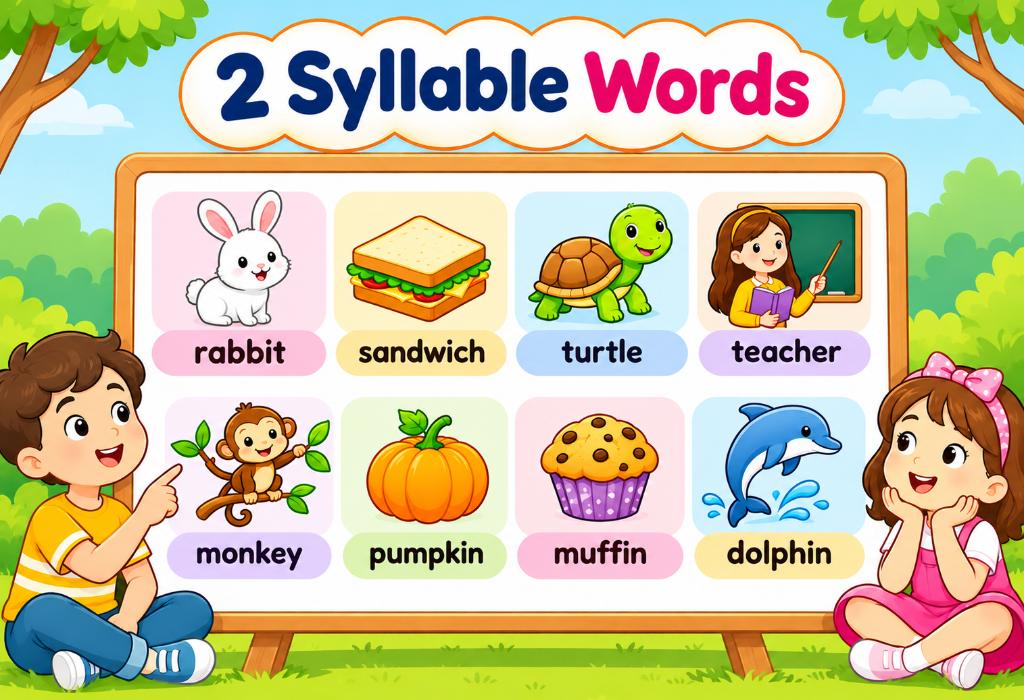
Two-syllable words for kids are words that are spoken in two beats, such as table, pencil and happy. They turn up in everyday talk, from storybooks to snack time, which makes them a natural next step after one-beat words like cat and sun.
Thank you for reading this post, don't forget to subscribe!
Spotting words that have two syllables gets easier with a little practice, and a few handy tricks make it feel like a game. This guide shares clear counting steps, big word lists, example sentences and quick activities, with plenty of two-syllable words for preschoolers to begin with and trickier ones to stretch older learners.
What Is A Two-Syllable Word?
A two-syllable word has two beats, and each beat holds one vowel sound. Say it slowly, and your mouth makes two separate pulses, as in ap-ple, hap-py and rab-bit. These are also called disyllabic words, and the two-syllable meaning is simply this: two vowel sounds, two beats, one word.
Words that have 2 syllables can look short or long on the page. “Baby” and “pumpkin” both qualify, even though one is much longer than the other.
How To Count Two-Syllable Words?
Use these three quick steps to check any word.
- Clap it out. Say the word slowly and clap once for each beat. “Pen-cil” gets two claps.
- Feel your chin. Rest a hand under your chin, which drops once for every syllable. “Wa-ter” makes it drop twice.
- Count the vowel sounds. Listen for vowel sounds, not letters. “Mon-key” has two vowel sounds, so it has two syllables.
One-Syllable Vs. Two-Syllable Words
Easy two-syllable words are often built from two small pieces, which makes the jump from one-beat words feel small. The table shows how the two groups compare.
| One beat, one clap, one chin drop | Two beats, two claps, two chin drops |
| Cat, Sun, Book, Tree | Cap-tain, Sun-set, Win-dow, Ap-ple |
| Can be long on the page (street) | Can be short on the page (ba-by) |
| One vowel sound | Two vowel sounds |
Two-Syllable Words By Learning Stage
Children pick up simple two-syllable words in stages, moving from familiar objects to trickier patterns. Here is what suits each stage.
- For Preschoolers: Begin with words for things they see and touch every day, such as apple, baby, puppy, water and teddy. Clapping along keeps it playful.
- For Kindergarten: Many 2-syllable words for kindergarten follow regular spelling patterns, such as pencil, basket, rabbit, window, sunset and ticket. Children can now read them and split them on paper.
- For Older Kids: Move on to less common words like protect, ancient, orbit, justice and rhythm, and ask children to mark which beat sounds strongest.
Two-Syllable Words List (A to Z)
Here are examples of two-syllable words for every letter, with a hyphen showing where each word splits. Use them for reading practice, spelling lists or syllable games.
Two-Syllable Words From A To E
| A | Ap-ple, A-bove, A-gain, An-gry, A-way, Ac-tor |
| B | Ba-by, Bas-ket, But-ton, Bot-tle, Bal-loon, Bub-ble |
| C | Can-dy, Car-rot, Cas-tle, Cir-cus, Cook-ie, Cow-boy |
| D | Dai-sy, Dol-phin, Dra-gon, Don-key, Doc-tor, Den-tist |
| E | Eag-le, Ea-sy, El-bow, Emp-ty, En-gine, En-joy |
Two-Syllable Words From F To J
| F | Far-mer, Fa-ther, Fea-ther, Fin-ger, For-est, Fun-ny |
| G | Gar-den, Gi-ant, Gin-ger, Gui-tar, Gob-lin, Gen-tle |
| H | Hap-py, Hel-lo, Hon-ey, Ham-mer, Hel-met, Hor-net |
| I | In-sect, In-side, In-to, Is-land, I-gloo, I-vy |
| J | Jel-ly, Jun-gle, Jack-et, Jig-saw, Jour-ney, Jump-er |
Two-Syllable Words From K To O
| K | Kit-ten, Ket-tle, Kitch-en, King-dom, Key-board, Knuck-le |
| L | Lad-der, Lem-on, Lit-tle, Lan-tern, Leop-ard, Lap-top |
| M | Mon-key, Mit-ten, Mon-ster, Mu-sic, Mir-ror, Muf-fin |
| N | Nap-kin, Noo-dle, Num-ber, Nee-dle, Net-work, Noi-sy |
| O | O-pen, Or-ange, O-cean, Ot-ter, O-ver, On-ion |
Two-Syllable Words From P To T
| P | Pen-cil, Pup-py, Pump-kin, Pi-rate, Pic-nic, Pil-low |
| Q | Quar-ter, Ques-tion, Quick-ly, Quar-rel, Quiv-er |
| R | Rab-bit, Rock-et, Rib-bon, Ro-bot, Rain-bow, Rid-dle |
| S | Sis-ter, Spi-der, Sum-mer, Sil-ver, Sug-ar, Sand-wich |
| T | Ta-ble, Tick-et, Tur-tle, Ti-ger, Tea-cher, Tun-nel |
Two-Syllable Words From U To Z
| U | Un-der, Un-til, Up-on, Ug-ly, Um-pire, Up-set |
| V | Val-ley, Vis-it, Vil-lage, Van-ish, Vel-vet |
| W | Wa-ter, Win-dow, Win-ter, Wag-on, Weath-er, Wiz-ard |
| X | Box-er, Mix-er, Tax-i, Re-lax, In-dex, Com-plex |
| Y | Yel-low, Yum-my, Yo-yo, Yo-gurt, Year-ly, Yard-stick |
| Z | Ze-bra, Zig-zag, Zip-per, Zom-bie, Ze-ro |
2-Syllable Words By Category
Sorting words by topic helps children link new vocabulary to things they already know. The Animals, Food, Home And School, Nature And Places, and Family And Body Parts groups below also make a handy 2-syllable nouns list.
Animals
Animal names are often among the first two-syllable words children learn to say.
| Rabbit | Monkey |
| Tiger | Turtle |
| Puppy | Kitten |
| Donkey | Spider |
| Dolphin | Panda |
| Parrot | Otter |
Food
Snack and mealtime words give children plenty of chances to practise syllables at the table.
| Apple | Carrot |
| Cookie | Sandwich |
| Butter | Muffin |
| Sugar | Pumpkin |
| Noodle | Pepper |
| Lemon | Honey |
Home And School
These words describe objects children use or see every day in the house and the classroom.
| Table | Window |
| Pencil | Ladder |
| Pillow | Kitchen |
| Basket | Ruler |
| Teacher | Backpack |
| Notebook | Blanket |
Action Words
Verbs show what people and animals do, and many of them split neatly into two beats.
| Listen | Follow |
| Carry | Gather |
| Whisper | Travel |
| Visit | Enjoy |
| Repeat | Answer |
| Wander | Giggle |
Describing Words
Describing words add colour and feeling to sentences, and these ones all have two beats.
| Happy | Angry |
| Funny | Little |
| Gentle | Empty |
| Shiny | Sleepy |
| Tiny | Noisy |
| Sunny | Lazy |
Nature And Places
From the garden to the mountains, these words name the places children read and hear about.
| Garden | Forest |
| River | Ocean |
| Island | Valley |
| Desert | Jungle |
| Mountain | Meadow |
| Village | City |
Family And Body Parts
People and body words are personal and familiar, which makes them easy for children to remember.
| Mother | Father |
| Sister | Brother |
| Grandma | Grandpa |
| Uncle | Finger |
| Elbow | Ankle |
| Shoulder | Tummy |
Two-Syllable Words By Phonics Pattern
Parents and teachers can group two-syllable words by spelling pattern, which makes reading them far less guesswork. Each pattern below comes with words to try.
2-Syllable Short Vowel Words
These words have a short vowel sound in the first beat, such as the “o” in pocket.
- Pock-et
- Lem-on
- But-ton
- Wag-on
- Tick-et
- Ham-mer
2 Closed Syllable Words
In these words, both syllables end in a consonant, so each vowel stays short.
- Bas-ket
- Den-tist
- Hel-met
- In-sect
- Sand-wich
- Con-test
2-Syllable Words CVC
Each syllable here follows the consonant-vowel-consonant pattern, as in rab-bit (rab + bit).
- Rab-bit
- Sun-set
- Nap-kin
- Pic-nic
- Mag-net
- Pup-pet
- Muf-fin
- Cac-tus
2-Syllable Silent ‘E’ Words
A silent “e” at the end of a syllable makes the vowel before it say its own name.
- Cup-cake
- Sun-shine
- In-side
- Pan-cake
- Rep-tile
- Out-side
Long Vowel Two-Syllable Words
Here the vowel says its own name, often in an open syllable or a vowel team.
- Pa-per
- Ti-ger
- Ro-bot
- O-pen
- Rain-bow
- Tea-cher
- Sea-son
2-Syllable Words That Rhyme
Rhyming helps children hear how word endings repeat, which supports both reading and spelling. Use the table to build silly rhymes or sound games.
| -ocket | Rocket, Pocket, Socket, Locket |
| -ater | Later, Skater, Crater, Waiter |
| -unny | Funny, Sunny, Bunny, Runny |
| -appy | Happy, Snappy, Scrappy |
| -ellow | Yellow, Mellow, Fellow, Bellow |
| -etter | Better, Letter, Sweater, Wetter |
| -able | Table, Stable, Cable, Fable |
Sentences Using Two-Syllable Words
Reading words inside sentences shows children how they work in real language. Ask them to spot and clap the two-syllable words in each line.
- The rabbit hid behind the garden fence.
- My sister packed a sandwich for our picnic.
- A tiny turtle crawled across the sunny path.
- The teacher gave each student a new pencil.
- We watched the rocket zoom over the mountain.
- The monkey climbed up the wooden ladder.
- Mother baked a pumpkin muffin for dinner.
- Please listen while I whisper a secret.
- The puppy chased the bubbles across the yard.
- A silver dolphin jumped out of the ocean.
- Grandma put a blanket on the little kitten.
Activities To Practice 2-Syllable Words
These five activities turn counting into play and need little more than paper, cards and a pair of hands.
- Clap And Count: Say a word aloud and clap each beat together. Children hold up two fingers when they hear two claps, starting with names and moving on to objects around the room.
- Syllable Sort: Write words on cards and let children sort them into one-beat and two-beat piles, such as sun and sunset. Check each card by clapping it out.
- Split the Compound Word: Give compound words like rainbow, cupcake and cowboy, and have children split them into two parts. They can draw each part, such as a rain cloud and a bow.
- Picture Match: Lay out pictures of a tiger, a window and a rabbit. Children match each picture to a card showing its split, such as ti-ger.
- Syllable Bingo: Make bingo cards filled with a mix of words. Call out a word, and children cover it only if it has two syllables.
Test Your Knowledge (Quiz)
Try this quick quiz to see how well you can spot two-syllable words. Pick the best answer for each question.
1. How many syllables are in “pencil”?
a) 1
b) 2
c) 3
2. Which of these is a two-syllable word?
a) Tree
b) Elephant
c) Window
3. How many claps does “sunset” get?
a) 2
b) 1
c) 3
4. Where does “pumpkin” split?
a) Pum-pkin
b) Pump-kin
c) Pumpk-in
5. Which word has a silent “e” and two syllables?
a) Cake
b) Ball
c) Cupcake
Answers
| b) 2 | c) Window |
| a) 2 | b) Pump-kin |
| c) Cupcake |
FAQs
These questions cover a few points that are not mentioned in the sections above.
1. Do Words Ending In -Ed Always Add A Syllable?
No. The -ed ending adds a beat only after the sounds t or d, as in plant-ed and need-ed. Words like jumped and played stay at one syllable, so they are not two-syllable words.
2. Why Are Words Like Fire And Hour Left Out Of The Lists?
Some words are said with one beat in certain accents and two in others. “Fire” can sound like “fyre” or “fy-er,” and “hour” like “owr” or “ow-er.” Skipping them keeps every example clear for readers everywhere.
3. Which Syllable Gets The Stress In Two-Syllable Words?
Most two-syllable nouns and describing words stress the first beat, as in TA-ble and HAP-py, while many verbs stress the second, as in re-PEAT and en-JOY. A few words even change meaning with stress, such as PRE-sent (a gift) and pre-SENT (to show).
4. Do Double Consonants Help Spot A Syllable Break?
Yes. When a word has two matching consonants in the middle, such as rab-bit, but-ton and lad-der, the split usually falls between them. It is a handy shortcut when clapping feels tricky.
5. What Should Children Learn After Two-Syllable Words?
Three-syllable words such as ba-na-na and but-ter-fly are the natural next step, once children can spot easy two-syllable words by ear. The same clap, chin and vowel checks still work.
Two-syllable words are a big step in a child’s reading journey, and the habit of clapping, counting and splitting makes them easy to master. Use the lists, phonics patterns, sentences and games above regularly, and children will soon read longer words with confidence.