



Last Updated on September 18, 2026
The letter C brings together some of the most recognisable creatures in the animal kingdom, alongside a few that rarely make anyone’s first guess. Children searching for animals with ‘C’ for kids will find familiar farmyard faces like the cow and chicken sitting alongside wild hunters such as the cheetah and cobra, proof that a single letter can stretch across nearly every corner of the natural world.
Thank you for reading this post, don't forget to subscribe!
This guide pulls together a full set of animal names that start with the ‘C’ in English, each one paired with a picture and a specific detail worth remembering rather than a generic label. Some of these animals will already be familiar from storybooks and farms, while others, like the cassowary or centipede, offer a genuine surprise. The full list starts below.
List Of Animal Names Starting With C
This group of ‘C’-letter animal names covers farmland, rainforest, ocean, and grassland alike, giving children a real sense of how much ground one letter can cover, including several farm animals that start with the letter ‘C’ kids will already recognise. Below are 20 animals starting with C, each explained through a simple description, its animal type, and where it’s commonly found.
1. Cat
The cat is a small, domesticated carnivore known for its sharp claws, keen night vision, and independent nature. Cats sleep for around 12 to 16 hours a day, more than almost any other mammal, and their whiskers are roughly as wide as their body, helping them judge whether a gap is safe to squeeze through in the dark.
Type Of Animal: Mammal
Where It Is Found: Cats are kept as pets almost worldwide, with wild relatives found across nearly every continent.
2. Cow
The cow is a large, docile farm animal raised mainly for milk and meat, easily recognised by its broad body and calm, grazing nature. Cows have an almost 360-degree field of vision thanks to the position of their eyes, and their stomachs have four separate chambers, allowing them to digest tough grass by bringing it back up to chew again as cud.
Type Of Animal: Mammal
Where It Is Found: Cows are raised on farms across nearly every country in the world.
3. Chicken
The chicken is a common farmyard bird kept mainly for its eggs and meat, known for its clucking calls and constant pecking at the ground. Chickens can remember over a hundred different faces, human and chicken alike, and communicate using more than 30 distinct sounds, each tied to a specific message like an alarm call for a hawk overhead.
Type Of Animal: Bird
Where It Is Found: Chickens are kept on farms and in backyards nearly worldwide.
4. Camel
The camel is a large, sturdy mammal built for survival in extreme desert heat, easily recognised by the hump or humps on its back. Camels can drink up to 100 litres of water in a single sitting after going without for weeks, and their humps store fat rather than water, shrinking and flopping to one side when food has been scarce.
Type Of Animal: Mammal
Where It Is Found: Camels are found across the deserts of the Middle East, North Africa, and Central Asia.
5. Crocodile
The crocodile is a large, armoured reptile known for its powerful jaws and ability to lie almost completely still while waiting for prey. Crocodiles have the strongest bite force of any living animal, yet the muscles used to open their jaws are so weak that a person could hold one shut with a hand, provided they never let go.
Type Of Animal: Reptile
Where It Is Found: Crocodiles are found in rivers, lakes, and wetlands across Africa, Asia, the Americas, and Australia.
6. Cheetah
The cheetah is a slender, spotted big cat built for speed rather than strength, with long legs and a flexible spine that allow it to outrun almost any other land animal. Cheetahs can accelerate from 0 to 100 kilometres per hour in around three seconds, faster than most sports cars, but they can only sustain that top speed for around 30 seconds before overheating.
Type Of Animal: Mammal
Where It Is Found: Cheetahs are found across the grasslands and savannas of Africa, with a small population in Iran.
7. Chimpanzee
The chimpanzee is a highly intelligent great ape known for its close genetic relationship to humans and its complex social behaviour. Chimpanzees share around 98 per cent of their DNA with humans and are known to use tools, such as stripped twigs, to fish termites out of narrow mounds for food.
Type Of Animal: Mammal
Where It Is Found: Chimpanzees are found in the forests and savannas of central and western Africa.
8. Coyote
The coyote is a medium-sized wild canine known for its slender build, pointed ears, and remarkable ability to adapt to almost any environment. Coyotes have adapted so well to human presence that they now live in major cities, including within park systems in the middle of large urban areas, feeding on rodents, fruit, and even household rubbish.
Type Of Animal: Mammal
Where It Is Found: Coyotes are found across North America, from forests and deserts to city parks.
9. Crab
The crab is a small, hard-shelled sea creature known for its pair of pincer claws and distinctive sideways walk. Crabs walk sideways because of the way their leg joints bend, which makes forward movement far less efficient than a quick, scuttling side-step, and many species can regrow a lost claw over successive moults.
Type Of Animal: Crustacean
Where It Is Found: Crabs are found in oceans, rivers, and along coastlines almost worldwide.
10. Cardinal
The cardinal is a small songbird best known for the male’s vivid red feathers and pointed head crest. Males are bright red to attract mates and defend territory, while females have a warm brown colouring that helps camouflage them while nesting, and pairs are often seen feeding one another beak to beak.
Type Of Animal: Bird
Where It Is Found: Cardinals are found across the eastern and central United States, particularly in gardens and woodlands.
11. Caterpillar
The caterpillar is a soft-bodied, crawling creature that represents the early larval stage of butterflies and moths. Many species shed their skin several times as they grow before forming a chrysalis or cocoon and emerging in an almost entirely different body.
Type Of Animal: Insect
Where It Is Found: Caterpillars are found worldwide, particularly on the leaves of the specific plants they feed on.
12. Cockatoo
The cockatoo is a large, expressive parrot known for the tall crest of feathers it raises when excited or alarmed. Cockatoos can live for 40 to 70 years, rivalling some of the longest lifespans of any bird, and their raised crest is unique among parrot species.
Type Of Animal: Bird
Where It Is Found: Cockatoos are found across Australia, Indonesia, and the Philippines.
13. Cobra
The cobra is a venomous snake known for the wide, distinctive hood it spreads out when it feels threatened. Cobras can raise the front third of their body off the ground and spread the ribs behind their neck into this hood, a warning display used before resorting to a venomous bite.
Type Of Animal: Reptile
Where It Is Found: Cobras are found across Africa and Asia, particularly in forests, grasslands, and farmland.
14. Chipmunk
The chipmunk is a small, striped rodent known for its quick movements and habit of storing food in its cheeks. Chipmunks can carry surprisingly large amounts of food in their stretchy cheek pouches, sometimes doubling the size of their head, and they store the food in underground burrows to survive winter months.
Type Of Animal: Mammal
Where It Is Found: Chipmunks are found across North America and parts of Asia, particularly in forests and woodlands.
15. Clownfish
The clownfish is a small, brightly striped orange-and-white fish best known for its unusual, safe partnership with sea anemones. Clownfish live among the stinging tentacles of anemones thanks to a protective layer of mucus on their skin, forming a relationship where the fish gets shelter and the anemone gets cleaned and defended in return.
Type Of Animal: Fish
Where It Is Found: Clownfish are found in the warm coral reefs of the Indian and Pacific Oceans.
16. Cougar
The cougar is a large, tawny wild cat known by several other names, including mountain lion and puma, depending on the region. Cougars go by more names than almost any other animal, and unlike big cats such as lions, they cannot roar, communicating instead through purrs, hisses, and screams.
Type Of Animal: Mammal
Where It Is Found: Cougars are found across the Americas, from Canada down to the southern tip of South America.
17. Caribou
The caribou is a large member of the deer family known for its wide, branching antlers, which both males and females grow, unlike most other deer. They undertake some of the longest land migrations of any mammal, travelling thousands of kilometres between seasonal feeding grounds each year.
Type Of Animal: Mammal
Where It Is Found: Caribou are found across the Arctic and subarctic regions of North America, Europe, and Asia.
18. Cassowary
The cassowary is a large, flightless bird known for its tall, bony head crest and powerful, dagger-clawed feet. Despite being unable to fly, cassowaries are considered one of the most dangerous birds in the world, capable of delivering a powerful, defensive kick when threatened.
Type Of Animal: Bird
Where It Is Found: Cassowaries are found in the tropical rainforests of northern Australia and New Guinea.
19. Centipede
The centipede is a long, many-legged arthropod known for its quick movement and venomous front pincers used to catch prey. Despite its name, a centipede never actually has exactly 100 legs; the number varies by species and always comes in an odd pair count, ranging from under 30 to well over 300 depending on the type.
Type Of Animal: Arthropod
Where It Is Found: Centipedes are found in soil and leaf litter almost worldwide, particularly in damp, dark environments.
20. Chameleon
The chameleon is a slow-moving lizard best known for its remarkable ability to change the colour of its skin. This colour change is used mainly to communicate mood and regulate body temperature rather than purely for camouflage, and its eyes can move independently of one another, allowing it to look in two directions at once.
Type Of Animal: Reptile
Where It Is Found: Chameleons are found across Africa, Madagascar, and parts of southern Europe and Asia.
More Animal Names Beginning With C
Beyond the animals covered above, there’s a long list of additional letter ‘C’ animal names worth knowing, spanning household pets, farmland regulars, and species that rarely make an appearance outside of nature documentaries. Here are some further C animals to add to your child’s growing list.
- Caiman
- Canary
- Capybara
- Caracal
- Carp
- Catfish
- Cave Swallow
- Chinchilla
- Chinstrap Penguin
- Cicada
- Civet
- Clam
- Cockroach
- Collie
- Common Loon
- Conger Eel
- Coral Snake
- Corgi
- Cottontail Rabbit
- Cowbird
- Crane
- Cricket
- Crow
- Cuckoo
- Curlew
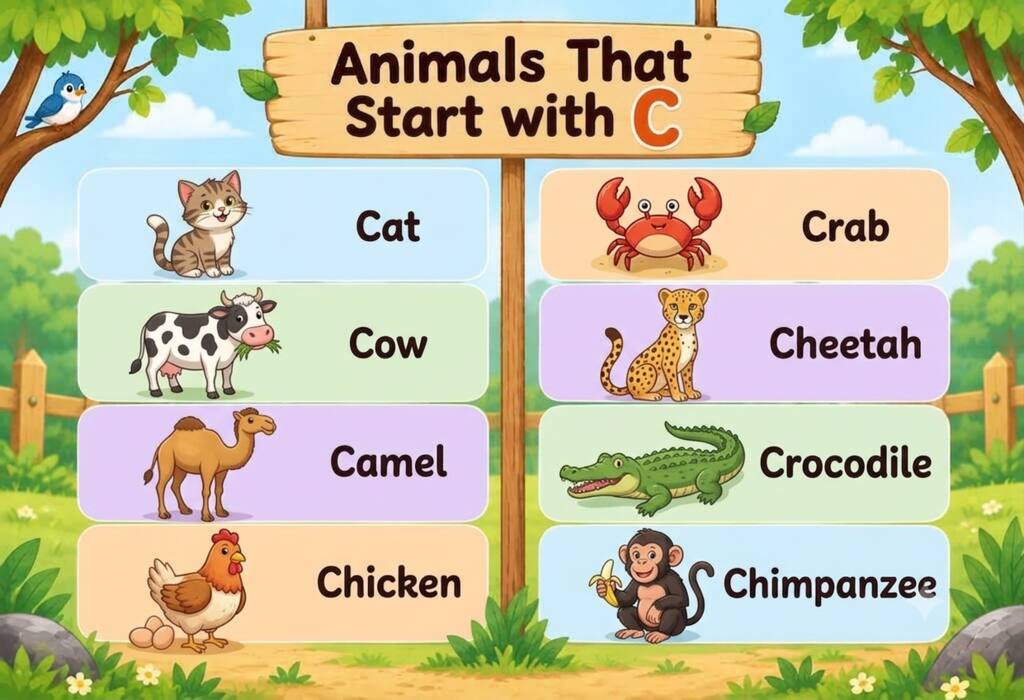
Animals That Start with C – Chart
Anyone curious about letter ‘C’ animals as a full set can use the chart below to scan every species covered across this guide in one place.
FAQs
1. Why Do Some C Animal Names Get Confused With Each Other?
Names like cougar, puma, and panther all refer to the same animal, which can make lists confusing, since the same creature sometimes appears under different common names depending on the region.
2. Is A Crab An Insect?
No, crabs are crustaceans, not insects, a group that also includes lobsters and shrimp, distinguished by their hard exoskeleton, jointed legs, and the fact that most live in or near water.
3. Which C Animal Is Best Known For Its Speed?
The cheetah is best known for its speed, capable of reaching around 100 kilometres per hour in short bursts, making it the fastest land animal on Earth.
4. Are There Any C-Letter Animal Names Used For More Than One Species?
Yes, “cobra” is a good example, since it refers to several different venomous snake species across Africa and Asia rather than just one, all sharing the same hood-raising defence display.
C proves to be one of the richer letters in the alphabet, pairing everyday farm animals like the cow and chicken with striking wild names such as the cassowary and cougar. Whether a child is drawn to gentle grazers or fast, sharp-eyed hunters, exploring wild animals with the letter ‘C’ alongside familiar farmyard names gives this list a genuine range worth spending time with.