


Writing essays in English is the most important aspect of children’s educational growth. It enables children to expand their thinking and improve their reading and writing skills. Therefore, we must encourage children to enhance their language skills by writing essays on common topics, like the India Gate essay in English. Remember that it is difficult for children to acquire writing skills with one or two essays. They need to practice writing essays regularly to improve their writing skills.
Thank you for reading this post, don't forget to subscribe!
This essay on India Gate for classes 1, 2, and 3 will help children understand how to structure and write an essay. Continue reading to know more.
Key Points To Remember When Writing An Essay On India Gate
Essays are a great way for children to share what they know in their own words. Here are some helpful pointers to guide them as they write about India Gate:
- Start by introducing India Gate — when it was built, who built it, and where it is located.
- Write about its history and significance — what led to its construction and what it symbolises for India.
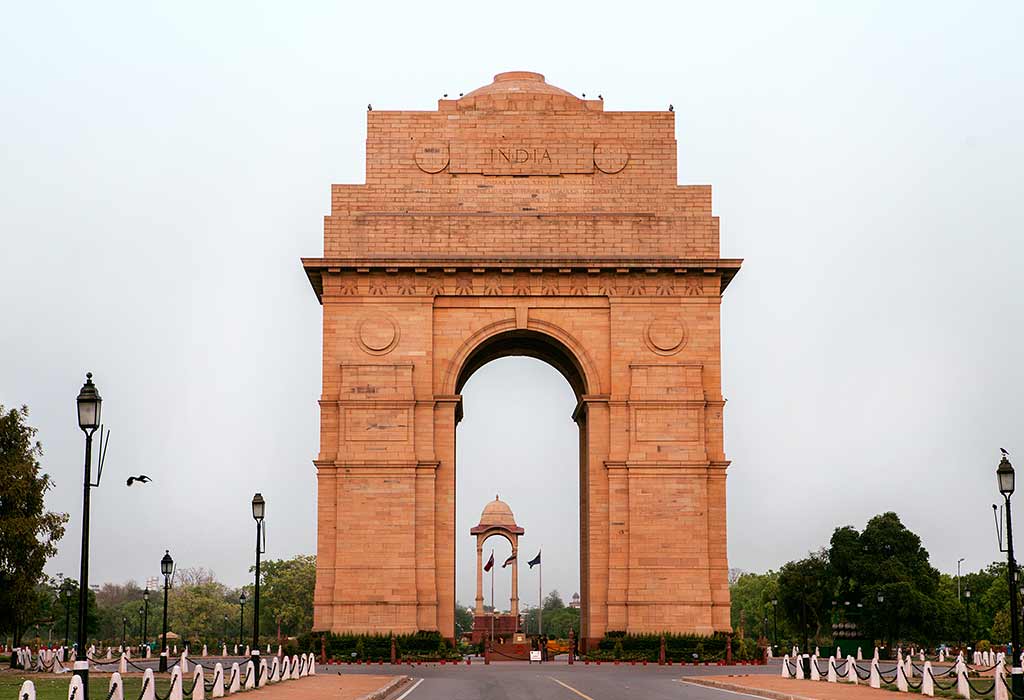
- Describe its architectural features — what it looks like, how tall it is, and what makes its design unique.
- Talk about the Amar Jawan Jyoti — the eternal flame beneath the arch and what it represents.
- Mention the key celebrations held at India Gate, such as Republic Day, and why it is an important national gathering point.
- Include why the India Gate is a popular tourist destination and what visitors experience there.
- End with a few fascinating facts about the India Gate to leave the reader curious and impressed.
- Once done, review the essay for spelling mistakes, sentence flow, and whether all points have been covered clearly.
5 Lines On India Gate
Here are five lines on India Gate. You can use these lines in your essay and paragraph while writing about the war memorial.
- India Gate is situated in the capital of India, New Delhi, which was inaugurated in February 1931.
- It took 10 years to build this war memorial.
- Designed by Sir Edwin Lutyens, India Gate is engraved with the names of soldiers who lost their lives during World War I.
- This war memorial is one of the major tourist attractions, visited by local, national, and international tourists.
- The Republic Day parade is the centre of attraction, starting at Rashtrapati Bhawan and ending at the Red Fort via India Gate.
10 Lines On India Gate
Children of lower primary classes are often asked to write a few lines on the India Gate. So, here is an essay for classes 1 and 2.
- India Gate is situated in Delhi, the capital of India.
- The war memorial is 42 meters high.
- The foundation of this memorial was laid in 1921, and the construction was completed in 1931.
- The main designer of India Gate was Edward Lutyens, who also designed Viceroy’s House, now known as the Rashtrapati Bhavan.
- This historical monument was earlier known as the All India War Memorial.
- The name of our country, “INDIA,” is inscribed on both sides on the topmost portion of the arch of India Gate.
- This war memorial was built to pay homage to the British and Indian soldiers of the British Army who died in the First World War.
- Locals and national and international tourists like to visit this memorial after dusk to see the India Gate illuminated.
- On Republic Day, the parade is the centre of attraction. The parade starts from Rashtrapati Bhawan and goes to the Red Fort via India Gate.
- The Amar Jawan Jyoti memorial was also constructed after the completion of the India Gate, but later merged with the Eternal Flame at the National War Memorial.
Paragraph On India Gate
Here is a short paragraph about the India Gate for children. This will help them frame their essays later.
The India Gate is one of the most beautiful architectural wonders in India. It was inaugurated in Delhi, India, in 1931 to pay respect to the martyrs who sacrificed their lives in World War I. This historical monument is one of the most visited places by locals and tourists. India Gate was designed and built under the supervision of Edwin Lutyens, and it took almost 10 years to be completed. It is 42 meters tall and 9 meters in width. The Amar Jawan Jyoti memorial was also constructed in 1972, but it was later merged with the Eternal Flame at the National War Memorial.
Short Essay On India Gate
Given below is a short essay for classes 1, 2, and 3 on the topic – India Gate. This will be very helpful for children when they have to write an essay on the same in around 200 words.
The India Gate is an architectural marvel that took nearly 10 years to build. Inaugurated in February 1931, this iconic war memorial stands tall in the heart of New Delhi. It was built in memory of more than 70,000 soldiers who fought bravely during World War I and laid down their lives for the nation. Designed by Sir Edwin Lutyens, India Gate bears a striking resemblance to the Arc de Triomphe in Paris and stands at an impressive height of 42 metres.
Many years after its construction, a small memorial known as Amar Jawan Jyoti was built beneath it in 1972, honouring the soldiers who lost their lives in the Indo-Pakistani War of 1971. It was later merged with the Eternal Flame at the National War Memorial.
India Gate also holds a special place in the Republic Day celebrations — the parade begins at Rashtrapati Bhawan, passes through India Gate, and concludes at the Red Fort. It is one of the most-watched events in the country, drawing thousands of spectators every year.
Beyond its historical significance, India Gate attracts visitors from across the country and the world, thanks to its stunning architecture and the sprawling green lawns that surround it, making it a beloved landmark for all.
Long Essay On India Gate
Find below an essay for class 3 on the topic of the India Gate. With the help of this long essay, children will get a basic idea of how to structure their essays.
India Gate holds a special place in the heart of every Indian. India Gate is a war memorial inaugurated in 1931 to honour thousands of soldiers who sacrificed their lives during World War I. Another important memorial, the Amar Jawan Jyoti, was constructed under India Gate to commemorate the heroism of our Indian soldiers killed during the Bangladesh Liberation War in 1971. Amar Jawan was merged with the Eternal Flame at the National War Memorial in January 2022.
History Of India Gate
The First World War lasted more than 4 years, from July 1941 to November 1918. India was under British rule during that period, and thus, millions of Indian soldiers were employed to fight the battle as part of the British Army. Unfortunately, more than 70,000 Indian soldiers lost their lives during the war.
India Gate was built by the British government to honour the struggle and sacrifice of these soldiers. This historical monument bears the names of more than 13,000 British and Indian soldiers, officers, and service members.
Architectural Design Of India Gate
The architectural style of India Gate is generally compared to that of the Arc de Triomphe in Paris. India Gate was designed by Sir Edwin Lutyens, who wanted the monument to be classic. India Gate is situated in the middle of a hexagonal complex, and the structure is 42 meters tall and 9.1 meters wide. The yellow and red sandstone was brought directly from Bharatpur to build the structure.
What Values Does India Gate Represent?
India Gate represents the following values:
- Patriotism
- Unity in diversity
- A celebration of India’s progress
Important Celebrations At India Gate
India Gate stands witness to the grand Republic Day parade that passes through the memorial on the 26th of January each year. The celebration begins with remembering those who sacrificed their lives for the country. Then the program begins, and the parade starts from Rashtrapati Bhawan and goes to Red Fort via India Gate.
What Will Your Child Learn From This Essay On India Gate?
An essay on the India Gate will help children learn about the history of this architectural marvel. Children will also learn about the values it represents and some amazing facts about the memorial.
FAQs
1. What Words Are Written On India Gate?
The names of Indian and British soldiers, service members and officers who lost their lives during World War I are inscribed on the India Gate.
2. How Many Names Are Inscribed On India Gate?
The war memorial is engraved with the names of more than 13,000 British and Indian soldiers, service members and officers.
3. Who Designed The India Gate?
India Gate was designed by the renowned British architect Sir Edwin Lutyens, who also designed several other structures in New Delhi.
4. How Tall Is The India Gate?
India Gate stands at an impressive height of 42 metres, making it one of the largest war memorials in India.
5. What Is Amar Jawan Jyoti?
Amar Jawan Jyoti was an eternal flame that burned beneath India Gate since 1972, honouring the soldiers who sacrificed their lives in the Indo-Pakistani War of 1971. It was later merged with the Eternal Flame at the National War Memorial in 2022.
6. Why Is India Gate Important?
India Gate is important as it stands as a symbol of national pride and sacrifice. It honours the brave soldiers who laid down their lives for the country and serves as a reminder of their courage and dedication.
India Gate is more than just a monument — it is a symbol of courage, sacrifice, and national pride that every Indian holds close to their heart. Learning about its history and significance helps children develop a deeper connection with their country and its past. We hope this essay on India Gate in English has given young learners enough insight and inspiration to write their own essays with confidence. Whether it is a 10-line essay, a short essay, or a long essay, the key is to write from the heart and let your words reflect your love and respect for this iconic landmark.
Also Read:
Essay On Red Fort for Kids
Taj Mahal Essay for Children
Essay On Independence Day for Kids