

Last Updated on August 5, 2026
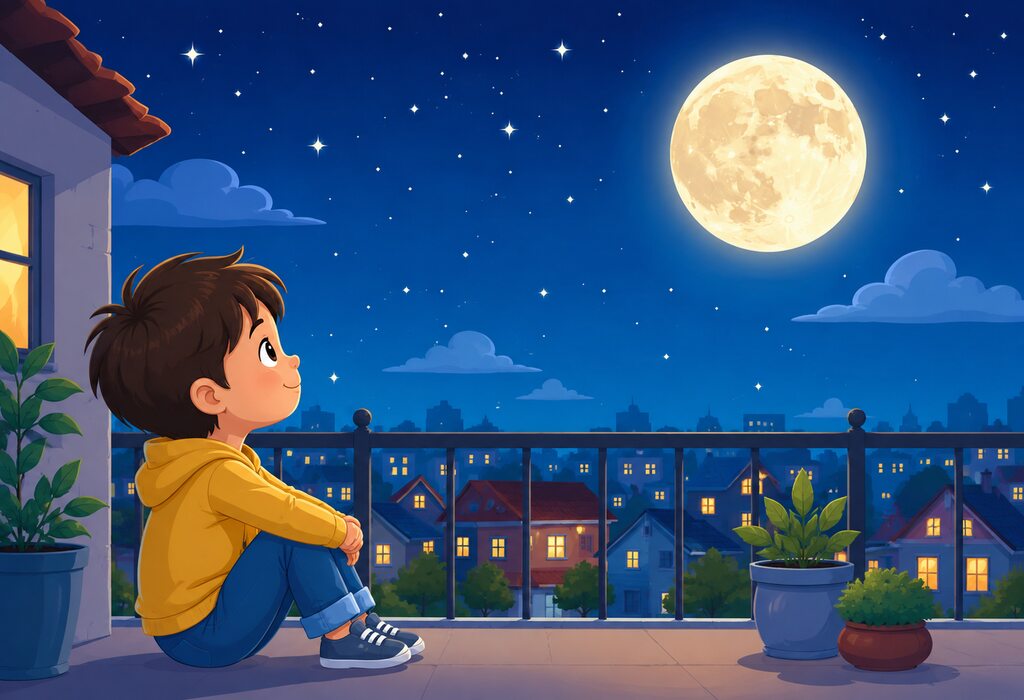
The moon revolves around the earth and is Earth’s natural satellite. It reflects bright light from starry skies and adds a sense of peace and tranquillity to nightly environments. The moon is a beautiful sight, and it’s not every night that we get to experience a full moon. Many cultures consider moonlight calming, believing it helps improve focus, imagination and creative thinking, and even young children enjoy writing simple moon sentences to describe its glow.
Thank you for reading this post, don't forget to subscribe!
There is a lot to learn about the moon, and a wonderful way to teach children is by asking them to write an essay in English on the moon. Essay writing assignments for classes 1, 2, and 3 will be a great way to learn about this fantastic celestial body as well as develop their language, vocabulary and communication skills.
Key Points To Remember When Writing An Essay On The Moon
The moon symbolises serenity, beauty, and tranquillity in the night. Here are a few key points to remember when writing sentences on the moon for classes 1, 2, and 3, or a full essay on the topic:
- Start with a Strong Introduction – Begin with an introductory paragraph on how the moon was formed and its position in the solar system, setting the context for the reader.
- Explore the Benefits and Missions – Get into the benefits of moonlight for humans, along with a mention of space missions that have explored the moon over the years.
- Add Interesting Facts – Include a few fascinating details about the moon, such as its phases or its effect on tides, to make the essay more engaging.
- Keep the Language Simple – Use age-appropriate words and short sentences so the essay is easy to understand and enjoyable to read.
- End with a Clear Conclusion – Conclude with a summary paragraph that wraps up the key points of the essay in a thoughtful way.
- Review and Proofread – Once done, read through the essay to check for spelling and grammar mistakes before finalising it.
5 Sentences About The Moon
The moon has always attracted humans in some way or other, and kids feel a special bond with it. Here are a few lines about the moon in English:
- The moon reflects light from the sun and does not produce its own light.
- The moon follows a fixed orbital pathway and is Earth’s natural satellite.
- There are many rocks and craters on the moon.
- Life is not sustainable on the moon since it lacks an atmosphere.
- The age of the Moon is approximately 4.53 billion years.
10 Lines On The Moon
You can help your child learn about the moon by writing these ten easy lines. Here are a few lines that can be used in an essay on the moon for classes 1 and 2.
- The moon is an astronomical body with a diameter of around 3,475 km.
- No signs of life have been found on the moon so far.
- Humans cannot live on the moon due to the absence of a breathable atmosphere.
- Many authors, artists and poets have been inspired by the moon over the years, creating some of history’s most memorable works.
- Neil Armstrong was the first person to land on the moon in 1969.
- The moon is extremely dry, with no wet or watery environments on its surface.
- The moon is Earth’s only natural satellite.
- The moon is beautiful and marvellous to look at, especially during a full moon.
- The temperature on the moon ranges from around +127°C during the day to -173°C at night.
- The moon is approximately 4.5 billion years old.
Paragraph On The Moon
Since the beginning of time, man has always had a deep connection with the moon. It’s no wonder why there are so many mysteries around the moon and why scientists continue to do staggering research. Here is a short paragraph on the moon for kids:
The moon has always been an object of admiration and curiosity for humanity. Moon is an astronomical body with a diameter of around 3475 km. The moon reflects light from the sun and does not produce its own light. Neil Armstrong and Edwin Aldrin were the first two people to make a landing on the moon. They explored the surface, collected lunar rocks, and gave a moment to humans to remember always. It’s fascinating how scientists study the moon since there is still a lot we don’t know. Since then, many scientists worldwide have flown many astronauts to the depths of the moon.
Short Essay On The Moon
It’s confirmed that man has conquered the moon. Many moon missions have been carried out since Neil Armstrong made his mark. Here is an essay for classes 1, 2, and 3 on the moon in English.
The moon can be seen from Earth at night and shines brightly amidst the starry skies. We do not get to see a full moon every night but rather in different phases. The way Earth revolves around the sun, the moon revolves around the Earth. It takes around 27 days for the moon to do a complete orbit around the Earth. There is no atmosphere on the moon; therefore, life cannot exist on the moon. The moon is crucial in the formation of calendars. The temperature on the moon fluctuates between +200 and -200 degrees Celsius. It serves spiritual significance and is dubbed the fifth-largest natural satellite in our solar system. Though the moon looks beautiful, it is full of rocks and craters. The moon doesn’t have its own shine; it is the reflection of the sunlight. The moon is the only natural satellite Earth has. It’s amazing to see how scientists study the moon since there is still a lot we don’t know.
Long Essay On The Moon
The moon is approximately 384,400 kilometres away from Earth and is one of the brightest and most prominent objects in the night sky. Below is a long essay for class 3 on the moon for kids.
The moon is one of the most beautiful celestial bodies visible from Earth, and it has always inspired curiosity and imagination in humankind. As a result, scientists have designed several spacecraft missions to study the moon and observe its surroundings up close. When the Earth passes directly between the sun and the moon, blocking sunlight from reaching the moon’s surface, it results in a phenomenon known as a “total lunar eclipse.”
The moon is known by different names across various languages and cultures, such as “Luna” in Italian, “Mond” in German, and “Selene” as its poetic name in Greek mythology. You can think of the moon as a barren, rocky landscape with mountains, valleys and craters, since no life forms have ever been found there. There are several theories about how the moon was formed, but scientists widely believe it formed after a massive object collided with Earth billions of years ago, with debris from the impact eventually coming together to form the moon. Just as the Earth revolves around the sun, the moon revolves around the Earth, taking around 27 days to complete a full orbit.
What Is the Moon?
The moon is a vast, rocky object that orbits the Earth in space and has a total diameter of roughly 3,475 kilometres, making it about a quarter the size of Earth.
Phases of the Moon
The key phases of the moon are:
- New Moon – When the moon appears completely unlit from Earth’s perspective, as sunlight falls only on the far side.
- Waxing and Waning Crescent – When a small, curved sliver of the moon is visible, gradually growing or shrinking.
- Half-Moon Phase – Referred to as the first and third quarter, when exactly half of the moon’s visible surface is lit.
- Full Moon – When the entire visible surface of the moon is illuminated and fully visible.
- Waxing and Waning Gibbous – When more than half of the moon’s surface is visible, either growing towards or shrinking from a full moon.
Importance of the Moon
The moon plays a crucial role in creating tides in Earth’s oceans through its gravitational pull, maintaining a steady rhythm that has shaped coastal ecosystems and human activity for centuries. It also helps stabilise Earth’s axial tilt, keeping our planet’s seasons relatively consistent and predictable over long periods of time.
Man’s Journey to the Moon
The Apollo 11 mission marked humankind’s first successful lunar landing. On July 20, 1969, Neil Armstrong and Edwin “Buzz” Aldrin stepped out of the Apollo 11 spacecraft onto the moon’s surface, becoming the first humans to walk on another celestial body. They collected rock and soil samples from the lunar surface, opening the door to decades of further research on this glowing companion of Earth we call the moon.
The moon continues to be a source of wonder, discovery and scientific curiosity, connecting humankind to the vastness of space in a way few other celestial bodies can. From its phases and mysterious origins to its role in stabilising life on Earth, the moon reminds us just how much there still is to learn about the universe beyond our own planet.
Interesting Facts About The Moon For Children
Beyond the basics, the moon has some genuinely surprising facts that fascinate children and adults alike. Here are ten interesting facts to spark your child’s curiosity about our closest neighbour in space.
- The moon has no atmosphere or air, which means sound cannot travel there, so a shout on the moon would be completely silent.
- Footprints left by astronauts on the moon can last for millions of years, since there is no wind or rain to wear them away.
- The moon experiences its own version of earthquakes, called “moonquakes,” which are usually weaker than earthquakes on Earth but can last much longer.
- The moon is slowly moving away from Earth at a rate of about 3.8 cm every year, roughly the same speed our fingernails grow.
- Despite looking small in the sky, the moon is actually bigger than the dwarf planet Pluto.
- The moon always shows the same face to Earth, because it rotates at the same speed it orbits our planet.
- A person who weighs 45 kg on Earth would weigh only around 7.5 kg on the moon, due to its much weaker gravity.
- Some mountains on the moon are taller than Mount Everest, with certain peaks reaching over 6,000 metres.
- Scientists have found frozen water in the form of ice hidden in permanently shadowed craters near the moon’s poles.
- The moon’s surface is actually quite dark, reflecting less sunlight than a stretch of asphalt road, even though it looks bright to us at night.
What Will Your Child Learn From An Essay On The Moon?
Writing about the moon offers far more than just a lesson in astronomy for young learners. Here’s a look at the broader skills and understanding your child can gain from this essay.
Writing an essay on the moon helps children strengthen their research and observation skills, as they learn to gather scientific facts and present them in a clear, structured way. It also introduces them to key concepts in space science, such as orbits, phases and gravity, building an early foundation for subjects like physics and astronomy.
Beyond the academic value, this topic often sparks genuine curiosity and wonder, encouraging children to look up at the night sky with a deeper appreciation for what they see. The exercise also improves their vocabulary and descriptive writing skills, as they learn to explain complex ideas, such as lunar eclipses or the moon’s phases, in simple, age-appropriate language.
FAQs
1. How Was the Moon Formed?
It is widely believed that the moon formed when Earth collided with a Mars-sized celestial body billions of years ago, with debris from the impact eventually coming together to form the moon.
2. How Old Is the Moon?
The moon is approximately 4.5 billion years old, forming not long after Earth itself.
3. Has India Successfully Landed on the Moon?
Yes, India’s Chandrayaan-3 mission successfully landed near the moon’s south pole in August 2023, making India the fourth country in the world to achieve a soft lunar landing, after the former Soviet Union, the United States and China.
4. How Many Days Does the Moon Take to Complete an Orbit Around the Earth?
The Moon takes approximately 27 days to complete a full orbit around the Earth.
The moon has captivated human curiosity for centuries, and writing about it gives children a wonderful opportunity to blend science with imagination. Whether through a short paragraph or a longer, detailed essay, exploring this topic helps young learners appreciate just how much wonder lies in the glowing companion that lights up our night sky.
Also Read:
Save The Earth Essay for Kids
Essay On Nature for Children
How to Write An Essay on Sun for Kids