


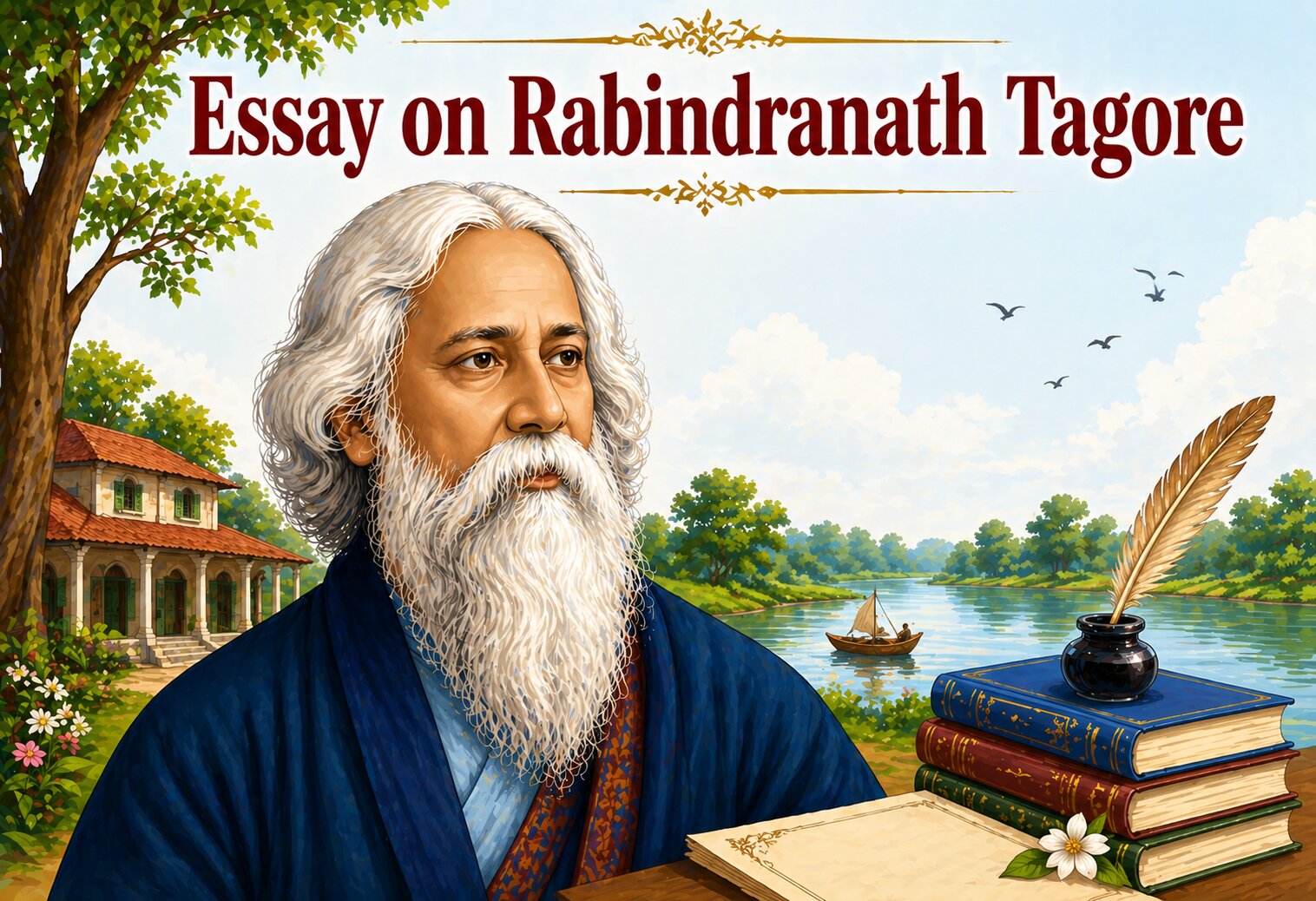
- Key Points To Remember When Writing an Essay on Rabindranath Tagore
- 5 Lines On Rabindranath Tagore
- 10 Lines On Rabindranath Tagore
- A Paragraph on Rabindranath Tagore
- Short Essay on Rabindranath Tagore
- Essay on Rabindranath Tagore In 200 Words
- Essay on Rabindranath Tagore In 300 Words
- Long Essay on Rabindranath Tagore
- What Will Your Child Learn From The Essay on Rabindranath Tagore?
- FAQs
Last Updated on April 29, 2026
Writing is one of the most essential skills for your child’s education. This essay on Rabindranath Tagore will help your kid enhance their writing abilities. If you are looking for a ‘paragraph on Rabindranath Tagore’, this resource will guide you. It will include general pointers and a few lines on Rabindranath Tagore. Writing essays for kids is crucial for academic success and personal development. Children with good essay-writing skills can develop expression and creativity through language and ideas. Children should receive plenty of opportunities to practise essay writing, which they may easily do at home with parental supervision.
Thank you for reading this post, don't forget to subscribe!
These essays on Rabindranath Tagore in English will also encourage children to explore the life and works of the renowned poet, the first non-European to win the Nobel Prize in Literature.
Key Points To Remember When Writing an Essay on Rabindranath Tagore
This paragraph explains how to write an essay on Rabindranath Tagore, and it covers some major points to remember:
- Make your essay on Rabindranath Tagore clear, concise, and engaging for the reader. Use simple language and structure your ideas logically to ensure easy readability.
- Include a strong introduction that provides context about Rabindranath Tagore and a thoughtful conclusion that summarizes your main points.
- Use smooth transitions between paragraphs to connect your ideas and maintain a natural flow throughout the essay.
- Include detailed information about Rabindranath Tagore, such as his major achievements, influences, and lasting legacy.
- Cover various aspects of his life, such as childhood, education, adulthood, books he has written, etc.
- Highlight his contribution to India’s freedom movement, as well as his impact on literature, culture, and society.
- After completing your essay, review and revise your work carefully. Check for clarity, grammar, and completeness to ensure your writing is polished and error-free.
5 Lines On Rabindranath Tagore
Rabindranath Tagore was a celebrated poet, writer, and philosopher whose work continues to inspire people worldwide. These five lines on Rabindranath Tagore in English for classes 1 & 2 offer a brief glimpse into his remarkable life and achievements.
- Rabindranath Tagore was a great poet from India.
- He wrote many poems, stories, and songs.
- He wrote the national anthem of India.
- He loved nature and children.
- People love and remember him for his beautiful work.
10 Lines On Rabindranath Tagore
Younger children might be asked to write a few lines about Rabindranath Tagore to practice essay-writing skills. Here are ten lines about Rabindranath Tagore that can be useful while writing an essay for classes 1 and 2:
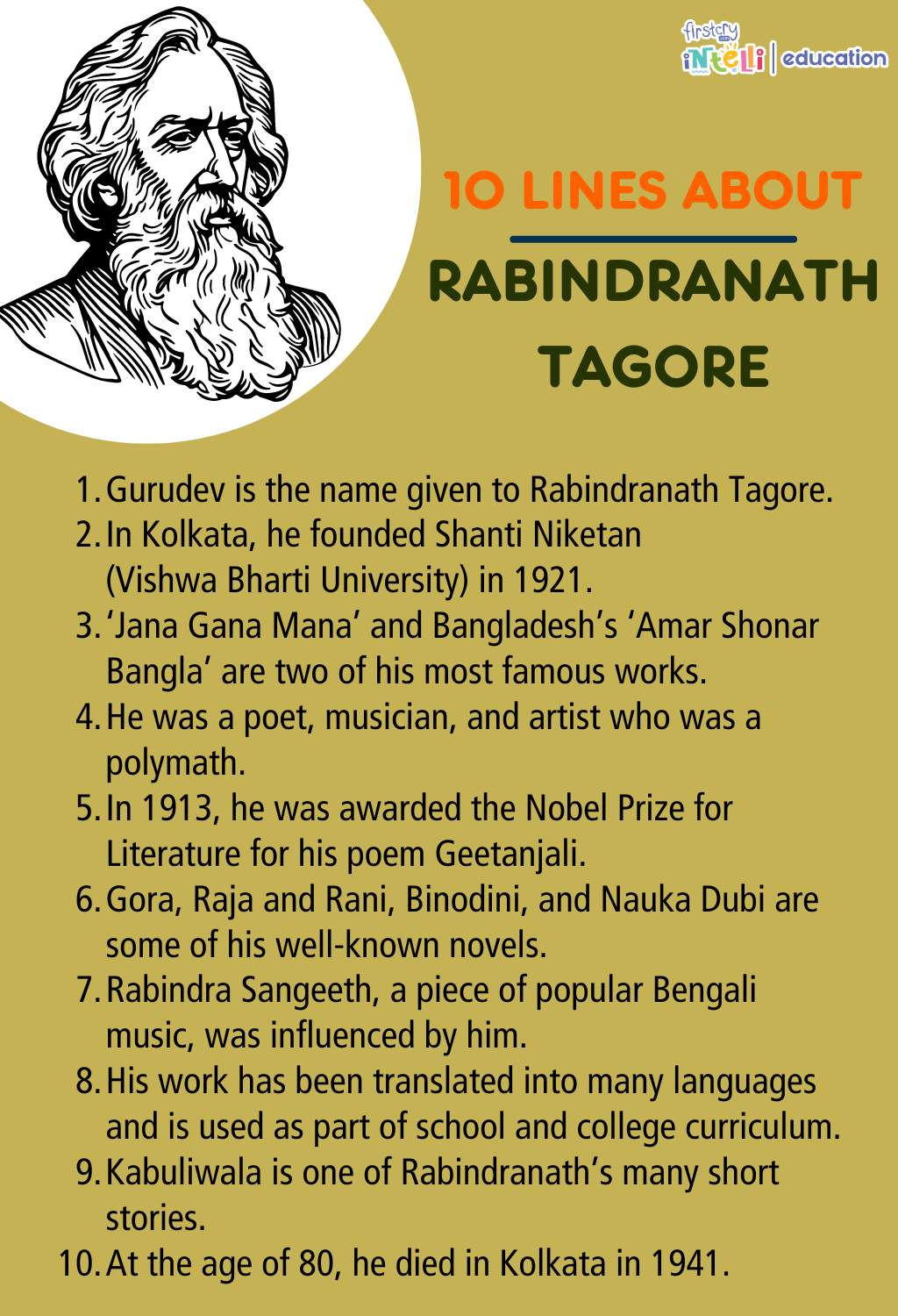
- Rabindranath Tagore, fondly known as Gurudev, was a renowned Indian poet, writer, and philosopher.
- He founded Shanti Niketan (Vishwa Bharti University) in Kolkata in 1921.
- ‘Jana Gana Mana’ and Bangladesh’s ‘Amar Shonar Bangla’ are two of his most famous works.
- He was a polymath, a poet, musician, and artist.
- In 1913, he was awarded the Nobel Prize for Literature for his poem Geetanjali.
- Gora, Raja, and Rani, Binodini, and Nauka Dubi are among his well-known novels.
- Rabindra Sangeeth, a popular Bengali music genre, was influenced by him.
- His work has been translated into many languages and is used in school and college curricula.
- Kabuliwala is one of Rabindranath’s many short stories.
- At the age of 80, he died in Kolkata in 1941.
A Paragraph on Rabindranath Tagore
Teachers ask kids in lower grades to write short paragraphs on various topics. Here is a template that will help your little one write a short paragraph on Rabindranath Tagore:
Rabindranath Tagore is my favourite author. In 1861, he was born into the illustrious Tagore family of Kolkata. He was admitted to a school as a young boy. However, he disliked school education. As a result, he received his education at home. He began writing poems at the age of eight. He authored a lot of poems. He won the Nobel Prize in Literature for his collection of poems, Gitanjali. His poetry is notable for its compassion, power, musicality, and melody. He also penned numerous novels, short tales, plays, and songs. In 1941, he passed away. He is the pride of Bengal and India’s glory.
Short Essay on Rabindranath Tagore
As kids advance academically, they are expected to write independent English paragraphs on Rabindranath Tagore in various subjects. Below is an example for your kid to follow while writing a short essay on Rabindranath Tagore:
My favourite author, Rabindranath Tagore, was born on May 7, 1861, in Jorasanko, Kolkata. He never attended a conventional school, so he learned Bengali, Sanskrit, and English under the personal supervision of his father, Debendranath Tagore, and with the help of several capable tutors. He was a poet, dramatist, composer of songs, short story writer, novelist, critic, essayist, and painter, among other things. The Gitanjali, Sonar Tari, Kheya, Kalpana, Balaka, and other works contain some of his finest poems. In 1913, he was awarded the Nobel Prize in Literature for his English translation of Gitanjali. He was a brilliant educator who founded a school in Shantiniketan. After that, he established Visva-Bharati University to realise his vision for education. His profound impact on our literature and culture is something I deeply admire. On August 7, 1941, he passed away, leaving a void in the realm of literature.
Essay on Rabindranath Tagore In 200 Words
Writing an essay about Rabindranath Tagore allows us to explore the life and achievements of a great poet and thinker. In this essay example, we will learn about his contributions and why he is remembered with admiration and respect:
Rabindranath Tagore was a great poet, writer, and thinker from India. He was born in Kolkata on 7th May 1861. Tagore is most famous for writing the national anthem of India, “Jana Gana Mana,” which is sung with pride in schools and at important events. He also wrote many beautiful poems, stories, and songs that people of all ages love.
Tagore had a deep love for nature. He often wrote about trees, flowers, rivers, and the sky. He believed that children should learn in a happy and free environment. To make this possible, he founded a special school called Shantiniketan, where children could study outdoors and enjoy nature while learning.
Tagore was the first Indian to win the Nobel Prize for literature. His work is admired worldwide. His poems and songs teach us to be kind, to love nature, and always to try to learn new things. They also show us the importance of peace and happiness.
We remember Rabindranath Tagore for his excellent work and his kind heart. His life and achievements inspire us to be creative, caring, and curious about the world.
He will always be remembered as a true inspiration for children and adults everywhere.
Essay on Rabindranath Tagore In 300 Words
This essay about Rabindranath Tagore provides a concise overview of his life and legacy as one of India’s greatest cultural icons. In 300 words, it highlights his major contributions to literature, music, art, and education, and notes that he was the first non-European to receive the Nobel Prize in Literature.
Rabindranath Tagore, born on 7th May 1861 in Jorasanko, Calcutta, was a poet, philosopher, playwright, composer, and painter who profoundly shaped the cultural and intellectual landscape of India. Widely regarded as the “Bard of Bengal,” he remains one of the most towering figures in the history of world literature.
Tagore displayed an extraordinary gift for writing from a very young age, publishing his first collection of poems at just fifteen years of age. His literary brilliance flourished over decades, producing a vast body of work that included poetry, novels, short stories, essays, and plays. His most celebrated work, Gitanjali, a collection of devotional poems, earned him the Nobel Prize in Literature in 1913, making him the first Asian to receive this prestigious honour.
Beyond literature, Tagore made an indelible mark on music and education. He composed over 2,000 songs, collectively known as Rabindra Sangeet, which are still cherished across Bengal and Bangladesh today. He founded Visva-Bharati University in Shantiniketan in 1921, an institution built upon his progressive vision of education that blended the best of Indian and Western traditions.
Tagore was also a passionate advocate for Indian independence and a vocal critic of narrow nationalism. His deep humanitarian values were reflected in his decision to renounce his knighthood in 1919 as a protest against the Jallianwala Bagh massacre, an act that demonstrated his unwavering moral courage.
He passed away on 7th August 1941, leaving behind a legacy that continues to inspire generations worldwide. Rabindranath Tagore’s contribution to literature, music, and education is truly immeasurable, and his vision of a compassionate and enlightened humanity remains as relevant and inspiring today as ever before.
Tagore’s influence extends far beyond his own works. His ideas on universalism, peace, and cultural exchange have left a lasting impact on modern thought. Schools, awards, and literary festivals continue to celebrate his legacy, ensuring that his message of harmony and creativity endures for future generations.
Long Essay on Rabindranath Tagore
Here is a long essay for class 3 children about the renowned Rabindranath Tagore:
Who was Rabindranath Tagore?
Rabindranath Tagore is regarded as one of India’s greatest poets and novelists. He was a world-renowned philosopher, nationalist, and rationalist. He began his career as a writer early, and everyone affectionately called him “Gurudev.” As India’s cultural ambassador, he gave the country a voice and became a tool for spreading awareness of Indian culture worldwide. Tagore opposed divisions, limits, and discrimination based on region, geography, race, and other factors. He believed in the unity and manifestation of life. He tried his hardest to bring people closer together through his message of love, fraternity, peace, and poetry.
Early Life and Education
Rabindranath Tagore is India’s greatest poet. He is also one of the world’s best poets. On May 7, 1861, he was born into a wealthy and intellectual Kolkata family. His father’s name was Devendranath Tagore, and his mother’s name was Sarada Devi. Dwarakanath Tagore, his grandfather, was one of Kolkata’s wealthiest men. He was admitted to a school as a young boy. However, Rabindranath Tagore disliked school education, so he received his early education at home and later went to England for higher studies. He spent his childhood reading the Mahabharata and Ramayana. As a child, Tagore wrote his first poetry. His poems were published under the alias Bhanushingho (Sun Lion) when he was sixteen. In 1878, he went to England to study law but returned to India before finishing to pursue a career as a poet and writer.
Tagore’s Famous Work and Contributions
Rabindranath Tagore was a genius, writer, novelist, visual artist, composer, playwright, philosopher and a well-known poet. He had a firm grasp of language when penning poetry and fiction, and was a good philosopher who influenced many Indians during the independence war. His most well-known work is a collection of beautiful poems called Geetanjali. Tagore was awarded the Nobel Prize for literature in 1931 for Geetanjali. His contribution to Indian literature is significant and memorable. Two of his Rabindrasangeet compositions have become national anthems of two countries:
“Amar Shonary Bangla” (Bangladesh’s national anthem) and “Jana Gana Mana” (India’s national anthem). Even today, his innovative creations, whether poems or short stories, are unrivalled. He may have been the first to bridge the gap between the West and the East through his brilliant works.
Puravi was another of his compositions that addressed evening and morning songs across many social, moral, cultural, religious, and political topics. He collected some social and lyrical poetry in Manasi, which he wrote in 1890. The lives of the Bengali people inspired the majority of his works. Another work, Galpaguccha, was a compilation of stories about the Indian people’s poverty, backwardness, and illiteracy. Sonar Tari, Kalpana, Chitra, Naivedya, and other poetry collections and novels include Gora, Chitrangda and Malini, Binodini and Nauka Dubai, Raja and Rani, and others. He was a deeply pious and spiritual man, which aided him greatly during difficult times. As a renowned educator, he established Santiniketan, a unique university dedicated to peace.
Death of Tagore
He died in Kolkata on August 7, 1941, before India gained independence.
What Will Your Child Learn From The Essay on Rabindranath Tagore?
An essay on Rabindranath Tagore will teach the children about one of the most renowned poets. This essay about Rabindranath Tagore will help students gain a better understanding of his life, and a few lines about the author will inform children about the famous author and help them write a basic yet effective essay on the subject. We’ve included all pertinent information about his family, literary works, and contributions to art, music, literature, and politics, among other areas.
FAQs
1. Why Was Tagore Awarded A Nobel Prize?
Rabindranath Tagore received the Nobel Prize in Literature for his collection of beautiful poems, Geetanjali. He won the award in 1931.
2. What Are Some Famous Books By Rabindranath Tagore?
Gitanjali, for which he won the Nobel Prize in Literature; Gora; the National Anthems of India and Bangladesh; The Home and the World; Kabuliwala; The Post Office; Stray Birds; The Gardener; Choker Bali; and other works of Rabindranath Tagore are among his best-known works.
3. How Did He Take Part In The Freedom Movement?
Rabindranath Tagore wrote during a period when the fever of the independence struggle gripped the entire country, and he was fully immersed in it. He supported the independence movements by starting a Swadeshi business that sold only Indian goods and refused to sell foreign goods. During the traumatic partition of Bengal in 1905, he penned several patriotic songs and writings.
4. Why Did Tagore Renounce His Knighthood?
The British monarchy knighted him. He did, however, return the award in protest of the terrible killing in Jallianwala Bagh.
The article outlining essays about Rabindranath Tagore for classes 1, 2, and 3 can help you and your kids learn about Rabindranath Tagore while enhancing their writing and creative thinking skills.
Also Read:
Essay on Bhagat Singh for Kids
Essay On Swami Vivekananda for Children
Essay On Dr. Rajendra Prasad for Children