


Essay writing is a vital part of the school curriculum. Writing an essay in English enhances problem-solving and critical-thinking skills, as it involves starting with a few lines on the Red Fort, correct sentence construction and the sequencing of ideas throughout the essay. It allows students to learn the language more effectively, analyse subjects, and express their ideas with clarity, leading to overall cognitive and personality development.
Thank you for reading this post, don't forget to subscribe!
An essay on the Red Fort in English teaches kids about its glorious history, majestic architecture and political and cultural significance as a part of the country’s heritage. Thus, this essay on the Red Fort for classes 1, 2 & 3 can help a child develop an interest in the power of the Mughal Empire, which shaped our country’s political history.
Key Points to Remember When Writing an Essay on the Red Fort
A few simple habits can lift an essay from good to great. Here are some pointers to keep in mind while writing an essay on the Red Fort for lower primary classes:
- Gather accurate, age-appropriate facts about the Red Fort’s history and significance before you begin writing.
- Structure the essay clearly into an introduction, body, and conclusion, so the ideas flow logically from one point to the next.
- Keep sentences short and simple, suited to a young reader’s understanding.
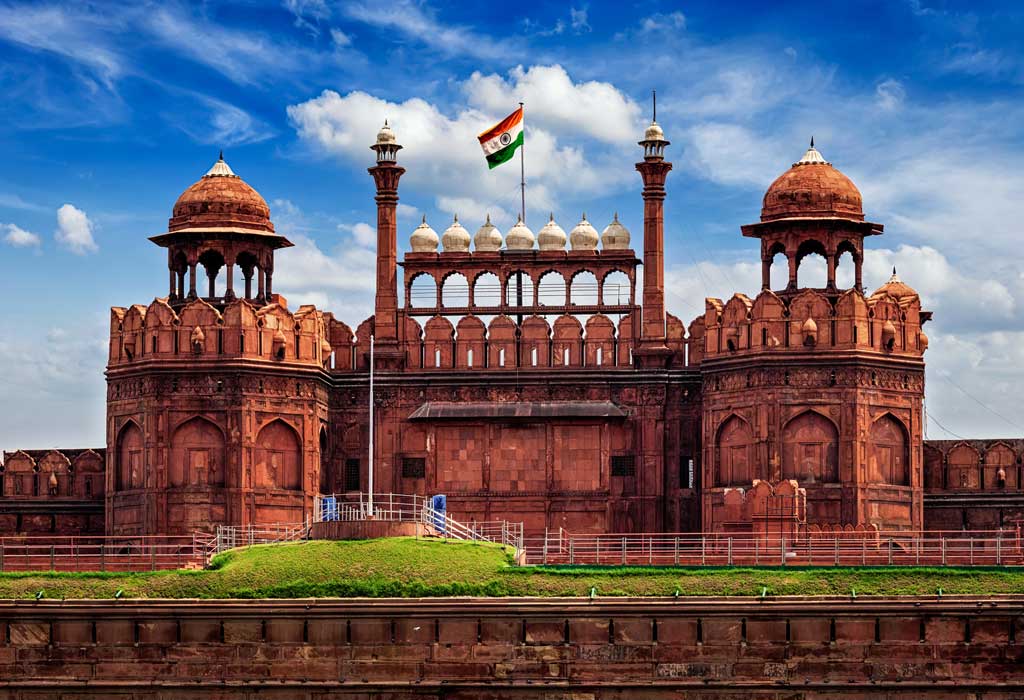
- Use descriptive words to help children picture the Red Fort’s grandeur, such as its red sandstone walls or the flag-hoisting ceremony.
- Mention well-known facts that children can relate to, such as the Red Fort being the venue for the Prime Minister’s Independence Day speech each year.
- Include the historical context briefly, such as who built the Red Fort and why, without overwhelming young readers with too many dates.
- Use a friendly, conversational tone rather than complex vocabulary to keep the essay engaging for young readers.
- Proofread carefully for spelling, punctuation, and grammatical errors before finalising the essay.
- End with a strong concluding line that reflects pride or curiosity about India’s heritage.
5 Lines on the Red Fort
Essay writing can be a fun experience for a student. Here are five lines about the Red Fort that can surely pique a child’s interest:
- Red Fort is one of the most beautiful historical monuments of India.
- Red Fort, or ‘Lal Qila’, was built by the Mughal Emperor Shah Jahan.
- It is made of red sandstone and was earlier coated with precious jewels.
- Every year, the national flag is hoisted at the top on Independence Day.
- The Government of India is the rightful owner of the Red Fort at present.
10 Lines on the Red Fort
An essay for classes 1 and 2 tests a student’s creative ability and writing prowess. Here are a few lines on the Red Fort that would surely enlighten them about the popular monument:
- Since the Red Fort was the residence of royal families, it was referred to as ‘Qila-i- Mubarak.’
- The Red Fort is considered one of the most significant monuments of India, built by the Mughal Emperor Shah Jahan.
- It showcases a splendid display of architecture in marble and red sandstone.
- Construction of the Lal Quila began in 1638.
- The Red Fort is a famous tourist place in India.
- Ustad Ahmad Lahori designed this magnificent fort.
- The Red Fort is located in Old Delhi on the banks of the River Yamuna.
- There is a large park surrounding the Red Fort.
- Thousands of tourists visit the Red Fort every year.
- In 1747, Nadir Shah invaded the fort to loot its jewels and artwork.
Paragraph on the Red Fort
An essay in 100 words on the historic monuments helps a child to appreciate our past. Here is a short paragraph on the Red Fort:
A historical monument like the Red Fort is a treasure for a nation and a symbol of pride. Built by the Mughal Emperor Shah Jahan in the 17th century, this symbol of national heritage is made up of red sandstone. The Indian prime minister hoists the national flag on the Red Fort and delivers the ceremonial speech on Independence Day every year. It took almost eight years for skilled masons of its time to complete its construction. This world-famous landmark consists of a large museum, the Diwan-i-Aam for public audiences, and the Diwan-e-Khas for private meetings.
Short Essay on the Red Fort
An essay for classes 1, 2 and 3 needs to have simple words, clarity of thought, and expression. Here is an essay on the Red Fort in 150 words for kids that would showcase India’s rich tradition and diverse cultural splendour:
Red Fort, or ‘Lal Qila’ in Hindi, is one of the most beautiful monuments in the world, built by Emperor Shah Jahan. The aesthetic beauty of the Red Fort represents a harmonious blend of Persian, Hindi, and Timurid architectural styles, showcasing the height of Mughal creativity. It took almost eight years and a few months to build the fort. The architecture of the Red Fort was done by Ustad Ahmad Lahauri, the Indo-Islamic architect. Shah Jahan’s rule from 1627-1658 is considered the golden age of Mughal architecture and fine arts. The Sheesh Mahal can be found in the Red Fort’s northern and southern regions. UNESCO designated this monument a World Heritage Site in 2007. Our Prime Minister hoists the Indian National Flag on the Red Fort every year on August 15, Independence Day, making it one of the leading centres of political achievements and cultural heritage.
Long Essay on the Red Fort
Irrespective of the language or type of essay, formal or informal, essay-writing skills need to be cultivated from early childhood. Given here is an essay for class 3 that conveys the historical significance of the Red Fort:
Located at the centre of New Delhi, on the banks of the River Yamuna, the Red Fort is also known as the Hindustani Lal Qila. Originally known as the Blessed Fort, meaning Quila-i-Mubarak, the Red Fort was built by the Mughal Emperor Shah Jahan. It has a large museum, a Diwan-e-Aam for receiving the public, and a Diwan-e-Khas for meeting purposes. The emperor commissioned skilled architects of his time to build this fort that enhanced the country’s glory around the globe. It took around nine years to complete this fort. Ustad Ahmad Lahauri designed the Red Fort.
The construction of this famous fort began in the auspicious month of Muharram in 1638 and was completed in 1648. Lahore Darwaza is the main gate in the Red Fort. The rectangular dimension of the fort is 900m x 500m, while the ramparts of the fort measure 34m in height and have a moat surrounding them.
The fort’s artwork showcases a fusion of Persian, European, and Indian art. The three-storied structures of the Red Fort are surrounded by octagonal towers that form two of the five gateways, known as the Gate of Delhi and the Lahori Gate. There are two giant elephant figures guarding the gates of Delhi. The Lahori Gate is the fort’s main entrance, leading to various shops selling multiple decorative items and artefacts.
The Shah Burj and the War Museum are other attractions of this magnificent fort. Every year, our Prime Minister unfurls the national flag and addresses the nation from the ramparts of the Red Fort on Independence Day. Monday is an official holiday for this fort. The Red Fort is one of India’s many wonders and has a treasured history that we’re very proud of.
History of the Red Fort
In 1638, Shah Jahan, the fifth Mughal Emperor of India, moved the capital of his empire from Agra to Delhi. The Red Fort Complex was initially built as the palace fort of Shahjahanabad. Building this massive walled fort took around a decade. The Red Fort was the seat of the Mughal Empire for many years till the British conquered it. In 1837, the last Mughal Emperor, Bahadur Shah Zafar, was crowned here.
What is the Significance of the Red Fort?
Historical monuments play a significant role in the analysis of ancient India’s culture and architecture. The importance of the Red Fort lies in the fact that it not only tells a lot about the country’s history but also serves as a symbol of the nation’s pride and glory.
Architectural Features of the Red Fort
The magnificent architecture of the Red Fort makes it a well-known monument worldwide. Here are some specific architectural features to note.
- Shape – This octagonal fort covers around 225 acres.
- Style – Its unique architectural style blends Mughal, Persian, Timurid, and Hindu influences.
- Segments – The fort consists of the palace and the adjacent Salimgarh Fort. Diwan-i-‘Am and Diwan-i-Khas are the two chambers of the fort.
Some Prominent Structures Within The Red Fort
| Structure | Description |
| Rang Mahal | The emperor’s wives and mistresses resided here. It is divided into six apartments. Tiny beautiful pieces of glass are embedded in the walls and ceilings of this apartment. |
| Mumtaz Mahal | Located in the southern part of the fort and currently housing the Archaeological Museum. |
| Khas Mahal | This private residence was mainly divided into the chamber for telling beads, the sitting room, and the sleeping chamber. |
| Hira Mahal | This palace houses a priceless diamond that was supposed to have been hidden by Shah Jahan and is yet to be discovered. |
| Moti Masjid | This palace was built and personally used by Aurangzeb. |
| Hammam | The emperors used these imperial baths. It has three apartments, one of which is used as a dressing room. |
Major Events
The Red Fort has been at the centre of many important events in India’s history. It was here that Jawaharlal Nehru hoisted the national flag for the first time after India gained independence on 15th August 1947. Since then, the Prime Minister has addressed the nation from the ramparts of the Red Fort every Independence Day, making it a symbol of freedom and unity. The fort has also witnessed historic trials, royal ceremonies, and cultural celebrations over the centuries, reflecting its importance not just as a monument, but as a living part of the country’s national story.
The Red Fort stands tall as one of India’s most treasured monuments, reminding us of our country’s rich history and the courage of those who fought for its freedom. From its grand architecture to its role in India’s Independence Day celebrations, the Red Fort continues to inspire pride in every Indian heart. Visiting this magnificent fort is not just a journey through stone and history, but a chance to connect with the spirit of the nation.
What Will your Child Learn From the Essay on the Red Fort?
An essay on the Red Fort teaches about our past. It showcases Delhi’s cultural significance and the monument’s architectural beauty, helping cultivate a spirit of patriotism in a child.
FAQs
1. What Is Red Fort Also Known As?
The Red Fort is also known as the ‘Lal Qila.’
2. Why Is Red Fort Red In Colour?
Due to the red sandstone structures, the Red Fort is red in colour.
The composition of the Red Fort will help kids explore the significance of such historical monuments. This way, they will learn about important aspects of India’s history.
Also Read:
Essay On Holiday for Kids
Essay On Taj Mahal in English for Children
How to Write An Essay On Qutub Minar for Kids