

Last Updated on August 17, 2026
Words are the building blocks of communication, helping us share our thoughts and feelings with others and understand theirs in return. Educating children with words helps them read and write and supports their academic development. Once your child has learnt a sound, they can more easily pronounce and recognise related words, and parents can begin with simple, everyday words with the ‘ew’ sound before moving on to slightly more advanced vocabulary, eventually working through a broader range of ‘Ew-sound’ words in English.
Thank you for reading this post, don't forget to subscribe!
Learning new words this way strengthens both pronunciation and comprehension over time. It helps to start with easy, simple words that contain Ew, since this builds familiarity before introducing trickier spellings. As vocabulary expands, children begin to notice and understand words that contain Ew across a wider range of contexts, from storybooks to everyday conversation. Let’s look at some easy Ew words for kids, followed by three-, four-, and five-letter words that include this sound.
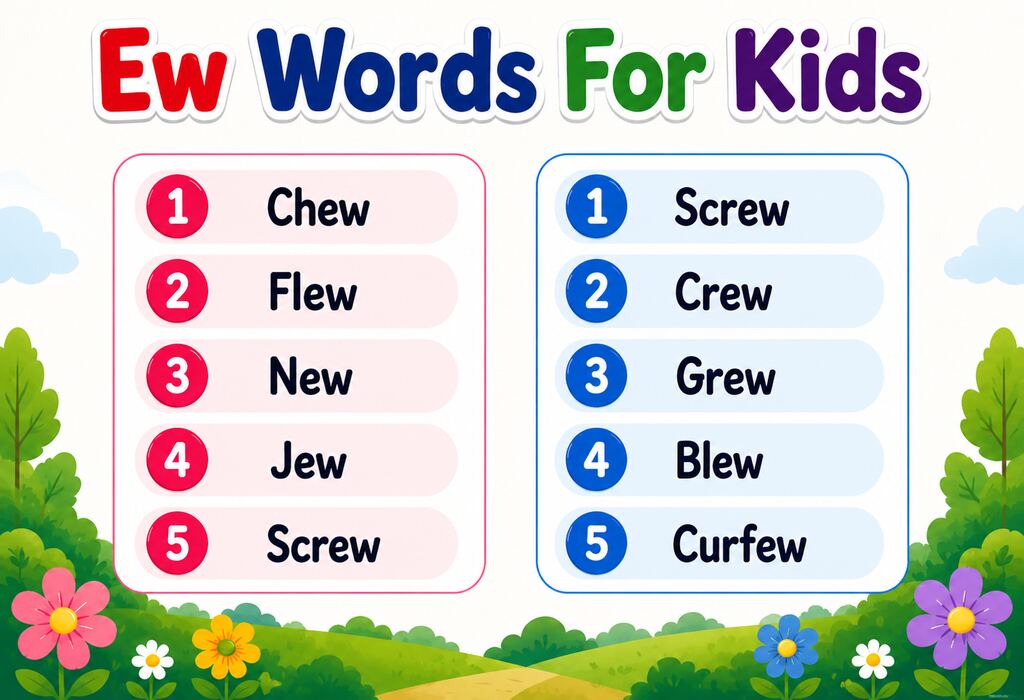
List Of ‘Ew’ Words For Kids
Words help children communicate better while also expanding their vocabulary. They can easily pick up new terms from this list and start using them in everyday conversation. Below is a helpful ‘ew’ word list that also supports learning ‘Ew’ phonic words, making it easier for children to recognise and use these words confidently.
| Chew | Screw | Curfew |
| Flew | Crew | Interview |
| New | Grew | Review |
| Jew | Blew | News |
| Stew | Nephew | Brew |
| Dew | Knew | Drew |
| Jewel | View | Few |
| Threw | Shrew | Skew |
| Renew | Preview | Newt |
| Yew | Anew | Sewer |
| Viewer | Pew | Spew |
Other Words Containing ‘Ew’ For Children
Preschool and kindergarten children benefit from learning short words with Ew, as it builds reading and writing fluency early on. Below are some three-, four-, and five-letter words with Ew, compiled in a simple table for quick learning.
Three-Letter Words With ‘Ew’
Here are some three-letter words that contain ‘ew’. Ask your child to make simple sentences using these words.
| New | Jew | Sew |
| Few | Dew | Pew |
| Hew | Mew | Yew |
Four-Letter Words With ‘Ew’
Here are some four-letter words with ‘ew’ in them. Teach these words to your kids with fun activities.
| View | Chew | Blew |
| News | Anew | Crew |
| Knew | Skew | Stew |
| Grew | Brew | Drew |
| Flew | Slew | Spew |
| Flew |
Five-Letter Words With ‘Ew’
Here are some five-letter words containing ‘ew’. These words might be too much for small children to learn, but once your child has a grasp on three- and four-letter words that contain ‘Ew’, they will easily be able to learn the five-letter words with ‘Ew’ in them.
| Fewer | Chewy | Askew |
| Newer | Threw | Screw |
| Unsew | Renew | Resew |
| Strew | Newly | Sewer |
| Shrew | Views |
Words That Start with ‘Ew’
Beyond words that simply contain “ew,” there are also a few interesting words starting with ‘ew’ itself, though genuinely common ones are quite rare. Here’s a look at the standard words that fit this category:
| Ewe | Ewer | Ewes |
Fun Ways To Teach ‘Ew’ Words
Learning new words becomes much easier when paired with playful, hands-on activities. Here are five fun ideas to help your child practise and remember words with the “ew” sound, including many words ending in ‘ew’.
1. Rhyme Time
Since many “ew” words rhyme with one another, turn learning into a rhyming game by asking your child to think of as many words as they can that sound alike, such as “new,” “few”, and “chew.”
2. Flashcard Matching
Create simple flashcards with pictures representing different “ew” words, such as a crew of people or a bowl of stew, and ask your child to match each picture with its correct word.
3. Silly Sentence Building
Encourage your child to create funny or silly sentences using two or three “ew” words at once, such as “The crew grew a new stew,” making the activity both memorable and entertaining.
4. Word Hunt in Books
While reading a story together, ask your child to spot and circle any “ew” words they come across, turning reading time into an active vocabulary exercise.
5. Ew Word Bingo
Create a simple bingo sheet filled with different “ew” words, then call out clues or definitions for your child to identify and mark the matching word on their sheet.
What Challenges Will Your Child Face While Learning ‘Ew’ Words?
Even with regular practice, children can face a few common hurdles while learning “ew” words. Here are five challenges to be aware of, along with why they happen.
- Confusing “Ew” With Similar Sounds – Children may mix up “ew” with sounds like “oo” or “u,” since words like “new” and “noon” can sound similar to an untrained ear.
- Inconsistent Spelling Patterns – The “ew” sound can be spelt differently across words, such as “flew” versus “blue,” which can confuse children as they try to apply consistent spelling rules.
- Silent or Tricky Letter Combinations – Words like “sew,” which don’t follow the typical “ew” sound pattern, can be especially confusing for early readers.
- Limited Everyday Exposure – Since many “ew” words aren’t used as frequently in daily conversation, children may struggle to retain them without regular reinforcement.
- Difficulty Differentiating Similar-Looking Words – Words like “chew” and “chow,” or “stew” and “stow,” can be easily confused visually, especially for children still developing their reading skills.
FAQs
1. Why Do Some “Ew” Words Sound Different From Each Other?
Even though words like “sew” and “few” both contain “ew,” they don’t always sound the same, since English spelling doesn’t always follow consistent pronunciation rules.
2. Why Is It Helpful to Learn “Ew” Words Through Rhyming?
Rhyming helps children recognise sound patterns more easily, making it simpler to remember and pronounce new “ew” words by connecting them to familiar ones.
3. Are There More “Ew” Words at the End of a Word Than at the Beginning?
Yes, “ew” appears far more often at the end of words, such as “chew” or “grew,” while very few standard English words actually begin with “ew.”
4. How Can I Tell if a Word With “Ew” Is Being Used as a Noun or a Verb?
The meaning usually depends on context; for example, “crew” can be a noun referring to a group of people, while “chew” is typically used as a verb describing an action.
Words containing the “ew” sound may seem small, but they play an important role in helping children build stronger reading, spelling and pronunciation skills. With consistent practice using the lists, activities and examples covered in this article, your child can confidently recognise and use these words in their everyday reading, writing and conversation.
Also Read:
Words Starting with ‘Un’ for Kids
Words that Start with RE for Kids
Words that Begin with Ab for Children