

- What Is a Prime Number?
- Why Your Child Needs To Learn Prime Numbers?
- When Do Kids Start Learning About Prime Numbers?
- Properties of Prime Numbers
- Examples of Prime Numbers
- Prime Number Chart For Kids
- How Can You Find Prime Numbers?
- Difference Between Prime And Composite Numbers
- Tips And Tricks To Learn And Memorise Prime Numbers For Kids
- Simple Questions To Help Kids Revise Prime Numbers
- Word Problems On Prime Numbers For Kids
- Interesting Facts About Prime Numbers For Kids
- Activities To Teach Your Kids Prime Numbers
- FAQs
Last Updated on April 14, 2026
Certain numbers cannot be divided evenly. These numbers are prime. In this article, we will discuss what prime numbers are in maths, why children should learn them, and tips for memorising them.
Thank you for reading this post, don't forget to subscribe!
We have also included a list of prime numbers and engaging activities on prime numbers in English to help kids identify and understand them easily. These fabulous, hands-on methods for teaching prime numbers will keep your child engaged and thinking as they explore the concept in depth.
What Is a Prime Number?
Here is the prime number meaning and definition for kids:
Prime numbers are numbers greater than 1 that have only two factors: 1 and the number itself. To make it easy to understand, these numbers cannot be divided by any other number except 1 and the number itself without leaving a remainder. Prime numbers are unique because they cannot be formed by multiplying two smaller natural numbers. Understanding the meaning of prime numbers helps children build a strong foundation in mathematics, especially in topics such as factors, multiples, and number patterns.
Why Your Child Needs To Learn Prime Numbers?
Read the following reasons to know why your child should learn about all prime numbers:
- All prime numbers are the building blocks of natural numbers.
- They are constantly used to solve mathematical problems.
- Learning about all prime numbers helps in understanding factors, multiples, divisibility, and the structure of the number system.
- All prime numbers exhibit patterns in mathematics that are still being studied, sparking curiosity and deeper exploration among young learners.
- Mastering all prime numbers improves problem-solving skills and logical thinking, both essential for mathematics and everyday life.
- A strong foundation in all prime numbers makes it easier to grasp more advanced mathematical concepts in the future.
When Do Kids Start Learning About Prime Numbers?
Children typically begin learning about prime numbers at the following times:
- When they enter grade 4, as part of the mathematics curriculum.
- When a child demonstrates curiosity about numbers and their properties.
- When your child shows strong foundational skills in multiplication and division.
- When your child asks questions about factors, divisibility, or why some numbers can only be divided by 1 and themselves.
- When you notice your child enjoys mathematical puzzles or games that involve number patterns.
- When your child is ready for more advanced problem-solving activities.
Properties of Prime Numbers
Prime numbers have special properties that make maths fun to explore. Learn about odd prime numbers, the largest prime number known, and rules like divisibility by one and itself.
- Prime numbers have exactly two distinct positive divisors: 1 and the number itself.
- Except for 2, all prime numbers are odd prime numbers and not divisible by 2.
- Prime numbers greater than 2 cannot be even, as they would be divisible by 2.
- They are indivisible by any integer other than 1 and themselves.
- Prime numbers form the building blocks of all integers via the Fundamental Theorem of Arithmetic.
- No prime number can be negative or zero; they are always positive integers greater than 1.
- Consecutive prime numbers have no common factors other than 1.
- The gaps between prime numbers can vary, and there is no largest prime number, as they continue infinitely.
Examples of Prime Numbers
Prime numbers appear in everyday maths and puzzles. This section lists clear examples of prime numbers, from small to large, with easy checks.
- 2: The only even prime number! If you split 2 sweets between 2 friends, each gets 1. Only 1 and 2 go into 2 evenly. Easy!
- 3: The first odd prime. Think of a triangle with 3 sides! Only 1 and 3 divide it. 3 can’t be split evenly into groups, except 1 or 3.
- 5: Ends with a 5. Count your fingers—there are 5 on one hand! Only 1 and 5 go into 5 perfectly.
- 7: There are 7 days in a week! Only 1 and 7 divide it evenly. If you try dividing by 2, 3, or 5, you get leftovers.
- 11: Think of a soccer or cricket team—there are 11 players! Only 1 and 11 go in without leftovers.
- 13: A baker’s dozen means 13! Only 1 and 13 divide it evenly. Try any other number and you get leftovers.
- 17: Imagine 17-year cicadas! 1 and 17 are the only numbers that divide 17 evenly. All other numbers leave extras.
- 19: Only 1 and 19 go into 19 without any left over. Imagine climbing 19 steps—no way to split them into equal groups (except 1 or 19).
- 23: There are 23 pairs of chromosomes in humans! Only 1 and 23 divide it evenly. Try any other number and it doesn’t work.
- 29: Sometimes February has 29 days! Only 1 and 29 go in with no leftovers. All other numbers leave extras.
Prime Number Chart For Kids
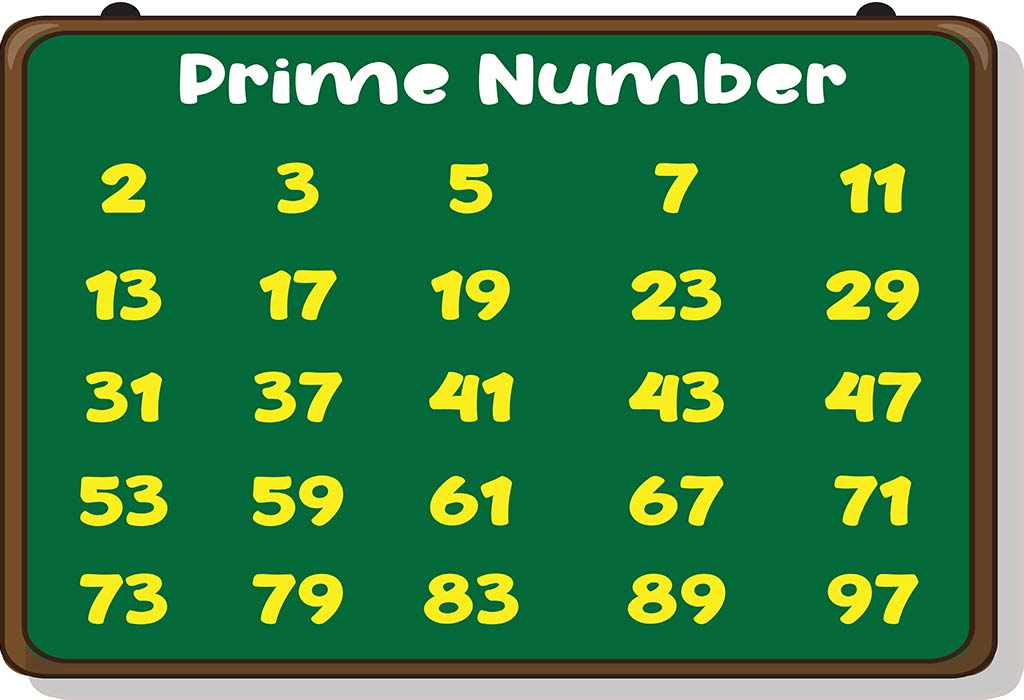
There are several prime numbers. These numbers have only two factors: 1 and themselves. Here is the chart of prime numbers up to 100 that you can use to teach your little one.
How Can You Find Prime Numbers?
Finding prime numbers is like a treasure hunt in maths. Follow these easy steps and tricks to spot them quickly among other numbers.
- Start with 2: It is the only even prime. Every other even number divides by 2, so skip them.
- Check only odd numbers: Test 3, 5, 7, 11, and so on. Primes over 2 are always odd.
- Divide by primes up to the square root: For 29, check divisors up to about 5 (√29 ≈ 5.4). Use 2, 3, 5.
- Use divisibility rules: Ends in 0,2,4,6,8? Divide by 2. Digits sum to 3,6,9? Divide by 3. Ends in 0 or 5? Divide by 5.
- Sieve of Eratosthenes game: List numbers 2-50. Cross out multiples of 2, then 3, then 5. Leftovers are prime!
Difference Between Prime And Composite Numbers
Prime and composite numbers look alike but follow different rules. This table clearly explains their differences with simple examples.
| Prime Numbers | Composite Numbers |
| Has exactly 2 factors (1 and itself) | Has more than 2 factors |
| Examples: 2, 3, 5, 7, 11 | Examples: 4, 6, 8, 9, 10 |
| Only even prime is 2 | Can be even or odd |
| Used to build other numbers | Made by multiplying primes |
| Infinite number exists | Finite up to any limit |
Tips And Tricks To Learn And Memorise Prime Numbers For Kids
Looking for ways to teach prime numbers to your child? Here are some easy tips to remember prime numbers. Let’s read the prime number tricks below.
- The prime numbers between 11 and 40: Consider the numbers ending with 1, 3, 7 or 9. Add the digits. The number is not a prime number if the sum is divisible by 3.
Example: 11 = 1+1 = 2.
2 is not divisible by 3. Hence, 11 is a prime number. - 2 is the only even prime number. Except for 2, all other prime numbers are odd.
Example: 3, 5, 11, 17, etc., are all odd prime numbers. - Two prime numbers are always coprime. This means that every prime number has only two factors – 1 and the number itself, so the only common factor of two prime numbers will be 1.
Example: Factors of 7 are 1 and 7.
Simple Questions To Help Kids Revise Prime Numbers
- Here are some prime number questions for children to practise.
- Pick out the prime numbers from the following numbers.
13, 49, 48, 23, 74, 80, 71, 59, 45, 47
Answer: 13, 23, 71, 59, 47 - List down the prime numbers between 20 and 30.
Answer: The prime numbers between 20 and 30 are – 23 and 29. - Which of the following is not a prime number?
61, 83, 71, 81.
Answer: 81. The rest of the numbers have only 2 factors – 1 and themselves. - How many prime numbers are there between 40 and 50?
Answer: There are 3 prime numbers between 40 and 50 – 41, 43 and 47. - Which of the following pairs of numbers is coprime?
7 & 14
15 & 27
25 & 35
8 & 55
Answer: 8 & 55. Co-prime numbers have only 1 as their common factor. The common factor of 8 and 55 is 1. - List down the first 10 prime numbers.
Answer: The first 10 prime numbers are – 2, 3, 5, 7, 11, 13, 17, 19, 23, 29. - Is the number 13 a prime number?
Answer: 13 is divisible only by 1 and 13. So, yes, 13 is a prime number.
Word Problems On Prime Numbers For Kids
There is a saying that “practice makes a man perfect.” The more you practice, the more perfect you will become at a particular task. Here are some word problems on prime numbers for kids to practice.
1. Four students wrote down a number between 30 and 40. The list shows the numbers they wrote:
Alex – 35
Javed – 39
Mark – 37
Penny- 33
Which student wrote down a prime number?
Answer: Mark
2. Ella thinks of two prime numbers. She adds the two numbers together. The answer is 36. Write all the possible pairs of prime numbers that Ella could be thinking of.
Answer: 3 & 33, 5 & 31, 7 & 29, 13 & 23, 17 & 19
3. The runners in a race all wore numbers from 20 to 60. The number on Aman’s shirt was a prime number. Which of the following could not be Aman’s number?
a) 51
b) 47
c) 29
d) 23
Answer: 51, as it is not a prime number.
4. What is the sum of the first seven prime numbers divided by 2?
Answer: First seven prime numbers are 2, 3, 5, 7, 11, 13, 17
Sum of first seven prime numbers = 2+3+5+7+11+13+17 = 58
58 divided by 2 = 58/2 = 29.
So, the sum of the first seven prime numbers divided by 2 is equal to 29.
Interesting Facts About Prime Numbers For Kids
Here are some interesting facts about prime numbers:
- 1 and 0 are not prime numbers. You can’t divide 0 by anything, and 1 can only be divided by itself, so they don’t count as primes. Imagine 1 and 0 as the outsiders in the world of prime numbers!
- 2 is the only even prime number! Every other even number can be cut in half, but not 2. It’s like the superhero of the number world—small, but super special!
- • Did you know? If you add up the digits of most prime numbers, you usually won’t get another prime! Try it with 13 (1 + 3 = 4) or 17 (1 + 7 = 8).
- There are infinite prime numbers. That means you can keep counting, and you’ll always find more primes—no matter how big the numbers get! It’s like an endless treasure hunt!
- • The largest known prime number has millions of digits! Imagine writing it out—it would fill up thousands of books!
- No prime number greater than 5 ends in a 5. That’s because any number ending in 5 (like 15, 25, or 35) can be divided by 5, so they can’t be prime!
- Prime numbers are like secret codes! They help keep your messages and information safe online—banks and websites use them to lock up secrets so only the right people can open them.
- Every even number greater than 2 can be made by adding two prime numbers together. For example, 4 = 2 + 2, 6 = 3 + 3, and 8 = 3 + 5. It’s like making number pairs!
- A long time ago, people thought 1 was a prime number, but now it’s not. Imagine 1 wearing a prime number badge, but it had to give it back!
Activities To Teach Your Kids Prime Numbers
Here are some activities to teach your child about prime numbers.
1. Colour The Prime Numbers
On a sheet with square boxes, write down numbers 1 to 100. Ask your child to identify all the prime numbers between 1 and 100, and colour them with their favourite colour.
2. Prime Number Song
Here is a song to teach your little one prime numbers up to 100:
A PRIME NUMBER…..is divided by
JUST ITSELF…… AND THE NUMBER ONE…..
A PRIME NUMBER….Oh, they’re lots of fun….
Oh!!! We love our PRIME NUMBERS!
2, 3, 5 and 7
11 and 13
17, 19, 23……
Oh!!! We love our PRIME NUMBERS!!!
29 and 31
37 and 41
43, 47, 53
Oh!!! We love our PRIME NUMBERS!!!
59 and 61
67 and 71
Oh……PRIME NUMBERS…. are a lot of fun!!
Oh!!!! We love our PRIME NUMBERS!!!
73 and 79
83 and 89
97………
Oh that’s all that’s left
In PRIME NUMBERS to 100!!!
3. Playing Cards
Children love playing with cards, and here is how to teach them prime numbers up to 13 using cards. Tell your child all the prime numbers between 1 and 13: 2, 3 ,5, 7, 11, 13. Now divide the playing cards equally between you and your child and ask your child to throw one card at a time. They can pick up all the cards if the number is a prime number and matches the card below it. The one with the maximum number of cards wins the game.
4. Hop And Tell
Here is the twist to the hopscotch game. Make a hopscotch on the floor with chalk and ask your child to write all the numbers up to 15 in the boxes. Start playing the game, and whenever your child moves to a number, ask them whether it is prime. If they answer correctly, they can take one extra chance.
5. Jump Or Sit
Ask your child to stand and tell them you will call out numbers; they will need to decide whether each is prime. If it is a prime number, they should jump; if it is not, they should sit down.
6. Even Number Between…
Learning is an ongoing process. Kids cannot learn everything in one go. That is why we should teach kids in steps, let them grasp each step, and then move to the next. Here is how you can start teaching kids about prime numbers. On day one, explain the concept of prime numbers and ask them to make a list of prime numbers between 0 and 10. The next day, ask them to make a list of prime numbers between 10 and 20, and so on. This way, your child will easily know how to identify a prime number.
7. Find The Prime Numbers
For this activity, all you need is a newspaper or a magazine. Give your child a page from a newspaper or magazine and ask them to circle all the prime numbers on it. A fun and easy way to teach your kids prime numbers while instilling the habit of reading in them.
FAQs
Here are some frequently asked questions related to prime numbers. If you have more questions, share them with us in the comments below.
1. Is 1 A Prime Number? If Not Why?
The definition of a prime number says that any number with exactly two positive divisors is a prime number. Number 1 has positive divisors itself. So, number 1 is not prime.
2. What Is The Smallest Prime Number?
2 is the smallest prime number.
3. What Is The Largest Prime Number?
Currently, the largest known prime number is 2^82,589,933−1.
Prime numbers are fascinating and play a vital role in mathematics and our daily lives. Whether you’re solving puzzles, playing games, or learning about how computers keep information safe, prime numbers are everywhere! Keep exploring, practising, and having fun with numbers — you never know what amazing patterns or secrets you might discover next!
Also Read:
WH Questions for Children to Learn
Easy Ways to Teach Your Child Basic Counting
Number Names for Children to Improve their Math Skills!