



- What Are Onset And Rime?
- Why You Should Teach Onset and Rime To Children?
- Onset And Rime Word List
- How Do Onset And Rime Work Together?
- Onset And Rime Examples
- How Will It Improve Your Child’s Writing?
- When Does A Word Not Have An Onset?
- Common Rime Patterns For Kids
- Onset And Rime Activities
- Mistakes To Avoid While Teaching Onset And Rime
- Onset And Rime Worksheet
- FAQs
Last Updated on September 18, 2026
Every word can be split into two simple parts, and that discovery is often a child’s first real step into reading. This is where onset and rime come in, a foundational phonics concept that breaks words down into their beginning sound and the part that follows.
Thank you for reading this post, don't forget to subscribe!
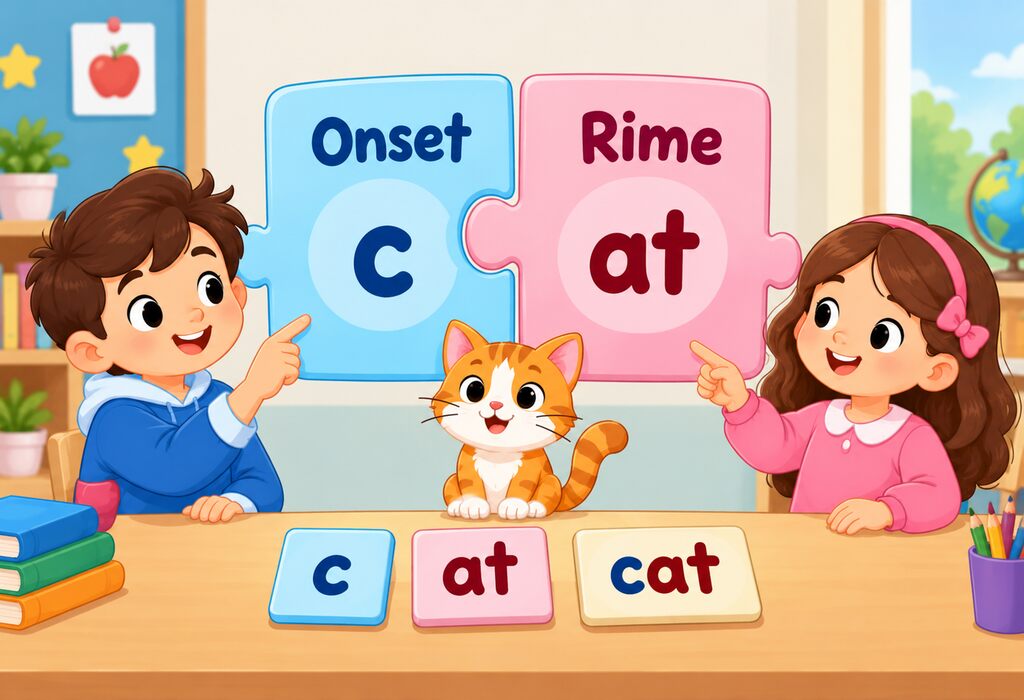
Think of the word “cat.” The “c” sound is the onset, while “at” is the rime. Once children spot this pattern, they start noticing it everywhere, in “hat,” “bat,” and “sat,” and suddenly rhyming and reading feel far less mysterious.
Building strong onset and rime for kindergarten and preschool learners lays the groundwork for blending, segmenting, and eventually independent reading. It also makes wordplay genuinely fun for little ones who are just starting to notice how language works.
This article covers clear lists, everyday examples, and simple activities parents and teachers can use to build onset/rime awareness at home or in the classroom, one playful sound at a time.
What Are Onset And Rime?
Understanding word sounds becomes much simpler once children learn to break words into two clear parts. Here is a straightforward onset and rime definition to help them get started.
What Is Onset?
The onset is the very first sound or group of sounds in a syllable, coming before the vowel begins. It can be a single consonant, like the “b” in “bat,” or a blend of consonants, like the “st” in “stop.” Not every word has an onset, though, as some begin directly with a vowel sound, such as “at” or “ant.” Learning to identify the onset helps children isolate beginning sounds, which is an important early step in building phonemic awareness.
What is a Rime?
The rime is the part of a syllable that includes the vowel and any consonants that follow it. In the word “bat,” for example, “at” is the rime, and it stays the same even when the onset changes, as in “cat,” “hat,” and “sat.” This is what makes rimes so useful for spotting rhyming patterns, since words sharing the same rime often sound alike. Recognising rimes helps children read new words more easily, as they can apply a familiar pattern instead of sounding out every letter from scratch.
Why You Should Teach Onset and Rime To Children?
Teaching onset and rime gives children a shortcut to reading fluency long before they can decode every letter on their own. Once they recognise a familiar rime, like “at” or “og,” they can quickly read a whole family of new words by simply swapping the onset, which builds both confidence and speed. This approach also strengthens phonemic awareness, helping children hear and manipulate the smaller sounds within words, a skill that research consistently links to stronger reading and spelling outcomes later on. Beyond the academic benefits, spotting these patterns turns rhyming games and wordplay into genuine fun, keeping young learners engaged while they build skills that will support them throughout their reading journey.
Onset And Rime Word List
Building a solid bank of onset and rime words makes pattern recognition second nature for young readers. Below is a handy onset and rime list to practise with, sorted by rime family.
| ONSET | RIME | WORD |
| c | at | cat |
| h | at | hat |
| m | at | mat |
| s | at | sat |
| b | at | bat |
| r | at | rat |
| d | og | dog |
| f | og | fog |
| l | og | log |
| j | og | jog |
| h | og | hog |
| c | og | cog |
| b | ig | big |
| d | ig | dig |
| f | ig | fig |
| p | ig | pig |
| w | ig | wig |
| j | ig | jig |
| c | an | can |
| f | an | fan |
| m | an | man |
| p | an | pan |
| r | an | ran |
| t | an | tan |
| b | ed | bed |
| f | ed | fed |
| l | ed | led |
| r | ed | red |
| w | ed | wed |
| n | et | net |
| p | et | pet |
| s | et | set |
| v | et | vet |
| w | et | wet |
| h | op | hop |
| m | op | mop |
| p | op | pop |
| t | op | top |
How Do Onset And Rime Work Together?
Onset and rime work together to form a complete syllable, with the onset supplying the beginning sound and the rime carrying the vowel and everything after it. When children combine a new onset with a familiar rime, they can instantly read or create a fresh word, turning “at” into “cat,” “hat,” or “sat” simply by changing the first sound. This blending process mirrors exactly how reading works in practice, since sounding out a word often means recognising its rime and adding the right onset in front. Understanding this partnership gives children a flexible tool they can apply again and again, rather than memorising each word as a separate, unconnected piece.
Onset And Rime Examples
Learning sticks best when children can see word patterns broken down clearly. Here are a few simple onset/rime examples to bring the concept to life.
| Word | Onset | Rime |
| bat | b | at |
| sun | s | un |
| dog | d | og |
| pig | p | ig |
| hen | h | en |
| cup | c | up |
| red | r | ed |
| fan | f | an |
| top | t | op |
| leg | l | eg |
How Will It Improve Your Child’s Writing?
Once children internalise onset and rime patterns, this awareness naturally extends beyond reading into their writing as well. Recognising familiar chunks within words helps them spell more confidently and construct sentences with greater ease, since they are no longer sounding out every word from scratch. Here is how this skill translates into stronger writing.
- Better Spelling Accuracy — Children can apply known rime patterns to spell new words correctly, rather than guessing letter by letter.
- Faster Word Recall — Familiar chunks are retrieved from memory quickly, letting children write without long pauses to sound things out.
- Wider Vocabulary Use — Spotting word families encourages children to experiment with new words that share a rime they already know.
- Improved Sentence Flow — Less time spent decoding individual words means children can focus on structuring ideas clearly.
- Stronger Editing Skills — Recognising familiar patterns helps children catch spelling errors more easily when reviewing their own work.
When Does A Word Not Have An Onset?
A word (or syllable) has no onset when it begins directly with a vowel sound, rather than one or more consonants coming before the vowel. Take words like apple, echo, igloo, orange, or umbrella — each one starts straight in with a vowel, so there’s no consonant sound leading into the nucleus. In these cases, the syllable is said to be “onsetless,” and it typically consists of just a nucleus (the vowel) plus, optionally, a coda (the consonant sound(s) that follow). This is different from words like cat or stop, where “c” or “st” form the onset before the vowel kicks in. Onsetless syllables are common across languages, though how frequently they occur — and whether they’re even allowed — can vary depending on a language’s phonological rules.
Common Rime Patterns For Kids
Rimes are the part of a syllable that includes the vowel and everything after it, and learning common patterns helps kids quickly recognise and read families of similar-sounding words. Here are five rime patterns that are great starting points for early readers:
- -at — as in cat, hat, bat, mat, sat
- -an — as in man, can, fan, pan, ran
- -in — as in pin, win, fin, tin, chin
- -og — as in dog, log, fog, jog, frog
- -ug — as in bug, rug, hug, mug, jug
Onset And Rime Activities
Playing an onset and rime game is one of the most effective ways to build phonemic awareness in young learners. Here are five simple onset and rime activities for kindergarten that make blending and segmenting sounds fun and hands-on.
1. Onset and Rime Sound Boxes
Give each child a set of small boxes or squares — one for the onset and one for the rime. Say a word aloud (like “c-at”), and have the child push a counter into each box as they hear the sound, then blend them to say the whole word.
2. Picture and Word Match
Lay out picture cards (like a cat, sun, or pig) alongside cards showing onset and rime pieces. Kids match the picture to the correct onset and rime combination, reinforcing sound-to-letter connections.
3. Rime Family Sorting
Give students a pile of word cards from different rime families (-at, -an, -ug, etc.) and have them sort the words into the correct family group. This helps them visually and audibly recognise shared patterns.
4. Onset Swap Game
Start with a simple word like “bat” and have kids swap out the onset to create new words — turning it into “cat,” “hat,” “mat,” or “sat.” This builds flexibility with sounds and letter recognition.
5. Onset and Rime Bingo
Create bingo cards with rime patterns in each square. Call out full words, and have kids identify the rime pattern and mark it on their card. This combines listening skills with pattern recognition in a fun, game-based format.
Mistakes To Avoid While Teaching Onset And Rime
A few common missteps can slow down progress when teaching this skill. Here’s what to watch for:
- Skipping oral practice — Introducing print too early, before kids can hear and manipulate sounds, creates confusion instead of building a foundation.
- Ignoring blending and segmenting — Rhyming alone isn’t enough; kids also need practice joining sounds together and pulling them apart.
- Using overly complex words — Stick to simple, decodable words at first so the pattern stays clear and not overwhelming.
- Lacking variety — Repeating one drill gets stale fast; mix in games, sorting, and hands-on tasks to hold interest.
- Skipping regular review — New patterns fade without reinforcement, so revisit past rimes even as you introduce new ones.
- Ignoring pacing — Kids learn at different speeds, so check for understanding often instead of rushing to the next pattern.
Onset And Rime Worksheet
This section has a printable worksheet to help kids practice identifying, blending, and separating onsets and rimes. It’s a simple way to reinforce what they’ve learned through games and oral activities with focused, independent practice.
FAQs
1. At What Age Should Kids Start Learning Onset And Rime?
Most kids start around age 4 or 5, usually in preschool or kindergarten, once they’re comfortable with basic letter sounds and rhyming.
2. Are Onset And Rime The Same As Phonics?
Not exactly. Phonics focuses on matching letters to sounds, while onset and rime focus on breaking spoken words into two chunks to help with blending and reading patterns.
3. Can Every Word Be Split Into An Onset And A Rime?
Almost every word can, except words that start with a vowel sound, like “ant” or “egg” — these only have a rime and no onset.
4. How Can Kids Practice Onset And Rime At Home?
Simple games work best, like clapping out word parts, playing rhyming games, or swapping the first sound of a word to make new words (turning “cat” into “hat” or “mat”).
Onset and rime are simple building blocks that make a big difference in how kids learn to read. With regular practice through games, worksheets, and everyday word play, children start to recognise patterns quickly and sound out new words with more confidence. A little consistent practice goes a long way in turning these small sound chunks into strong reading skills.
Also Read:
Connectives for Kids
Pronouns for Children
Helping Verbs for Kids
Determiners for Children