


- What Are Rhyming Words?
- What Are The Benefits Of Learning Rhyming Words For Kids?
- List of Rhyming Words for Your Children
- Examples Of Rhyming Words By Sound
- Rhyming Words For Kindergarten Or Preschool Kids
- Rhyming Words For Class 1, 2, And 3 Kids
- Activities/Games That Will Help Your Kid Learn Rhyming Words
- Rhyming Word Books For Kids
- FAQs
Last Updated on October 26, 2026
Rhyming words are great for your kids’ brains, and this article shows you how to bring them to life at home, school, and in the community. Kids will eventually start making up their own rhymes, which is a perfect chance to teach them new, creative ones.
Thank you for reading this post, don't forget to subscribe!
Whether your child is a preschooler or a teenager, exploring rhyming words for kids keeps them engaged and builds language skills. Here, we share some exciting rhyming words in English and ways to help your child create their own rhymes at home.
What Are Rhyming Words?
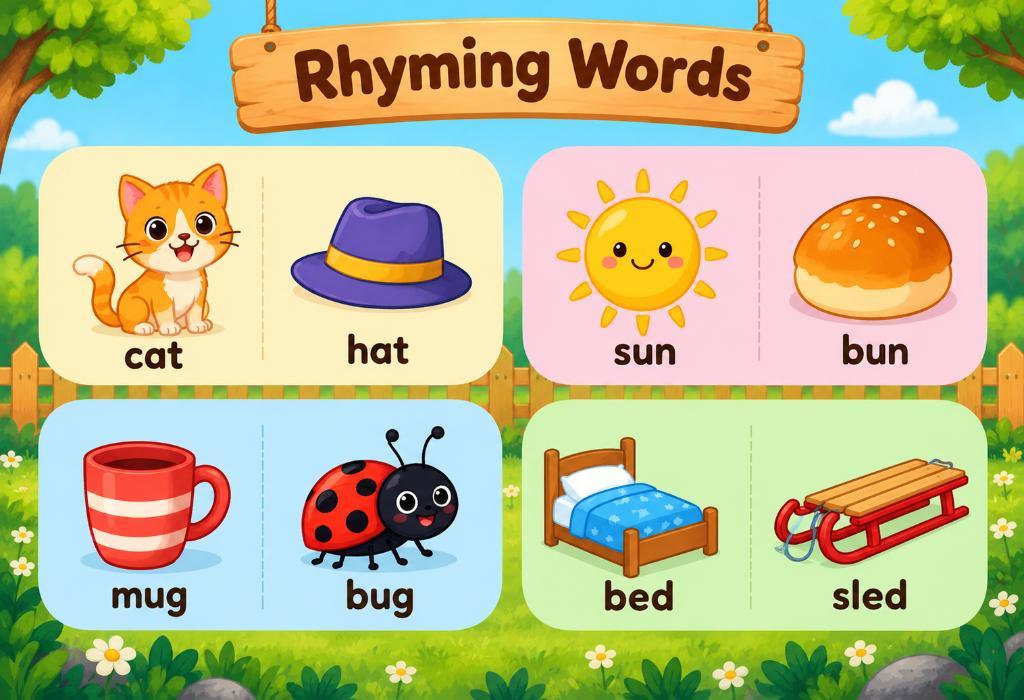
Rhyming words are words that end with the same or a very similar sound, even when their spellings differ, such as “cat” and “hat” or “light” and “night”. Children learn to spot, say and write the rhyming words by listening for the matching ending sounds, which builds phonemic awareness and early reading skills. Rhymes also make poems, songs and nursery rhymes more rhythmic, memorable and fun to recite.
| WORD | RHYMING WORD | EXAMPLE SENTENCE |
| Cat | Hat | The cat sat on the hat. |
| Light | Night | The stars shine bright, and the light glows at night. |
| Tree | Bee | A little bee buzzed around the tree. |
| Sun | Fun | We had so much fun playing in the sun. |
| Book | Look | Come and look at this lovely book. |
| Rain | Train | The train pulled out of the station in the rain. |
What Are The Benefits Of Learning Rhyming Words For Kids?
Rhyming words help children tune into the sounds that make up spoken and written language. Working through rhyming word examples such as “cat” and “hat” also builds vocabulary, because a new word met inside a familiar rhyme is easier to understand and remember.
1. Makes Reading Fun
Rhymes are catchy and playful, which makes reading feel like a game rather than a task. They also sharpen listening skills and support comprehension as children follow the patterns in what they hear.
2. Helps In Understanding Sounds And Phonics
By matching and comparing endings, children see how individual sounds are made and how they blend to form whole words. This is the foundation of confident phonics and early decoding.
3. Builds A Stronger Vocabulary
Repeating rhyming pairs improves word recall and pronunciation. Children pick up new words naturally, without the pressure of formal drilling.
4. Widens Learning Options
Rhymes open the door to the linguistic variations of other cultures and regions. This early curiosity about how language sounds and works around the world supports further learning in later years.
List of Rhyming Words for Your Children
This rhyming words list gives children a simple set of word pairs to read, say and practise together. Use it for quick rhyme games, bedtime chats or early reading practice.
| WORDS | RHYMES WITH |
| Bat | Cat, Hat, Mat, Sat,Chat,Flat,Rat,That |
| Bee | Tree, Sea, Key,Me,He,She,Knee,Flea,Fee |
| Sun | Fun, Run, Bun,Done,One,Son,Won |
| Light | Night, Kite, Bright,Bite,Height,Might |
| Rain | Train, Plane, Chain, Gain,Plane,Drain,Brain |
| Book | Look, Cook, Hook, Took,Shook,Brook |
| Star | Car, Jar, Far |
| Cake | Lake, Bake, Snake,Fake,Ache,Flake |
| Bear | Chair, Hair, Pear, Repair |
| Ball | Wall, Tall, Fall, Call,Crawl,Small |
Examples Of Rhyming Words By Sound
Rhyming words are easiest to spot when they are grouped by their shared ending sound. Here are some examples of rhyming words by sound, ready for children to read aloud and practise.
- -at sound: cat, hat, mat, bat
- -ay sound: day, play, say, stay
- -ig sound: big, pig, dig, wig
- -og sound: dog, log, frog, fog
- -ake sound: cake, lake, bake, snake
- -ight sound: light, night, kite, bright
- -ain sound: rain, train, plane, chain
- -un sound: sun, fun, run, bun
- -all sound: ball, wall, tall, fall
- -ook sound: book, look, cook, hook
- -ee sound: bee, tree, sea, key
- -ar sound: star, car, jar, far
Rhyming Words For Kindergarten Or Preschool Kids
Simple rhyming word sentences help young learners hear matching sounds and connect them to the words they see on the page. Short, playful lines like these are ideal for kindergarten and preschool children who are just beginning to read and rhyme.
AB Rhyming Words
| Cab | Flab |
| Tab | Grab |
| Fab | Jab |
| Crab | Nab |
AD Rhyming Words
| Had | Pad |
| Bad | Clad |
| Sad | Lad |
| Glad | Fad |
| Dad | Rad |
AG Rhyming Words
| Bag | Lag |
| Rag | Sag |
| Nag | Tag |
| Drag | Wag |
AM Rhyming Words
| Jam | Bam |
| Ham | Dam |
AN Rhyming Words
| Ran | Can |
| Van | Pan |
| Fan | Man |
| Tan | Lan |
AP Rhyming Words
| Cap | Rap |
| Gap | Chap |
| Lap | Yap |
| Sap | Map |
| Tap | Zap |
AR Rhyming Words
| Bar | Mar |
| Car | Par |
| Far | Tar |
| Jar | Are |
AT Rhyming Words
| Hat | Sat |
| Mat | Bat |
| Cat | Fat |
| Rat | Pat |
AY Rhyming Words
| May | Bay |
| Day | Tray |
| Pay | Hay |
| Say | Gay |
| Ray | Way |
ET Rhyming Words
| Pet | Jet |
| Net | Vet |
| Let | Wet |
| Get | Set |
| Bet | Met |
ED Rhyming Words
| Bed | Led |
| Red | Wed |
ID Rhyming Words
| Kid | Rid |
| Lid | Bid |
| Mid | Hid |
IG Rhyming Words
| Big | Rig |
| Dig | Gig |
| Fig | Wig |
IP Rhyming Words
| Lip | Nip |
| Sip | Hip |
| Rip | Zip |
| Tip | Dip |
IT Rhyming Words
| Hit | Kit |
| Bit | Fit |
| Sit | Pit |
| Lit | Knit |
OG Rhyming Words
| Log | Bog |
| Fog | Cog |
| Hog | Dog |
OP Rhyming Words
| Mop | Top |
| Cop | Flop |
| Hop | Pop |
| Lop | Chop |
OD Rhyming Words
| Bod | Pod |
| Cod | Odd |
| Rod | Sod |
| Nod | Mod |
OT Rhyming Words
| Cot | Lot |
| Dot | Bot |
| Rot | Sot |
| Hot | Tot |
| Not | Got |
Rhyming Words For Class 1, 2, And 3 Kids
Through these lists in English, kids will learn different rhyming words. A list of rhyming words for children in grades 1, 2, and 3 is given below:
‘All’ Rhyming Words
| Tall | Small |
| Fall | Recall |
| Call | Install |
| Ball | Stall |
| Mall | Pall |
| Hall | Thrall |
| Wall | Squall |
‘Ell’ Rhyming Words
| Bell | Smell |
| Shell | Spell |
| Dell | Tell |
| Hell | Fell |
| Sell | Dwell |
‘In’ Rhyming Words
| Tin | Twin |
| Bin | Skin |
| Sin | Thin |
| Rin | Fin |
| Chin | Lin |
| Pin | Grin |
| Win | Shin |
‘Ore’ Rhyming Words
| Wore | Tore |
| Shore | Fore |
| Pore | More |
| Lore | Spore |
| Core | Store |
| Sore | Score |
| Bore | Crore |
‘Ale’ Rhyming Words
| Sale | Hale |
| Pale | Scale |
| Tale | Male |
| Yale | Shale |
| Kale | Gale |
| Stale | Bale |
| Vale | Whale |
‘Ake’ Rhyming Words
| Shake | Awake |
| Snake | Quake |
| Stake | Rake |
| Wake | Sake |
| Lake | Fake |
| Cake | Bake |
| Take | Hake |
Activities/Games That Will Help Your Kid Learn Rhyming Words
Rhyming words are an essential skill that your kid needs to learn. And through some of the rhyming word activities, kids can quickly learn some beautiful rhyming words. In addition to recognising rhymes, kids will also be able to use them in their writing and speech.
So if you want your kid to learn rhyming words, try using one of these activities/games:
1. Stick a Rhyme
Sticky notes are a fun way to teach kids to match rhymes. You can use a whiteboard and sticky notes to create a fun activity. The five-column method is a good choice. Make five columns, and write a word family name in each one. Your children can place their sticky notes on the word family column after they have read the words.
2. Rhyming Names Game
This is an interesting rhyming game; it requires the children’s names to be used and provides a framework for developing their vocabulary. You will need to come up with nonsense-rhyming words for the children’s names and say, “If your name rhymes with James, touch your head; if your name rhymes with Sarah, jump three times.”
3. Fun Bag
You can create a fun bag using a collection of small rhyming objects. Pack the rhyming objects into a pillowcase or a transparent bag. After taking turns, the children remove two items to determine whether they rhyme. If they do, they receive another chance. If they do not, the items are packed back into the bag, and the next person gets a turn.
4. Rhyming Match
The rhyming items can be put into a basket, and the children can sort and match rhyming word families using makeshift sorting bowls. Alternatively, small hoops or placemats can be used for the bowls.
Rhyming Word Books For Kids
Rhyming books are a fun way to practise reading, spark imagination and pair well with activities like letter tracing and vocabulary games. Here are some favourites for teaching your child rhyming words in English:
- Dreamland My Jumbo Book of Nursery Rhymes 1: A collection of classics such as “Twinkle, Twinkle” and “Humpty Dumpty”, with lively illustrations that get children singing and dancing. Adults will enjoy revisiting their own childhood favourites too.
- My First Bedtime Rhymes: A soothing collection of 25 classic nursery rhymes, including “Rock-a-Bye Baby” and “The Owl and the Pussycat”, ideal for winding down at night.
- Usborne Whale Tells a Tale: A funny rhyming story from the Phonics Readers series, in which Whale outwits four hungry sharks. It is written to build phonemic awareness.
- Nursery Rhymes Sound Book: A four-book series with sound buttons that bring farm animals, wild animals and dinosaurs to life alongside popular nursery rhymes. Children love pressing the buttons and singing along.
- Pegasus Jingle Bells and Other Nursery Rhymes: Bright, colourful pictures help young children remember and learn familiar nursery rhymes.
FAQs
What Is The Difference Between Rhyme And Rhythm?
Rhyme is the matching sound at the end of words, such as “moon” and “spoon”. Rhythm is the beat or pattern of stressed and unstressed syllables in a line, which is what makes a poem feel like it can be clapped or tapped along to.
2. What Are Word Families, And How Do They Relate To Rhyming?
A word family is a group of words that share the same ending letters and sound, such as “-ake” in “bake”, “cake” and “lake”. Learning one family helps children read and spell several new words at once.
3. Is It Normal If My Child Cannot Rhyme Yet?
Yes, many children need time and plenty of repetition before they can spot or make rhymes. If your child is five or older and still struggles to hear rhymes, or also finds it hard to pronounce sounds, speak to a paediatrician or speech-language therapist.
4. Do Rhyming Words Change With Accent?
Yes, a pair can rhyme in one accent but not in another. For example, “bath” and “path” rhyme in some regions and not in others, so children should simply rhyme the way they naturally say the words.
5. How Long Should Children Practise Rhyming Each Day?
Five to ten minutes of relaxed play is enough for preschoolers. Short, regular sessions, such as a rhyme during a car ride or at bedtime, work better than one long sitting.
Rhyming words help children hear the sounds inside language, supporting early reading, spelling and vocabulary. With the lists, examples and books above, you can turn everyday moments such as bedtime or a car ride into short, playful rhyming sessions. A few minutes of practice each day is enough to build confidence.
Also Read:
Compound Words for Children
Two Letter Words for Kids to Learn
Four Letter Words for Children to Improve Vocabulary