



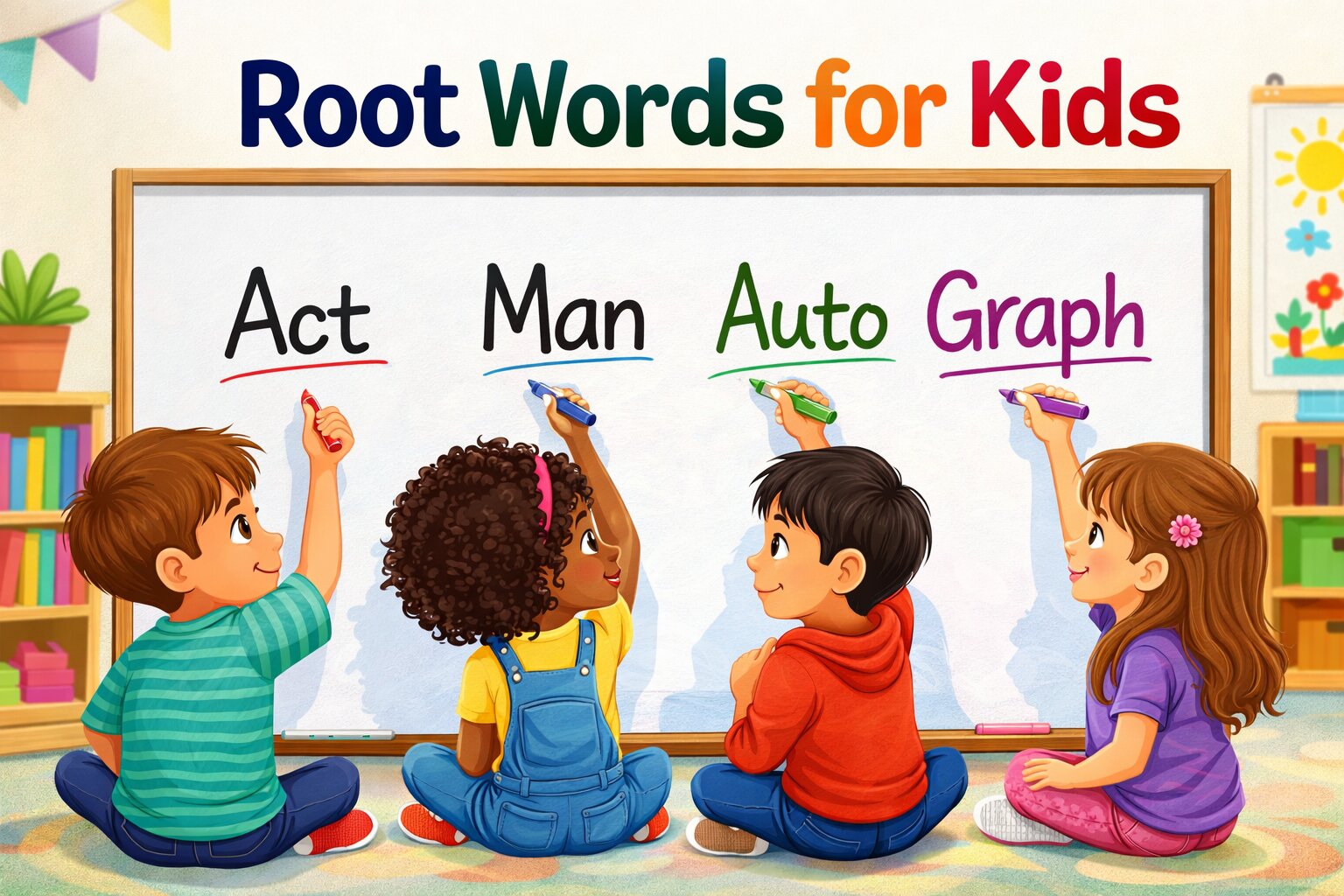
Helping children learn new words can be fun and easy, especially when you explore root words together! Root words are the building blocks of language. When kids learn them, they can figure out the meaning of many bigger words all by themselves. If you’re searching for an enjoyable way to boost your child’s vocabulary at home, starting with root words in English is a fantastic idea. Everyday moments, such as reading a story or talking at the dinner table, can become exciting learning adventures.
Thank you for reading this post, don't forget to subscribe!
In this article, you’ll discover simple explanations, a helpful list of common English root words, and easy examples you can use with your child every day. You’ll also find creative ideas for practising root words for kids through games, stories, and playful conversations. With these tips, you’ll spend less time explaining new words and more time laughing, exploring, and learning together!
What Are Root Words?
The meaning of a root word is the most basic part of a word. Understanding root word meanings helps us see the core idea that a word carries before any prefixes or suffixes are added. Most root words come from ancient languages like Latin and Greek, which is why they usually do not stand alone as complete words in English. Instead, root words need prefixes or suffixes to form meaningful English words.
Example: “struct” means “to build” (as in construct or structure)
Importance Of Root Words For Kids
When children begin to understand how words are formed, learning becomes much easier. Here are a few ways that knowing root words can benefit your child:
- Children can learn and understand many new words simply by knowing a single root word.
- They can more easily infer the meanings of unfamiliar words while reading.
- Understanding root words also improves spelling by revealing how words are constructed.
- Root words help children recognise patterns across different subjects, making it easier to connect vocabulary in science, math, and language arts.
At What Age Do Kids Learn Root Words?
Kids usually start picking up root words around ages 5 to 8, as they begin reading more and noticing patterns in words. By ages 8 to 10, they become more comfortable recognising root words and using them to figure out the meanings of new words.
Difference Between Root Words And Base Words
You may assume that root words and base words are identical, but there is actually a subtle distinction between them.
1. Root Words
They usually come from Latin or Greek and often do not stand alone as complete words. Instead, they need prefixes or suffixes to form meaningful words.
Example: “ject” means “to throw” (inject, reject).
2. Base Words
Base words are words that make sense on their own; they do not need any extra parts to be understandable. You can add prefixes or suffixes to base words, but even without them, the base word itself is still a complete and meaningful word.
Example: “help” means “to assist”.
Building Blocks Of Root Words: Prefix, Suffix, And Affix
Words aren’t simply random strings of letters. They are formed step by step from smaller building blocks. The three key components to understand are prefixes, suffixes, and affixes.
1. Prefix
A prefix is a group of letters added at the beginning of a word to change its meaning.
Examples:
- un + happy = unhappy
- re + write = rewrite
- pre + school = preschool
- dis + agree = disagree
- mis + take = mistake
2. Suffix
A suffix is a group of letters added at the end of a word to change its meaning or form.
Examples:
- play + er = player
- hope + ful = hopeful
- quick + ly = quickly
- teach + er = teacher
- kind + ness = kindness
.3. Affix
An affix is a general term that includes both prefixes and suffixes. It is any addition to a root word.
Examples:
- un + kind = unkind
- care + less = careless
- re + do = redo
- help + less = helpless
- reuse+ able = reusable
Examples Of Root Words With Meanings
A simple way to help kids learn root words is by showing them everyday examples. Here are some common root words along with their meanings and examples to help you get started.
| ROOT WORDS | MEANING | USAGE EXAMPLE |
| Act | Do something | Action: “The actor performed a brave action.” |
| Aud | Hear | Audience: “The audience listened quietly.” |
| Auto | Self | Automatic: “The door is automatic.” |
| Bio | Life | Biology: “We study biology in school.” |
| Chron | Time | Chronicle: “The chronicle tells old stories.” |
| Dict | Say/speak | Predict: “I predict it will rain.” |
| Duct | Lead | Conduct: “Conduct the orchestra well.” |
| Fac/Fact | Do/make | Factory: “The factory makes toys.” |
| Geo | Earth | Geography: “Geography shows maps.” |
| Graph | Write/draw | Photograph: “Take a photograph.” |
| Man | Hand | Manuscript: “Write a manuscript.” |
| Meter | Measure | Thermometer: “Use a thermometer.” |
| Micro | Small | Microscope: “See germs with a microscope.” |
| Path | Feeling/illness | Sympathy: “Show sympathy to friends.” |
| Phon | Sound | Telephone: “Call on the telephone.” |
| Photo | Light | Photosynthesis: “Plants use photosynthesis.” |
| Port | Carry | Transport: “Transport goods by lorry.” |
| Scrib/Script | Write | Describe: “Describe the picture.” |
| Struct | Build | Construct: “Construct a bridge.” |
| Tele | Far | Television: “Watch television.” |
| Terr | Earth/land | Terrain: “The terrain is hilly.” |
| Theo | God | Theology: “Theology studies beliefs.” |
| Vid/Vis | See | Visible: “The stars are visible at night.” |
| Voc/Vok | Voice/call | Vocal: “Sing with a vocal voice.” |
| Aqua | Water | Aquarium: “Fish live in an aquarium.” |
| Bene | Good | Benefit: “Exercise is a benefit.” |
| Cred | Believe | Incredible: “An incredible story!” |
| Dem | People | Democracy: “Vote in democracy.” |
| Mal | Bad | Malfunction: “The machine malfunctions.” |
| Omni | All | Omnipotent: “Heroes seem omnipotent.” |
Easy Daily Use Root Words
Children learn faster when they connect words to daily life. Here are simple root words and meanings they already hear and use every day.
| ROOT WORD | MEANING | EXAMPLE WORDS |
| Walk | To move on feet | walking, walker |
| Jump | To bounce up | jumping, jumper |
| Play | To have fun | playing, player |
| Read | To look at words | reading, reader |
| Write | To make letters | writing, writer |
| Talk | To speak | talking, talker |
| Help | To assist | helping, helper |
| Build | To make structures | building, builder |
| Paint | To colour | painting, painter |
| Cook | To prepare food | cooking, cooker |
| Clean | To make tidy | cleaning, cleaner |
| Find | To discover | finding, finder |
| Give | To hand over | giving, giver |
| Take | To get | taking, taker |
| Hold | To grip | holding, holder |
| Kick | To hit with the foot | kicking, kicker |
| Ride | To travel on | riding, rider |
| Fly | To soar in the air | flying, flyer |
| Dig | To make a hole | digging, digger |
| Pick | To choose | picking, picker |
| Wait | To stay ready | waiting, waiter |
| Call | To shout a name | calling, caller |
| Count | To add numbers | counting, counter |
| Grow | To get bigger | growing, grower |
| Learn | To gain knowledge | learning, learner |
Ways to Practice Root Words At Home
Practising prefixes, suffixes, and root words at home can be simple, fun, and highly effective when woven into daily routines. Here are a few creative and practical ways to build word skills at home:
1. Word Building Games
Use flashcards or letter tiles to build new words by adding prefixes and suffixes to root words. Turn it into a game by seeing who can make the most words in a set time!
2. Reading Together
Read storybooks together and challenge children to spot root words or words with prefixes and suffixes in each sentence. Discuss how the meaning of the word changes with each addition.
3. Daily Conversations
Incorporate root words into daily conversations and pause to explain their meanings in simple terms. For example, when using the word ‘predict,’ point out how ‘pre-‘ means before and ‘dict’ means to say.
4. Writing Practice
Encourage children to write sentences using a root word, its meaning, and several variations (with different prefixes or suffixes). For extra fun, create a mini story using as many related words as possible!
5. Matching Activities
Make matching worksheets or card games where children pair root words with their meanings or usage examples. You can also include prefixes and suffixes for a bigger challenge!
FAQs
1. How Often Should Kids Practice Root Words?
Regular short practice, even 10-15 minutes a day, is more effective than long sessions once in a while.
2. Can Songs Or Stories Help With Learning Root Words?
Definitely. Rhymes, songs, and stories with repeated words help kids notice patterns and remember root words naturally.
3. Can Learning Root Words Help With Synonyms And Antonyms?
Yes, understanding a root word can help kids find words with similar or opposite meanings more easily.
4. Are English Language Root Words The Same In Every Language?
Not exactly. Many English root words come from Latin and Greek, so they might look different from roots in other languages.
The strategies in this article offer practical ways to help children learn and enjoy language. As they keep practising, children will start to notice root words in different situations and find more joy in using language.
Also Read:
Action Words For Kids
Pictionary Words For Kids
Sight Words for Preschooler
Compound Words for Children