

- What Are Rainbows, and Who Discovered Them?
- Why Are There 7 Colours In A Rainbow?
- Table With 7 Rainbow Colours In Order
- Seven Colours of the Rainbow and Their Meanings
- Importance of Rainbow Colours in Daily Life
- How Can You Create A Rainbow?
- Why Is It Called VIBGYOR?
- Easy and Simple Ways to Remember the Colours of Rainbows
- FAQs
Last Updated on April 28, 2026
Nature is the world around us, made up of plants, animals, and the environment. Learning about nature helps kindergarteners understand and appreciate the world they live in.
Thank you for reading this post, don't forget to subscribe!
Exploring nature encourages kids to value the environment and understand why it’s important to protect it. Through these experiences, kids discover the wonders of the world and learn to appreciate all its amazing features.
In this article, your child will learn what a rainbow is, the seven colours of the rainbow in English, and simple ways to remember their names.
What Are Rainbows, and Who Discovered Them?
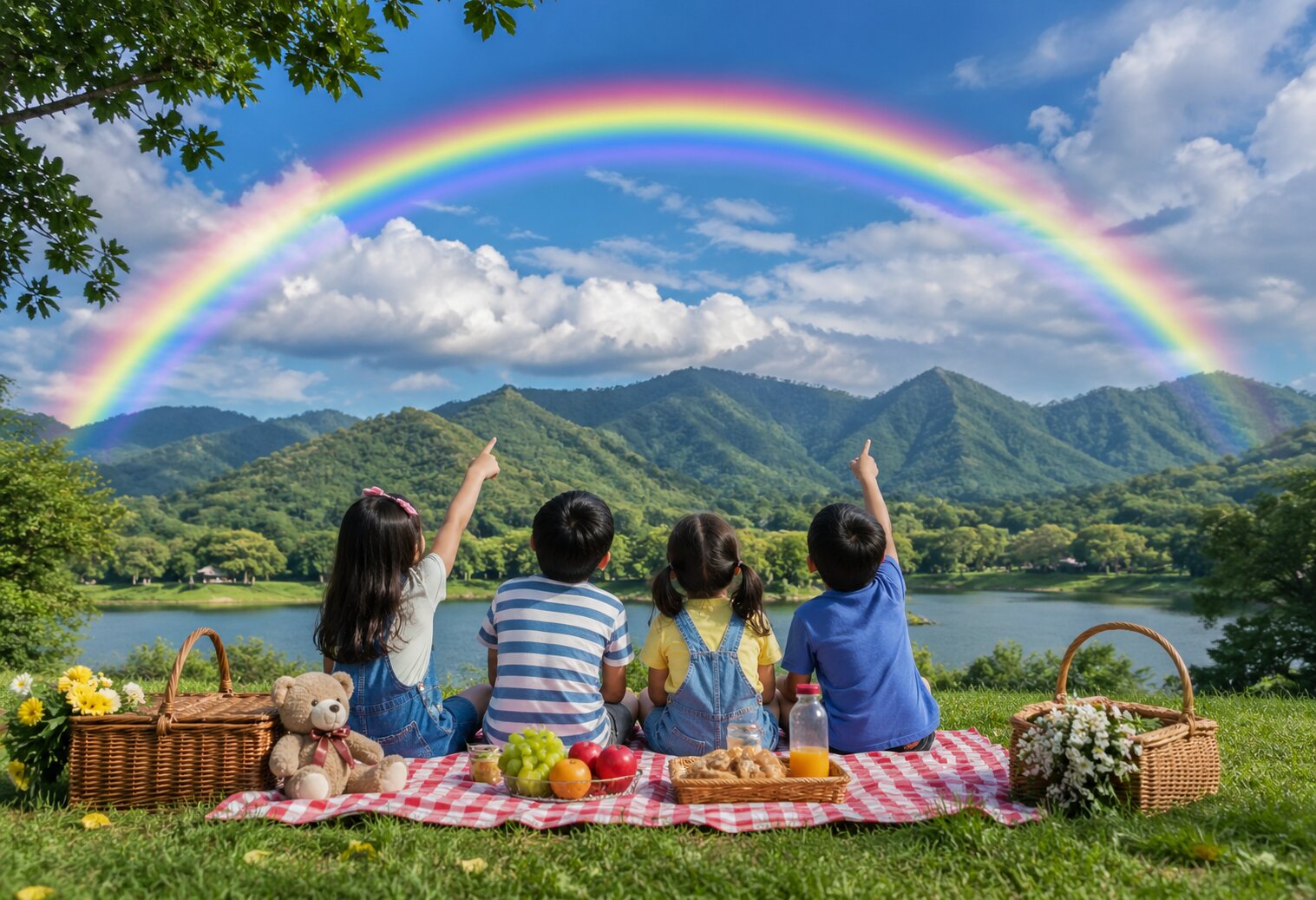
Rainbows are stunning natural phenomena formed when sunlight is refracted—bent—as it passes through airborne water droplets. These droplets act like tiny prisms, separating the light into its different colours and creating a vibrant, multicoloured arc across the sky. You can spot a rainbow when the sun is shining, and there is rain nearby, filling the sky with a magical display of colours.
Rainbows have fascinated people for centuries, appearing in the myths and legends of cultures around the world. The scientific explanation, however, became clear thanks to Sir Isaac Newton in the 17th century. Newton discovered that when light passes through a prism, it separates into a spectrum of colours. His work led to the first scientific understanding of rainbows, now known as “Newton’s theory of the rainbow.”
Why Are There 7 Colours In A Rainbow?
The colours of the rainbow or the rainbow order are the following: red, orange, yellow, green, blue, indigo, and violet. There are 7 colours in a rainbow. These colours are typically referred to as the “spectrum” of light, and they are caused by the bending of light as it passes through water droplets in the air.
When white light, such as sunlight, passes through a prism or other transparent medium, it is separated into different colours because each colour has a different wavelength. All the colours of the rainbow, in order, have the shortest wavelengths to the longest wavelengths. Red has the longest wavelength, while violet has the shortest.
There are seven colours in the rainbow because the human eye is able to perceive these seven colours as separate and distinct. However, it is possible to see even more colours beyond the seven colours of the rainbow by using instruments such as a spectroscope.
The primary colours of a rainbow are red, yellow, and blue. These colours are called primary because they cannot be created by mixing any other colours together. All other colours in the rainbow can be created by mixing different combinations of these primary colours.
For example, the colour orange can be created by mixing equal quantities of red and yellow, while the colour green can be created by mixing blue and yellow.
Table With 7 Rainbow Colours In Order
The table with the order of the colours in the rainbow helps children learn the sequence of colours they see in a rainbow. It lists each colour from red to violet so students can read, remember, and practise the correct order easily.
| ORDER | COLOUR NAME |
| 1 | Red |
| 2 | Orange |
| 3 | Yellow |
| 4 | Green |
| 5 | Blue |
| 6 | Indigo |
| 7 | Violet |
Seven Colours of the Rainbow and Their Meanings
The colours of the rainbow, in the correct order, are red, orange, yellow, green, blue, indigo, and violet. Each colour has its own meaning and symbolism:
1. Red
Red is a powerful colour that represents love, passion, and warmth. It is the colour of blood, symbolising life, vitality, and strong emotions. Red also signifies courage and determination, making it a dynamic and energising hue.
2. Orange
Orange is a vibrant and energetic colour, symbolising enthusiasm, joy, and creativity. It evokes feelings of excitement and adventure, and its connection to the sun highlights positivity, encouragement, and vitality.
3. Yellow
Yellow is a bright and cheerful colour, widely associated with happiness, optimism, and positivity. It also symbolises intellect, clarity, and wisdom, inspiring creativity and new ideas.
4. Green
Green is closely connected to nature and the environment, symbolising growth, renewal, and harmony. It represents balance, health, and freshness and is often associated with prosperity and tranquillity.
5. Blue
Blue is a calming and soothing colour, commonly associated with trust, loyalty, and stability. It represents peace, serenity, and reliability, and also evokes the vastness of the sky and the depth of the sea, inspiring contemplation and calmness.
6. Indigo
Indigo is a deep, rich colour linked to spirituality, intuition, and inner wisdom. It symbolises mystery, depth, and perception, encouraging introspection and a sense of wonder about the unknown.
7. Violet
Violet is a colour that sparks creativity and imagination, while also representing spirituality, dignity, and royalty. It is often linked to transformation, inspiration, and a sense of mystery, making it both uplifting and majestic.
Importance of Rainbow Colours in Daily Life
Rainbow colours play a significant role in our daily lives, far beyond their captivating appearance in the sky. They influence our emotions, moods, and even our choices in clothing, design, and art. Each colour carries its own psychological impact—red can energise and motivate us, while blue offers calm and reassurance. In marketing and branding, rainbow colours are used to attract attention, convey positivity, and foster inclusivity. Additionally, the spectrum of colours is essential in education, helping children learn about science, diversity, and creativity. By surrounding ourselves with a variety of colours, we not only brighten our environments but also enrich our experiences and express individuality.
How Can You Create A Rainbow?
Here are some ways you can create a rainbow:
1. Creating Rainbows With Prisms
A prism is a transparent, triangular object with flat sides. When white light passes through a prism, it bends (refracts) and splits into its various colours, displaying the full spectrum as a vivid rainbow. This visually demonstrates how light contains all the colours of the rainbow.
2. Making Rainbows With A Spray Bottle
Fill a spray bottle with water and spray a fine mist into the air while facing a light source, such as the sun. The tiny water droplets act like miniature prisms, bending and separating the light into a beautiful arc of rainbow colours visible in the mist.
3. Viewing Through A Crystal/Diamond
Crystals and diamonds can refract light just like a prism. When you hold a crystal or diamond up to sunlight or another bright light source, it will split the light into a dazzling pattern of rainbow colours that dance across nearby surfaces.
4. Using A Rainbow Maker
A rainbow maker is a fun device that uses a spinning crystal or prism to scatter sunlight into a spectrum of colours, creating rainbows around a room. These devices are often solar-powered and can be found online or in speciality stores, adding a magical touch to your space.
5. Observing A Natural Rainbow
Natural rainbows appear when sunlight shines through raindrops in the atmosphere, usually after a rain shower, while the sun is still out. The raindrops act as tiny prisms, refracting and reflecting the sunlight to form a large, colourful arc across the sky. The classic sequence is red at the top and violet at the bottom, creating a breathtaking natural display.
Why Is It Called VIBGYOR?
The term VIBGYOR is an acronym formed from the first letters of the seven colours that appear in a rainbow: Violet, Indigo, Blue, Green, Yellow, Orange, and Red. This sequence represents the order in which the colours are arranged in the visible spectrum. Using VIBGYOR makes it easy to remember and recall the colours of the rainbow in the correct order.
Easy and Simple Ways to Remember the Colours of Rainbows
Here are a few easy and simple ways to help kids remember the colours of the rainbow:
1. Mnemonics
A mnemonic is a phrase or acronym that helps kids remember something by associating it with a familiar word or phrase. For example, the phrase “Roy G. Biv” can help kids remember the colours of the rainbow in the perfect order: Red, Orange, Yellow, Green, Blue, Indigo, and Violet.
2. Visual Aids
A visual aid, such as a rainbow chart or a picture, can help kids remember the colours of the rainbow. They can look at the chart or picture and try to memorise the order of the colours.
3. Practice
Encourage kids to practice remembering the colours of the rainbow by quizzing them or asking them to recite the colours in order. The more they practice, the easier it will become for them to remember.
4. Songs Or Rhymes
Many songs and rhymes can help kids remember the colours of the rainbow. For example, the song “I Can Sing a Rainbow” is a popular choice for teaching kids the colours of the rainbow.
FAQs
1. In Which Shape Does The Rainbow Appear?
Rainbows typically appear as an arc, or a curved line, in the sky. The bending of any light causes the shape of the rainbow as it passes through water droplets in the air.
The rainbow is typically shaped like an arc because the water droplets that create the rainbow are not all the same size. Larger water droplets tend to refract light more, causing it to bend more sharply and creating the curved shape of the rainbow.
2. Is It Possible To See All The Colours Of The Rainbow Together?
It is not possible to see all the colours of the rainbow together in a single beam of light because the colours of the rainbow are caused by the refraction, or bending, of light as it passes through water droplets in the air. When light is refracted through a prism or other transparent medium, it is separated into different colours because each colour in the rainbow has a different wavelength.
To see all the colours together, you would need to look at a spectrum of light that spans the entire rainbow. This can be achieved using a spectroscope, a scientific instrument that measures wavelengths of light.
Alternatively, you can create a rainbow effect by shining a white light through a prism or other transparent medium, such as a crystal or a diamond. This will cause the light to be refracted and separated into its different colours, creating a rainbow effect.
3. Do The Colours Of The Rainbow Change?
The colours of the rainbow do not change, but their perception can be affected by various factors. For example, the colours of the rainbow can appear more or less vibrant depending on the amount of light available. The colours may also appear different depending on the angle at which you are viewing the rainbow.
In addition, the colours of the rainbow may appear differently to different people. This is because the human eye is sensitive to different wavelengths of light, and some people may be more sensitive to certain colours than others.
Overall, the colours of the rainbow are a fixed part of the visible spectrum and do not change. They are caused by the refraction, or bending, of light as it passes through water droplets in the air, and the colours are always in the same order: red, orange, yellow, green, blue, indigo, and violet.
Teaching kids about rainbows can be a fun and engaging way to introduce them to the concepts of light and colour. You can go on a rainbow hunt, experiment with colour, read books about rainbows, or even have your preschooler watch educational videos to learn about this amazing natural phenomenon.
Also Read:
Rainbow Stamping Craft for Kids
Bird Names for Preschoolers and Children
Things that are Red in Colour for Children