

- List Of Common 3-Letter Words Starting With U
- More 3-Letter ‘U’-Words
- 3-Letter Action Words That Start With U
- 3-Letter Everyday Objects That Start With U
- Three-Letter Animal Names That Start With U
- Positive Three-Letter Words That Begin With U
- Three-Letter Nouns Beginning With U
- 3-Letter Adjectives Starting With U
- Sentences Using Three-Letter U Words
- Activities To Teach 3-Letter Words Starting With U For Kids
- FAQs
Last Updated on November 5, 2026
Use a spoon, pour tea from an urn, say “umm” while thinking 3-letter words that start with U turn up in some genuinely ordinary moments of a child’s day, even though U isn’t a letter many English words begin with.
Thank you for reading this post, don't forget to subscribe!
This guide works through three-letter words starting with U for students, covering every genuine, child-friendly word available, along with grouped tables, example sentences and hands-on activities built around U.
List Of Common 3-Letter Words Starting With U
Open nearly any children’s book and a few of these 3-letter words beginning with U are bound to turn up within the first few pages.
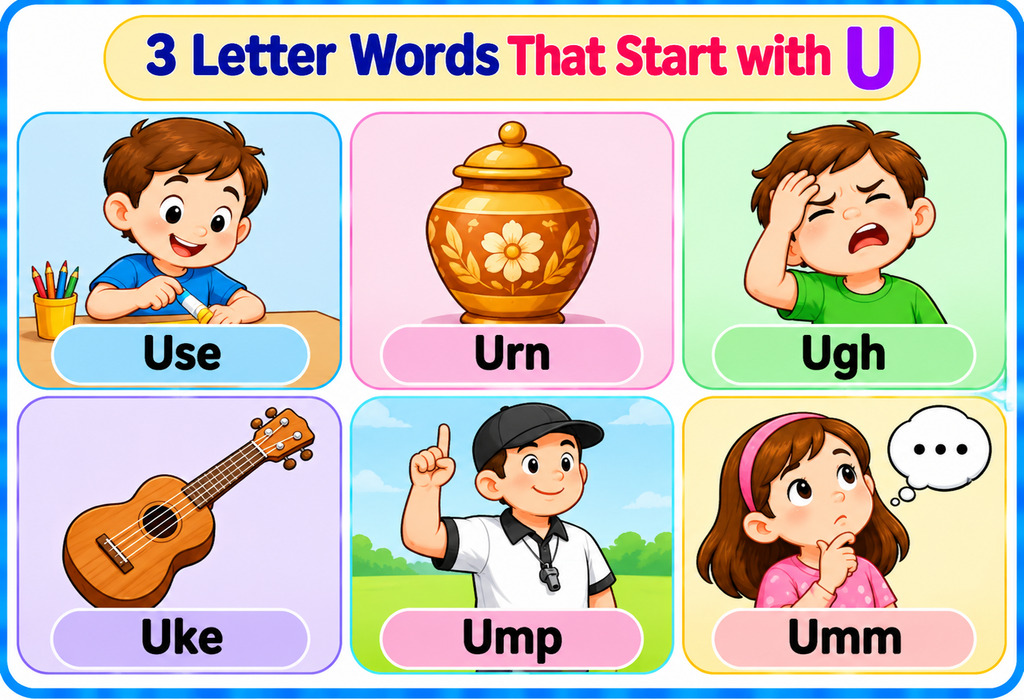
- Use – To put something to a purpose.
- Urn – A tall container, often used for holding ashes or serving hot drinks.
- Ugh – A sound made to show disgust or frustration.
- Uke – An informal short word for ukulele.
- Ump – An informal short word for umpire.
- Umm – A sound people make while pausing to think.
More 3-Letter ‘U’-Words
“Ute,” short for utility vehicle, rounds out the list for children ready to meet one more genuine word beyond the common set above.
| Ute |
3-Letter Action Words That Start With U
“Use” stands alone here, describing something a child does with an object rather than naming the object itself.
| Use |
3-Letter Everyday Objects That Start With U
An urn on a shelf or a uke propped in the corner of a bedroom are the two genuine 3-letter U words this short list can offer as everyday objects.
| Urn | Uke |
Three-Letter Animal Names That Start With U
U doesn’t lend itself to animal names the way some other letters do, so young readers won’t find one in this group — but there’s still plenty to explore above.
Positive Three-Letter Words That Begin With U
U doesn’t offer an obviously cheerful word at exactly three letters, but “use” carries a quietly positive sense of being helpful or put to good purpose.
| Use |
Three-Letter Nouns Beginning With U
A container, an instrument, an official at a match these three nouns each name something real enough for a child to picture or point to.
| Urn | Uke |
| Ump |
3-Letter Adjectives Starting With U
U doesn’t offer much in the way of describing words at exactly three letters, so young readers won’t find an example here but there’s still plenty to explore in the word lists and activities above.
Sentences Using Three-Letter U Words
A three-letter word that starts with U sticks best once a child sees it doing a real job inside a sentence. Try these together and ask your child to spot the U word each time.
- Can I use your pencil for a moment?
- Grandma keeps an urn of tea warm on the table.
- “Ugh,” he said, pulling a face at the broccoli.
- Dad strummed a few notes on his uke.
- The ump called the player out at first base.
- “Umm,” she said, trying to remember the answer.
- I use my toothbrush every morning and night.
- The old urn sat on the mantelpiece.
- She learned to play “Happy Birthday” on the uke.
- He said “umm” three times before answering.
Activities To Teach 3-Letter Words Starting With U For Kids
With fewer words to draw on, these 3-letter words starting with U for kindergarten and preschoolers lean on repetition through a small handful of memorable scenes.
1. Uke Strum Along
Let children gently strum a real or toy ukulele while singing a familiar nursery rhyme together. Pausing to say “uke” before each turn links the word to a genuinely fun, musical moment.
2. Umpire For A Day
Set up a simple throwing or rolling game, like beanbags into a hoop, and let each child take a turn being “ump,” calling out whether a toss landed in or out. This gives the word a real job within a game, rather than just a definition to memorise.
3. Use It Up Sorting
Gather a few household items nearing the end of their use, like a nearly empty glue stick or a worn-down crayon, and talk about how each one still has a “use” left in it. Children sort items into “still useful” and “all used up” piles, linking the word to something tangible.
4. Ugh Face Mirror
Hold up a mirror and have children pull their best “ugh” face, like they’ve just tasted something sour or seen something yucky. Talk about what other words might describe that same feeling, helping “ugh” connect to a genuine, familiar expression.
5. Umm Thinking Pause
Ask children a few gently tricky questions, like “what’s the opposite of up?”, and encourage them to say “umm” out loud while they think rather than staying silent. This normalises “umm” as a real, useful pause word rather than something to avoid.
FAQs
1. Why Does English Have So Few Three-Letter U Words Compared To Other Letters?
U mostly works as a vowel sound buried in the middle of English words, rather than leading a word on its own, which limits how many genuine words can start with it. This puts U in a similar position to letters like K and V earlier in this series.
2. Is “Uke” A Real Word Or Just Slang?
“Uke” began as informal slang but has become widely accepted as a standard short form of “ukulele,” appearing in dictionaries and everyday conversation alike. It’s a good example to share with children of how a nickname for something can eventually become a proper word itself.
3. Why Does “Ugh” Not Follow The Usual Spelling Rules?
“Ugh” is what’s known as an interjection, a word that exists purely to express a sudden feeling, which is why its spelling doesn’t follow typical phonics patterns. Pointing this out helps children understand that a small group of expressive words work differently from regular nouns and verbs.
4. Is “Ump” Only Used In Baseball?
Mostly, yes, since “ump” is most familiar from baseball and cricket, where an umpire makes calls during a match. It’s a useful word to introduce alongside watching or playing a simple game, where the role makes immediate sense.
5. Is “Umm” Really Considered A Proper Word?
Yes, “umm” is a recognised filler word in English dictionaries, used across languages in some form to signal a pause in speech. It’s a handy, low-pressure word to point out to children, since they likely already say it without realising it counts as real vocabulary.
Though U offers fewer words than busier letters in this series, use, urn and uke still give children genuinely useful vocabulary tied to everyday moments, from a quick strum to a thoughtful pause. Letting these words surface naturally through play works better than trying to stretch such a short list any further.
Related Articles:
| 3 Letter Words Starting With ‘A’ | 3 Letter Words Starting With ‘I’ |
| 3 Letter Words Starting With ‘O’ | 3 Letter Words Starting With ‘Z’ |
| 3 Letter Words Starting With ‘S’ | 3 Letter Words Starting With ‘Q’ |