


- What Does The Verb “To Do” Mean?
- Examples Of The Verb “To Do”
- Different Forms Of The Verb “To Do”
- Yes Or No Questions With The Verb “To Do”
- ‘Wh..’ Questions With The Verb “To Do”
- Activities That Will Help Your Kids Learn The Verb “To Do”
- What Is the Difference Between The Verbs “To Do” and “Make”?
- FAQs
Last Updated on September 16, 2026
The verb ‘to do’ is one of the most frequently used words in the English language, showing up in questions, negatives, and everyday statements far more often than most children realise. Even before kids learn to name it as a verb, they’re already using it constantly, in sentences like “I do my homework” or questions like “Do you want to play?” Understanding how this small but powerful word works is an important step in building stronger English grammar skills.
Thank you for reading this post, don't forget to subscribe!
Unlike most verbs, the English verb ‘to do’ can function in more than one way, sometimes as a main verb showing an action, and other times as a helping verb used to form questions or negative sentences. This article breaks down the different types and uses of “do,” along with simple examples to help children understand exactly when and how to use it correctly in their everyday speech and writing.
What Does The Verb “To Do” Mean?
At its core, the verb “to do” means to perform an action, complete a task, or carry something out, as in sentences like “I do my chores every evening.” However, its meaning shifts depending on how it’s used, since it can also act as a helping verb that supports another verb in a sentence, without carrying much meaning of its own. Because of this dual role, understanding the conjugation of the verb ‘to do’ across different tenses- do, does, did, and done- is essential for using it correctly, whether it’s forming a simple statement, asking a question, or making a sentence negative.
Examples Of The Verb “To Do”
Seeing the verb “to do” in action makes it much easier to understand how to use the verb ‘to do’ correctly in different situations. Here are a few examples to help illustrate its various uses.
- Can you do me a favour? Yes, tell me what you need!
- How do you make this science project work?
- How are you doing today? I’m doing great, thank you for asking!
- I do clean my room quite often, especially on weekends.
- They do their chores every Sunday when they get home from school.
- She likes to do charity work at the local shelter.
- Do you know the answer to this question?
- We do our homework together every evening after dinner.
- He didn’t do well on his last spelling test, but he’s practising harder now.
- Did you do the dishes before you left for school this morning?
Different Forms Of The Verb “To Do”
Like other verbs, “to do” changes form depending on the tense and subject being used. Here’s a simple breakdown of its different forms.
1. Simple Present Form: Do/Does
This is one of the most common forms of the verb and is used to make the simple present of “To Do” or to form the present tense. Depending on what the subject is, there are two types of ways to write this – do and does.
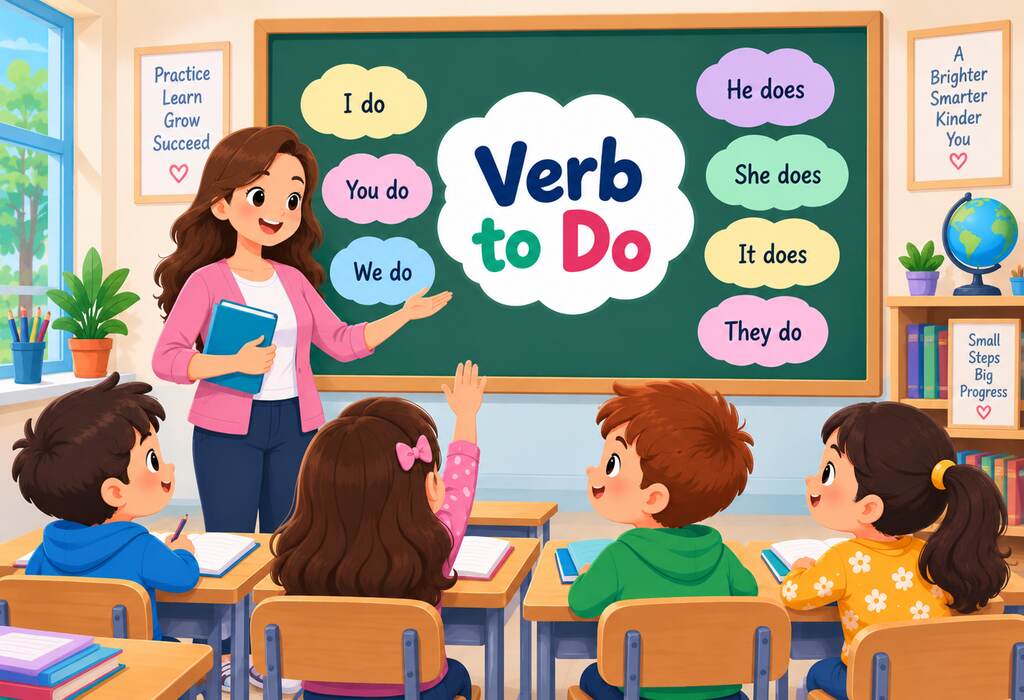
- I do
- You do
- He/She/It does
- We do
- You do
- They do
Examples Of The Verb “To Do” In Simple Present Tense
- I do like to eat meat once a week.
- He does the dishes every night, as a rule.
- They do volunteer work once a month.
2. Simple Past Form: Did
The past form of this verb is ‘did’. It is usually used to ask questions and make negative or affirmative sentences in the simple past form.
- I did
- You did
- He/She/It did
- We did
- You did
- They did
Examples Of The Verb “To Do” In Simple Past Form
- I did drink the juice.
- Did you go to work today?
- We did go for a picnic last Saturday.
- How did you manage to break this toy?
- Did you go to the gym today?
3. Past Participle Of “To Do”: Done
The past participle of the verb “To Do” is the word – Done. This is used to show an action that is complete. It can also be used as an adjective when a person wants to express that something has been completed.
Examples Of The Verb “To Do” In Past Participle
- Are you done with your work today?
- I am done sleeping!
- I have done it – I got the highest marks today!
4. Progressive Tense Of “To Do”
The progressive tense of the verb “To Do” is for a continuous activity that began sometime in the past and still continues in the present (or has just been finished very recently).
- Am doing
- Are doing
- Is doing
Examples Of The Verb “To Do” In The Progressive Tense
- I have been doing this dance move for 4 years now.
- Michael has been doing great at school!
- Don’t worry; you are doing great!
5. Future Tense Form Of “To Do”: Will Do
The future form of this verb is created with the word ‘will’ and the verb ‘do’ joined together. It is used to speak about things or actions that are yet to happen in the future.
- I will do
- You will do
- He/She/It will do
- We will do
- They will do
Examples Of The Verb “To Do” In Future Tense
- Yes, I will do this work today.
- They will do the needful when we ask them to.
- She will do it differently if you ask her.
6. Negative Sentences With The Verb “To Do”
Since a lot of the verbs do not have negative forms of their own, their negative forms are created and built over time with the “To Do” verb. The negative of the “To Do” verb in the simple present is do not or don’t and does not or doesn’t. It is did not or didn’t in the simple past.
- I do not – I don’t – I didn’t
- He/She/It does not – He/She/It doesn’t – He/She/It didn’t
- We do not – We don’t – We didn’t
- You do not – You don’t – You didn’t
- They do not – They don’t – They didn’t
Examples Of The Verb “To Do” With Negative Sentences
- No, you didn’t clean your room today.
- They do not like to eat vegetables.
- She doesn’t like to sing!
- I don’t miss my old home at all.
- We do not drink water from this tap.
Yes Or No Questions With The Verb “To Do”
Children need to understand how to frame yes-or-no questions using this verb, since it plays a key role in everyday English conversation. Here are some example questions to help them understand how to construct similar ones on their own.
- Do you like chocolate?
- Did he visit the palace when he went to Paris?
- Didn’t she say she likes to sing?
- Does this dog like to play catch?
- Do I like to eat sushi?
- Doesn’t she take a nap every afternoon?
- Does he like to swim in the pool?
- Did they finish their homework before dinner?
- Do we need an umbrella for the walk?
- Didn’t you say you wanted to join the art class?
‘Wh..’ Questions With The Verb “To Do”
When we talk about creating wh-questions, the structure is very simple, depending on whether it is the past or present. You just need to add “To Do” in front of every subject. Let us look at some examples below.
- When do you go to bed?
- What is your favourite colour?
- Why is the Earth round and not flat?
- Who is the father of our nation?
- Where did you go on a holiday?
- When does she go back to school?
- What are primary colours?
- Who is your favourite person?
- Which breed of dog is this?
- Why aren’t you wearing a sweater?
- What is your favourite toy?
- Why don’t you go out and play?
Activities That Will Help Your Kids Learn The Verb “To Do”
Learning more about this particular verb is important for every child, helping them build stronger sentences and communicate more confidently in English. Here are a few fun activities to make the learning process easier.
1. The Yes And No Game
This is a fun, interactive game to play with your little one. Draw simple pictures of people doing different activities, or use flashcards featuring various professions to make it even more engaging. Pick up one card or drawing and ask your child a yes-or-no question about what the subject is doing.
Example: “Is he painting a picture of a house?” “Yes, he is!”
2. The Question Game
Another great way to build familiarity with this verb is the question game, where you say a simple statement, and your child has to convert it into a question using “do,” “does,” or “did.”
Example: “She played with her cat yesterday.” becomes “Did she play with her cat yesterday?”
3. Passing The Parcel
In this twist on the classic party game, ask your child to think of a question using the verb “to do,” and whoever they pass the question to must answer using the same verb. This keeps things playful while encouraging creativity in how the verb can be used.
4. Fill InTheBlanks
Write out a few simple sentences with the correct form of “do” missing, and ask your child to fill in the blank with “do,” “does,” or “did,” depending on the subject and tense.
Example: “She ___ her homework every evening.” (does)
5. Spot The Mistake
Write a few sentences using the verb “to do” incorrectly, mixing up tenses or subject agreement, and challenge your child to spot and correct the mistake.
Example: “He do his homework yesterday.” should be corrected to “He did his homework yesterday.”
What Is the Difference Between The Verbs “To Do” and “Make”?
Many children mix up “do” and “make” since both can relate to performing an action, but they’re used quite differently in English. Here’s a simple comparison to help tell them apart.
| VERB | USED FOR | EXAMPLES |
| Do | General actions, tasks, duties, and activities without creating something physical | Do your homework, do the dishes, do exercise, do a favour |
| Make | Creating, producing, or building something new | Make a cake, make a plan, make a mistake, make noise |
FAQs
1. Can The Verb “To Do” Be Used On Its Own Without Another Verb?
Yes, “do” can stand alone as a main verb, as in “I do my chores every day,” where it directly describes the action being performed.
2. Why Do We Say “Doesn’t” Instead Of “Don’t” With He, She, Or It?
This follows a basic subject-verb agreement rule in English: singular subjects like he, she, and it require “does” or “doesn’t,” while plural subjects and I/you/we/they use “do” or “don’t.”
3. Is “Do” Ever Used To Add Emphasis In A Sentence?
Yes, “do” can be used for emphasis in positive sentences, such as “I do love this book,” which stresses the feeling more strongly than simply saying “I love this book.”
4. Why Do Some Questions Use “Do” While Others Don’t Need It At All?
Questions with regular verbs typically need “do,” “does,” or “did” to help form them, like “Do you like pizza?”, while questions with the verb “to be” don’t need it, such as “Are you hungry?”
The verb “to do” may seem small, but it plays a big role in everyday English, showing up in questions, negatives, and simple statements alike. With regular practice through examples, games, and everyday conversation, children can learn to use its different forms naturally and confidently in their own speech and writing.
Also Read:
Verb “To Have” for Kids
Modal Verbs for Children
Verb ‘To Be’ with Examples for Kids