



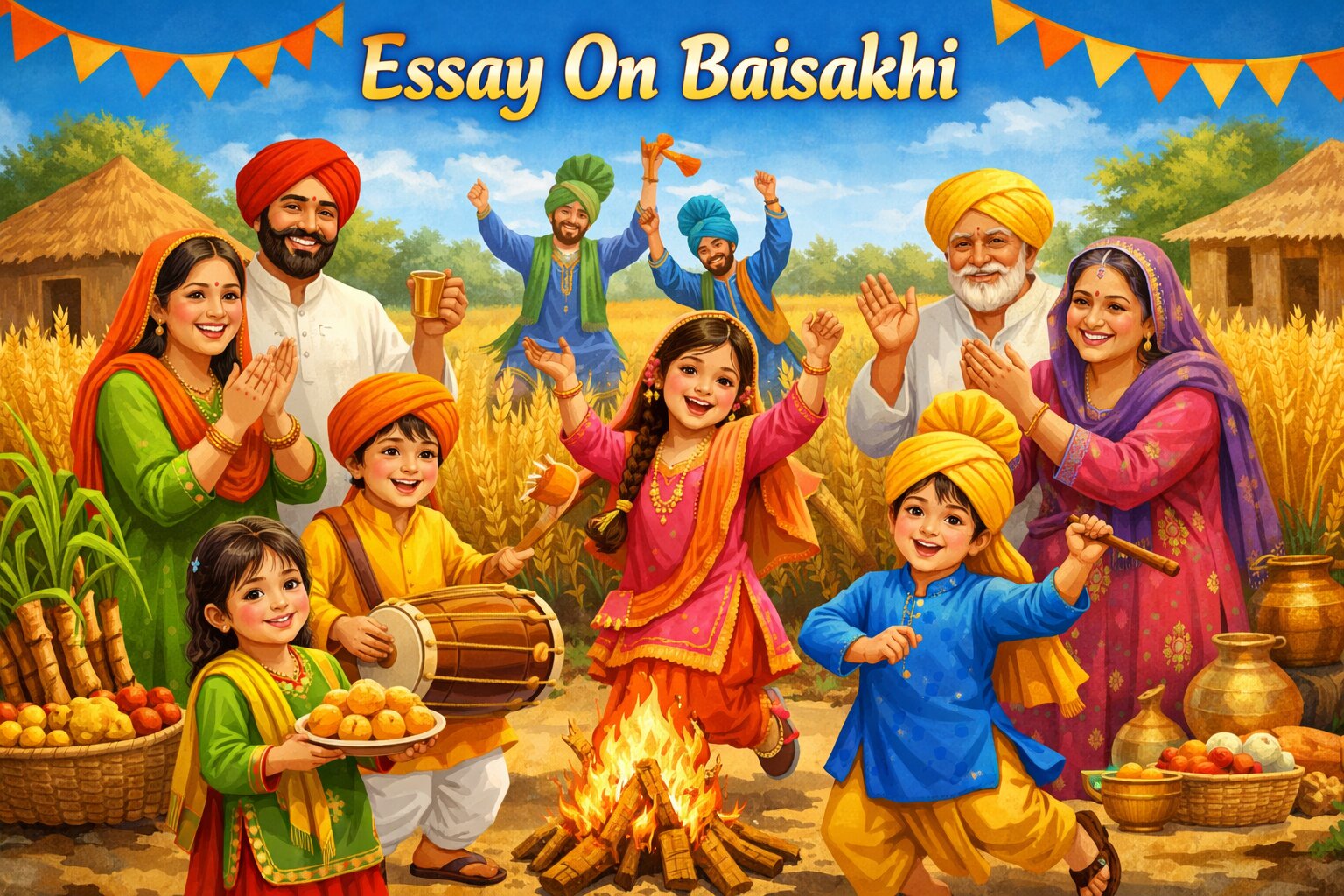
Baisakhi is a vibrant festival celebrated with joy across India, especially in Punjab, marking the Sikh New Year and the harvest season. This collection offers multiple essays on Baisakhi in English tailored for students and children, perfect for school assignments or festival projects. These essays highlight the cultural significance of Baisakhi, from its historical roots in the formation of the Khalsa by Guru Gobind Singh to its lively traditions, such as folk dances and feasts.
Thank you for reading this post, don't forget to subscribe!
Children will enjoy learning about Baisakhi through simple, engaging narratives that capture the spirit of gratitude for bountiful crops. Whether a short paragraph or a detailed essay on Baisakhi in English, these writings inspire appreciation for Sikh heritage and rural festivities. Download and share them to celebrate unity, faith, and renewal.
Key Points To Remember When Writing An Essay On Baisakhi
Follow these tips to craft a strong composition on Baisakhi that captivates readers. Include key facts such as harvest celebrations and Sikh history to create an engaging structure.
- Start with a festive hook: Begin your Baisakhi composition by describing joyful dances like Bhangra or golden wheat fields to grab attention.
- Cover historical roots: Mention Guru Gobind Singh forming the Khalsa in 1699 on Vaisakhi, marking Sikh strength and equality.
- Highlight harvest joy: Explain how Punjab farmers celebrate the spring harvest with feasts of ‘kadah prasah’ and gratitude to God.
- Include traditions: Describe folk dances, processions to Gurdwaras, and community ‘langars’ that unite people.
- Add cultural significance: Note Baisakhi as the Sikh New Year, symbolising renewal, faith, and rural prosperity.
- End with a message: It should reflect on unity, hard work, and the preservation of traditions for future generations.
- Keep it simple and structured: use short paragraphs and vivid words in school essays.
5 Lines On Baisakhi
Discover a short and simple essay for classes 1 and 2 with these 5 lines on Baisakhi. Perfect for young learners to recite or write about the joyful harvest festival.
- Baisakhi is a happy Sikh festival celebrated in April, marked by dances and feasts.
- Farmers in Punjab thank God for the golden wheat harvest.
- People wear bright clothes and perform energetic Bhangra dances.
- Guru Gobind Singh started the Khalsa on this day in 1699.
- Families enjoy kadah prasah and visit Gurdwaras together.
10 Lines On Baisakhi
Find a few lines on Baisakhi in this simple essay for classes 1, 2, and 3 with 10 easy points. These short sentences help young children learn about the festival’s joy and traditions.
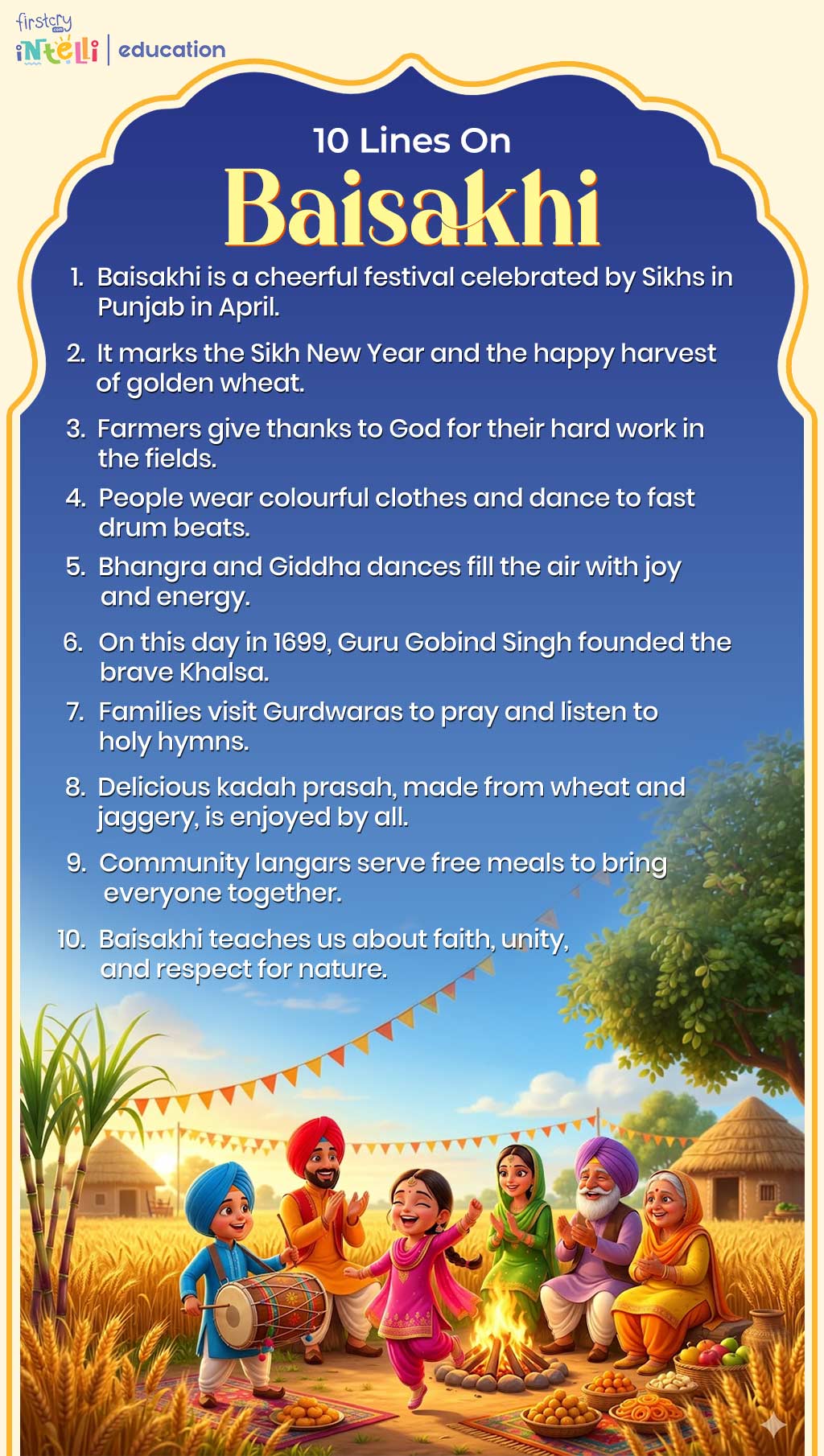
- Baisakhi is a cheerful festival celebrated by Sikhs in Punjab in April.
- It marks the Sikh New Year and the happy harvest of golden wheat.
- Farmers give thanks to God for their hard work in the fields.
- People wear colourful clothes and dance to fast drum beats.
- Bhangra and Giddha dances fill the air with joy and energy.
- On this day in 1699, Guru Gobind Singh founded the brave Khalsa.
- Families visit Gurdwaras to pray and listen to holy hymns.
- Delicious kadah prasah, made from wheat and jaggery, is enjoyed by all.
- Community langars serve free meals to bring everyone together.
- Baisakhi teaches us about faith, unity, and respect for nature.
Paragraph On Baisakhi
This short paragraph on Baisakhi captures the festival’s joy in a few sentences for young students. It highlights harvest celebrations, Sikh traditions, and community spirit in simple words.
Baisakhi is a vibrant Sikh festival celebrated on 13th or 14th April in Punjab, marking the harvest season and the Sikh New Year. Farmers rejoice in their bountiful wheat crops, offering thanks to God through deep prayers and joyous dances such as Bhangra and Giddha, all in colourful traditional attire. In 1699, Guru Gobind Singh Ji founded the Khalsa Panth on this auspicious day, symbolising courage and equality. Families visit Gurdwaras for kirtan and langar, sharing free community meals of kadah prasad made from wheat and jaggery. Baisakhi fosters unity, faith, and gratitude towards nature, bringing people together in celebration.
Short Essay On Baisakhi
Discover a short essay on Baisakhi perfect for classes 1, 2, and 3, blending harvest joy with Sikh heritage. These few lines introduce the festival’s lively traditions and spiritual meaning in simple words.
Baisakhi, a mid-April celebration, is Punjab’s vibrant harvest festival, igniting fields with folk energy and spiritual depth for Sikhs across generations. It honours ripe wheat crops while recalling a pivotal moment in faith that shaped community values.
Farmers, after tireless months under the sun, cut golden sheaves and gather for feasts of fresh produce, their laughter blending with dhol drums. Homes glow with mango leaf decorations, and children swing on jhoolas amid games like tug-of-war, capturing the simple thrills of rural life.
Back in 1699 at Anandpur Sahib, Guru Gobind Singh summoned fearless volunteers, baptising them as the Panj Pyare to birth the Khalsa—embodying baptism by steel, equality for all, and unwavering truth. This legacy turns Baisakhi into a beacon of resilience against injustice.
Streets pulse with nagar kirtans as devotees parade the Guru Granth Sahib amid floral tributes and chants. Gurdwaras brim with the warm sweetness of karah prasad and the inclusive spread of langar, drawing strangers into family circles. Evening mela fairs showcase crafts, wrestling bouts, and tales by bonfire light, knitting bonds of gratitude.
Through it all, Baisakhi whispers lessons of the rewards of hard work, nature’s generosity, and the power of unity, leaving hearts fuller and spirits soaring to the timeless rhythm of Punjab.
Long Essay On Baisakhi
Explore a long, in-depth essay on Baisakhi that details its rich history, traditions, and cultural impact, for students and young readers. This comprehensive piece weaves together harvest festivities and Sikh heritage in engaging detail.
Baisakhi, a radiant spring festival, lights up Punjab and northern India every April, blending the thrill of a bumper harvest with profound Sikh spiritual milestones. The festival marks a vibrant transition from spring to summer, celebrated with colourful fairs and community gatherings. It ushers in the New Year for many communities, filling hearts with gratitude, music, and shared feasts that echo across generations. Streets, homes, and villages are decorated with flowers and vibrant rangoli patterns, while families prepare traditional delicacies to share with neighbours and friends.
Importance Of Baisakhi
Baisakhi holds deep significance as a harvest thanksgiving, where farmers honour nature’s bounty after months of labour in sun-baked fields. For Sikhs, it symbolises unity, equality, and courage, rooted in the Khalsa’s formation, inspiring values of selfless service and communal harmony. Beyond agriculture, it fosters cultural pride through folk arts, reinforcing bonds in villages and cities alike.
History Of Baisakhi
The festival traces back to ancient harvest rites in Punjab, but its modern legacy began on April 13, 1699, at Anandpur Sahib. Guru Gobind Singh Ji, the tenth Sikh Guru, issued a bold call for heads, baptising five devoted Sikhs—the Panj Pyare—into the Khalsa Panth with amrit from a steel bowl. This act gave rise to a warrior-saint order clad in the five Ks, challenging oppression and promoting equality regardless of caste or creed. Over centuries, Baisakhi has evolved into a beacon of Sikh identity and resilience.
Celebrations of Baisakhi
Baisakhi comes alive through a series of rituals, dances, and communal activities that unite people in reverence and joy. The day often begins with the cleaning and decorating of homes, symbolising a fresh start and inviting prosperity. People dress in new clothes, often in bright hues of yellow and orange, which are considered auspicious and represent the blooming mustard fields of Punjab.
- Morning Prayers: Early dawn baths, followed by visits to Gurdwaras for kirtan and ardas, set a devotional tone.
- Nagar Kirtan Processions: Vibrant processions feature the Guru Granth Sahib on a flower-decked palanquin, accompanied by hymns and martial displays.
- Traditional Dances: Fields and streets host Bhangra and Giddha dances to dhol beats, performed in colourful phulkari attire.
- Community Langars: Langars serve kadah prasad, pinnis, sarson da saag, and makki di roti to all attendees.
- Mela Fairs: Fairs feature wrestling bouts, folk singing, children’s swings, rangoli, and bhangra competitions.
- Evening Gatherings: Bonfires and storytelling sessions share tales of gurus, culminating in reflection.
Celebrations Across India
While Punjab pulses with its core fervour, Baisakhi ripples nationwide as Vaishakhi, or regional harvest, joy. In Haryana and Himachal Pradesh, farmers echo Punjabi dances with local twists; Uttarakhand’s Jaat Naam celebrates sowing with ‘garhwali’ tunes. Assam’s Bohag Bihu is reflected in Bihu dances and feasts, while Bengal’s Poila Boishakh welcomes the year with sweet ‘mishti’ and pandal hops. Even in cities like Delhi and Mumbai, Gurdwaras host grand ‘akhand’ paths, drawing diverse crowds to embrace their universal spirit of renewal.
Baisakhi’s tapestry of faith, harvest, and festivity endures as a vibrant call to gratitude and unity. It reminds us that hard work blooms into abundance, and shared joys strengthen communities, ensuring their legacy dances on through time.
What Will Your Child Learn From A Baisakhi Essay?
A Baisakhi essay helps children learn about the festival’s lively mix of harvest celebrations and Sikh traditions. It explains how farmers in Punjab thank God for their golden wheat crops after months of hard work. Students in classes 1, 2, and 3 also learn about the important event in 1699, when Guru Gobind Singh Ji created the Khalsa Panth and the Panj Pyare, teaching lessons in courage, equality, and helping others.
By reading stories about Bhangra and Giddha dances to the sound of dhol drums, enjoying kadah prasad, and joining in community langars where everyone is welcome, children learn about unity, sharing, and respecting nature’s gifts. They also feel proud of traditions like nagar kirtans and mela fairs, and think about important lessons such as the rewards of hard work and living together peacefully. These essays make children curious about India’s many festivals and help them improve their language and cultural understanding in a fun way.
FAQs
1. How Can I Link Baisakhi’s Harvest To Sikh Values In An Essay?
Explain how ripe wheat fields teach sewa (selfless service) as farmers share crops via langar, tying to Guru Gobind Singh’s rejection of caste divisions, so your essay shows Baisakhi as a lesson in kirat karni (honest work) and vand chakna (sharing).
2. What Lesser-Known Regional Baisakhi Customs Fit A Long Essay?
Add how Himachal’s fairs feature akhada wrestling with prizes of dry fruits, or Uttarakhand’s Jaat Naam with bagpipe-like folk tunes honouring seeds, expanding your essay beyond Punjab to illustrate Baisakhi’s nationwide harvest spirit.
3. What Simple Activity Helps Learn Baisakhi Dates For Essay?
Cut paper into cards with key dates like “13 April” on one side and “Khalsa birth in 1699” on the other, then flip through them daily while saying the fact aloud to remember easily for your essay’s history part.
4. How Can Telling Stories Help Finish My Baisakhi Essay?
Sit with a friend, take turns telling one Baisakhi part like dances or feasts, write your bit on paper, read it aloud twice, and use it as your ending to say why the festival brings joy to all.
These Baisakhi essays in English equip students and children with simple tools to explore the joy of Punjab’s harvest and Sikh heritage through structured writing. From 10-line summaries to detailed 500-word pieces, FAQs, and learning activities, they spark creativity while teaching gratitude, unity, and cultural pride. Young writers can now craft their own vibrant essays, celebrating Baisakhi’s timeless spirit with confidence and fun.
Also Read:
Essay on Makar Sankranti
Pongal Essay for Children
Essay on Holi for Students and Children