



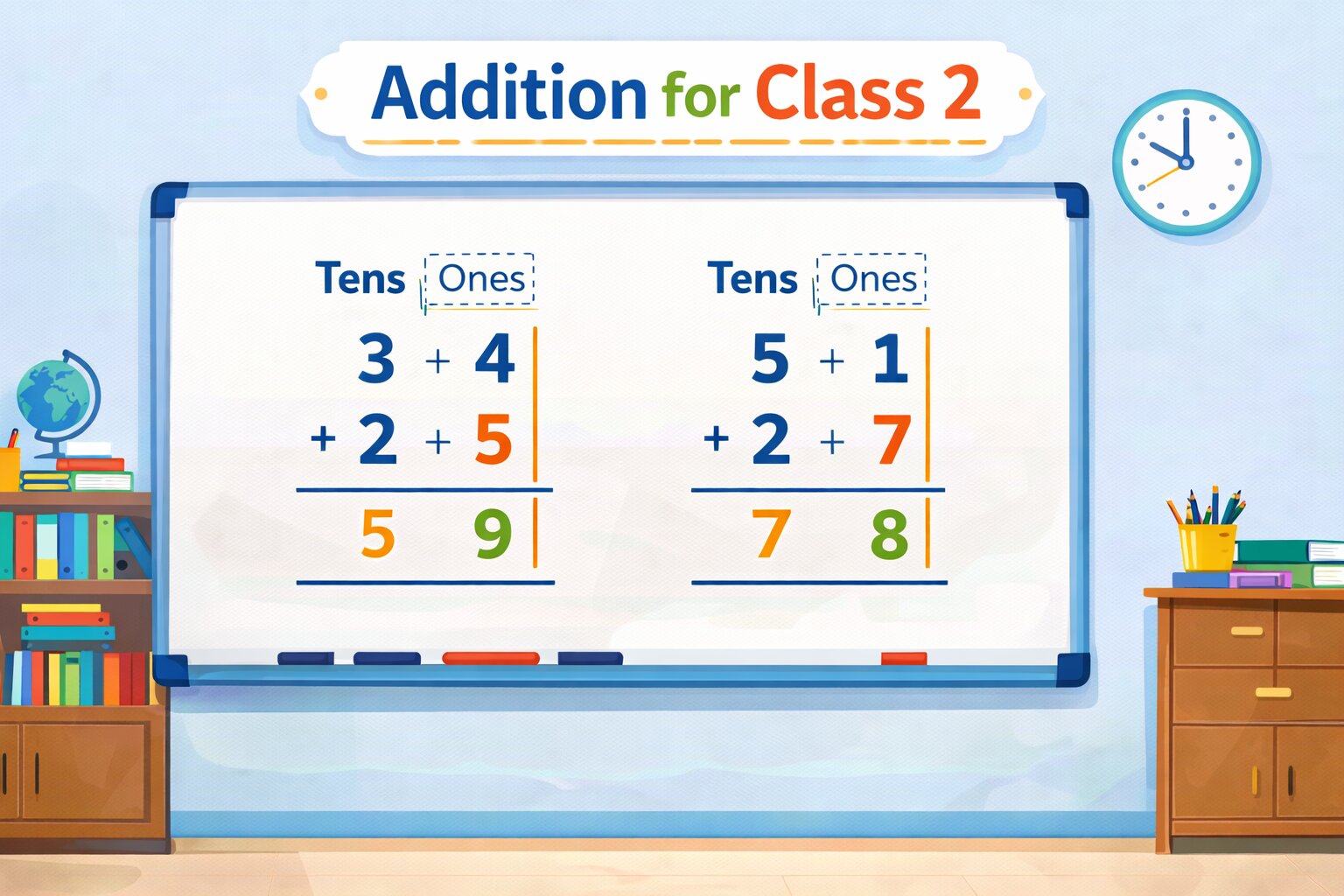
- Importance Of Learning Addition for Class 2 Kids
- 2 Digit Addition for Class 2
- 3 Digit Addition For Class 2
- Basic Carrying Addition for Class 2
- Addition Without Carry
- How To Teach Addition To Class 2?
- Mistakes Kids Should Avoid While Doing Addition
- Addition Word Problems for Class 2
- Practice Addition Worksheet for Class 2
Welcome to our guide on addition for class 2! At this stage, children build essential maths skills by mastering addition sums for class 2, from simple single-digit additions to exciting two-digit challenges. Addition isn’t just about numbers—it’s a fun way to solve everyday problems, like counting toys or sharing sweets with friends.
Thank you for reading this post, don't forget to subscribe!
In this article, we’ll explore easy methods, such as using fingers, number lines, and pictures, with clear examples to make learning a breeze. You’ll find step-by-step tips to help your child confidently grasp carrying over and word problems.
To practise at home or in class, download our free addition worksheet for class 2, packed with engaging exercises. Watch your little one’s confidence soar as they add up successes! Let’s make maths magical together.
Importance Of Learning Addition for Class 2 Kids
Discover why 2nd class addition is a cornerstone of early maths education in our section on the ‘Importance Of Learning Addition For Class 2 Kids’. We’ll explore how mastering how to add for class 2 builds vital skills for problem-solving and future learning success.
1. Builds Foundational Maths Skills
Addition teaches children to combine numbers confidently, forming the basis for subtraction, multiplication, and division later on. It helps them understand quantities in everyday situations, such as grouping toys or fruits.
2. Enhances Problem-Solving Abilities
Learning addition encourages logical thinking through word problems and real-life examples. Kids learn to break down challenges into simple steps, boosting their analytical mindset.
3. Boosts Confidence And Independence
Quick success with basic sums fosters a positive attitude towards maths. Children gain self-assurance, making them eager to tackle harder tasks without fear.
4. Supports Daily Life Applications
Addition skills apply to shopping, cooking, and sharing, making learning relevant. It prepares kids for practical decisions, like counting money or dividing snacks.
5. Develops Mental Agility
Regular practice sharpens memory and speed in mental calculations. This agility aids concentration and prepares children for timed activities in school.
2 Digit Addition for Class 2
In this section, children learn to add two-digit numbers without regrouping. This covers simple addition for class 2 methods and clear steps.
1. Lily has 14 apples, and Ravi has 12. How many apples do they have together?
Equation: 14+12=26
2. A toy shop sold 25 cars on Monday and 32 cars on Tuesday. How many cars did the shop sell in the two days?
Equation: 25+32=57
3. There are 16 books on one shelf and 23 on another. How many books are there altogether?
Equation: 16+23=39
4. Maya collected 18 marbles, and her brother collected 21 marbles. How many marbles do they have in total?
Equation: 18+21=39
5. A school bus carried 24 children in the morning and 15 children in the afternoon. How many children did the bus carry in one day?
Equation: 24+15=39
3 Digit Addition For Class 2
In this section, children are introduced to 3-digit addition sums with clear, step‑by‑step examples. The focus is on building confidence in adding three‑digit numbers without regrouping, using simple language suitable for class 2.
1. There are 124 red balloons and 235 blue balloons at the party. How many balloons are there altogether?
Answer: 124+235=359
2. A toy shop has 213 toy cars and gets 156 more. How many toy cars are there now?
Answer: 213+156=369
3. A school library has 242 storybooks and buys 137 more. How many storybooks are there now?
Answer: 242+137=379
4. A fruit seller kept 135 apples in one basket and 242 apples in another. How many apples are there in total?
Answer: 135+242=377
5. A farmer grew 221 carrots in one field and 168 in another. How many carrots did the farmer grow altogether?
Answer: 221+168=389
Basic Carrying Addition for Class 2
Basic carrying addition teaches children to add numbers when the sum in one column is 10 or more. This part focuses on carry-over addition with simple two‑digit examples for class 2.
- Example 1
8 + 7 = 15; 5 is written in the ones place, and 1 is carried to the tens place. - Example 2
9 + 5 = 14; 4 is written in the ones place, and 1 is carried to the tens place. - Example 3
6 + 8 = 14; 4 is written in the ones place, and 1 is carried to the tens place. - Example 4
7 + 6 = 13; 3 is written in the ones place, and 1 is carried to the tens place. - Example 5
5 + 9 = 14; 4 is written in the ones place, and 1 is carried to the tens place.)
Addition Without Carry
Addition without carry helps children add numbers where the total in each column stays 9 or less. This section focuses on addition for class 2 without carrying, using easy two‑digit examples to build confidence and accuracy.
- 24+35=59
- 13+26=39
- 32+47=79
- 21+14=35
- 43+25=68
How To Teach Addition To Class 2?
Teaching addition to class 2 is most effective when lessons are simple, visual, and hands‑on. This section suggests an addition activity‑based approach so children can learn through play, real‑life examples, and step‑by‑step practice.
1. Add With Fingers And Counters
Let children use their fingers or small objects, such as beads or buttons, to add two groups and count the total. This hands‑on activity helps them see that addition is about “putting together” and builds number sense naturally.
2. Number Line Jumps
Draw a number line and ask children to make “jumps” to add numbers, for example, start at 5 and jump 3 steps forward to reach 8. This visual activity makes addition concrete and strengthens their understanding of counting on.
3. Story Sum Cards
Prepare simple picture or word cards with small addition stories, like “3 birds + 2 more birds”. Children read or listen, then solve the sum; this turns an addition activity into a fun, language‑rich game.
4. Dice Or Spinner Addition
Have children roll two dice or spin two spinners and add the numbers that appear. Repeating this activity builds speed, confidence, and automatic recall of basic addition facts.
5. Worksheet Treasure Hunt
Hide small addition sums around the classroom or room, and give children a worksheet for them to write the answers once they find each sum. This active addition activity combines movement with practice, keeping young learners engaged.
Mistakes Kids Should Avoid While Doing Addition
Children often make small but repeated mistakes in addition, which can slow their progress. This section highlights common errors in addition and simple ways kids can avoid them with careful practice.
1. Wrong Column Alignment
Children sometimes add tens to ones or write numbers in the wrong columns, which changes the answer. To avoid this, always write numbers neatly in columns (ones under ones, tens under tens) and use lined paper or squared grids.
2. Forgetting To Carry Over
When the sum in the ones column is 10 or more, some kids forget to carry the extra ten to the tens column. Practising step‑by‑step addition and underlining the “carry” number helps them remember to add it to the next column.
3. Mixing Up Addition And Subtraction
Young learners may read the “+” sign as “−” or solve the problem backwards. Encourage them to say the symbol aloud (“plus”) and underline the operation sign before starting each sum.
4. Wrong Total In Single-Digit Sums
Errors like saying 7+5=11 instead of 12 usually come from weak basic facts. Regular practice with flash cards, number rhymes, or simple online games strengthens quick recall of small addition facts.
5. Skipping The Final Answer
Some children stop after adding one column and do not write the full answer. Teach them to always check both columns and write the complete number in the answer box, even if one column is 0.
Addition Word Problems for Class 2
Addition word problems for class 2 turn number sums into short, relatable stories children can understand. Here are examples with simple situations like toys, fruits, and friends to make addition both clear and enjoyable.
- Priya has 12 crayons, and her friend gives her 7 more. How many crayons does Priya have now?
Answer: (12 + 7 = 19) crayons - There are 15 red balloons and 14 blue balloons at the party. How many balloons are there altogether?
Answer: (15 + 14 = 29) balloons - A toy shop has 23 toy cars on Monday and sells 16 more on Tuesday. How many toy cars did the shop sell in the two days?
Answer: (23 + 16 = 39) toy cars - Rohan has 24 marbles, and his sister adds 13 more. How many marbles do they have in total?
Answer: (24 + 13 = 37) marbles - A school has 31 students in one bus and 26 in another. How many students are travelling in both buses?
Answer: (31 + 26 = 57) students - Sita collected 18 flowers, and Gita collected 15 flowers. How many flowers did they collect together?
Answer: (18 + 15 = 33) flowers - A fruit box has 22 apples and 17 oranges. How many fruits are there in the box?
Answer: (22 + 17 = 39) fruits - Rahul read 25 pages of a storybook on Monday and 14 pages on Tuesday. How many pages did he read in total?
Answer: (25 + 14 = 39) pages - A pet shop has 16 puppies and 13 kittens. How many pets are there in the shop?
Answer: (16 + 13 = 29) pets - A farmer has 24 hens and 15 ducks. How many birds does the farmer have in total?
Answer: (24 + 15 = 39) birds
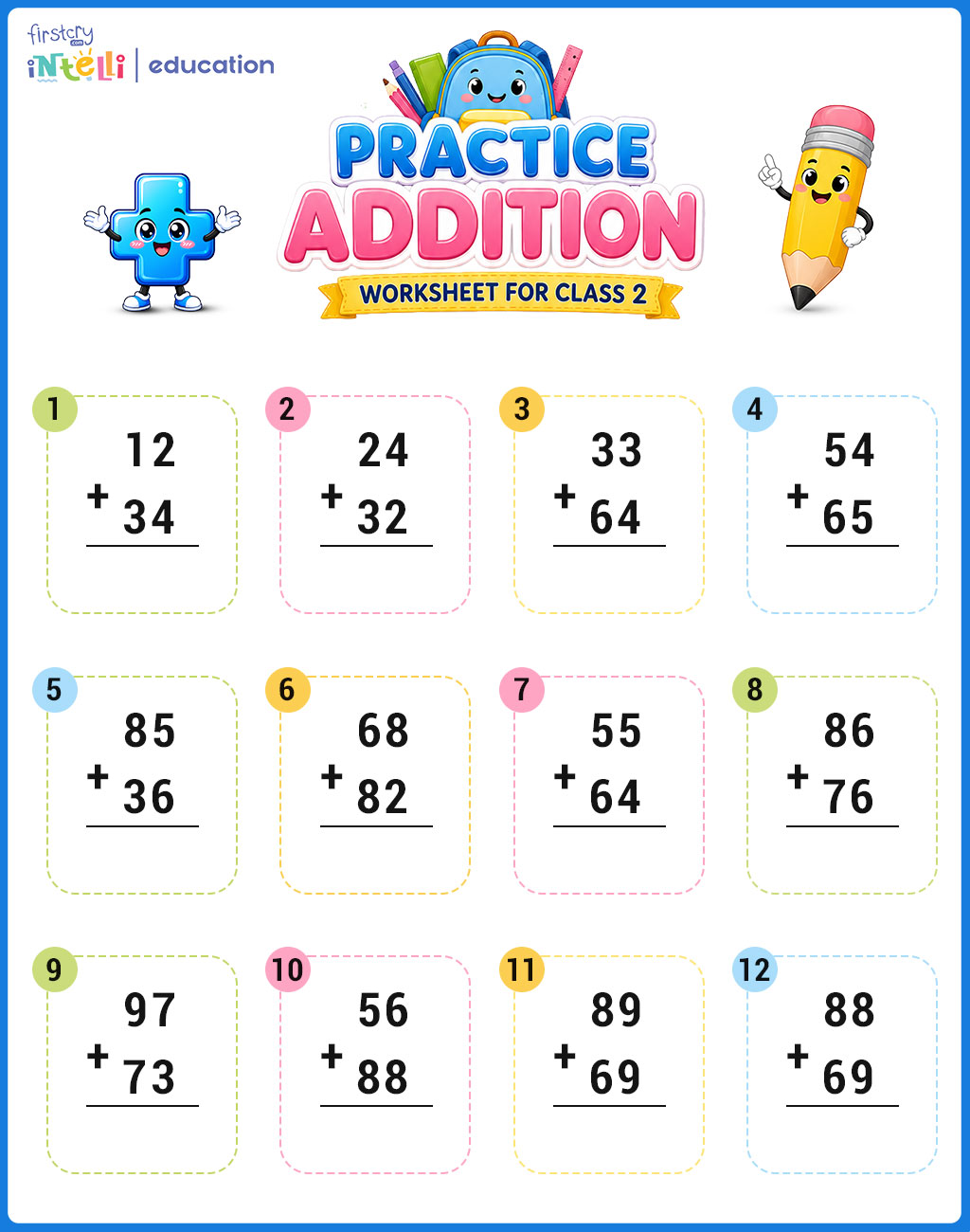
Practice Addition Worksheet for Class 2
Practice addition worksheet for class 2 helps children reinforce what they have learned through simple, graded exercises. This addition sheet for class 2 includes a mix of direct sums and short word problems to build speed, accuracy, and confidence.
Addition for class 2 is an important first step in building basic maths skills. By using simple methods, clear examples, and an addition sheet for class 2, children can practice different types of sums, including word problems and carrying, to become more confident and accurate in their work. This article provides parents and teachers with a clear guide to help Class 2 students strengthen their addition skills and prepare for more advanced topics later.
Also Read:
Roman Numerals For Kids
Odd Numbers for Children
Ten Frame For Preschoolers and Kids