



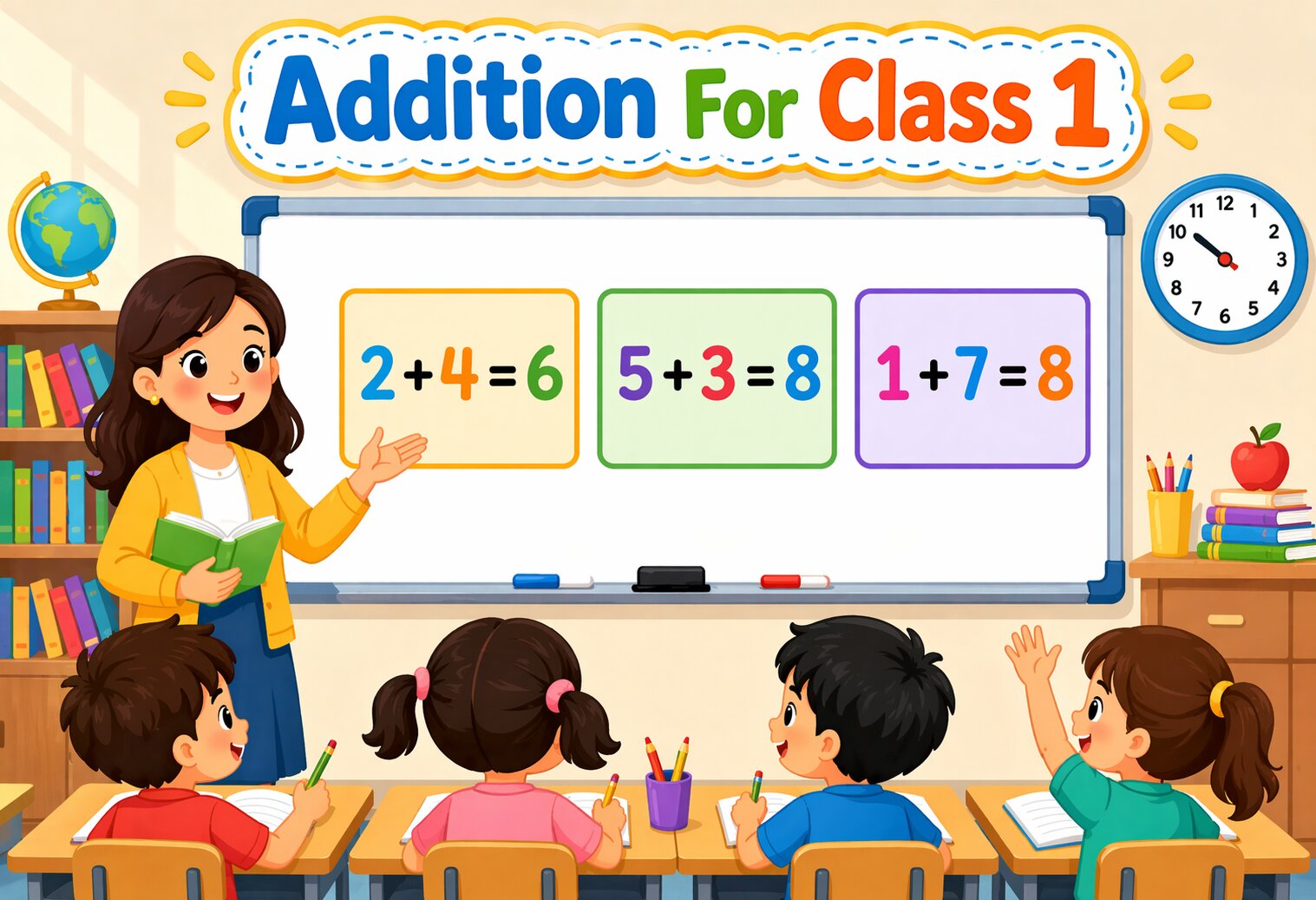
Welcome to our comprehensive guide on simple addition for Class 1! Addition is a foundational maths skill that introduces young learners to combining numbers in fun, everyday ways. In this article, we explore easy methods such as counting on fingers, using objects, and using number lines, making addition for Class 1 both accessible and exciting.
Thank you for reading this post, don't forget to subscribe!
You’ll find step-by-step examples, such as 2 + 3 = 5 (two apples plus three more make five), to build confidence. Download our free maths addition worksheet for Class 1, packed with engaging exercises and addition for Class 1 with answers for quick checks.
Perfect for home or classroom use, these resources spark curiosity and mastery. Let’s add up the fun together!
What Is Addition?
Addition is a fundamental operation in mathematics, representing the process of combining two or more numbers or sets to determine their total or sum. This operation forms the basis of arithmetic and is essential for understanding more advanced mathematical concepts. For instance, adding 3 red apples to 2 green apples results in a total of 5 apples.
At the Class 1 level, students are introduced to addition through tangible methods such as counting physical objects, using their fingers, or drawing visual representations. These practical techniques support the development of strong number sense and make abstract concepts more accessible to young learners. In addition, mastering addition equips students with essential skills for everyday tasks, such as distributing items equally, keeping track of possessions, and solving simple problems. Understanding how to add numbers accurately and confidently is a crucial building block for all future mathematics learning.
Importance of Learning Addition for Class 1 Students
Find out why learning addition is key for Class 1 children in the section below. It highlights how this skill supports daily life and future maths learning.
1. Builds Number Sense
Addition helps children understand how numbers grow when combined, such as 2 + 3 = 5. It strengthens their ability to recognise and compare quantities in everyday situations.
2. Develops Problem-Solving Skills
By solving simple sums, kids learn to break down problems into steps. This encourages logical thinking and prepares them for more complex challenges ahead.
3. Supports Real-Life Applications
Addition is used for counting items, such as toys or snacks, as in 4 biscuits plus 2 more. It shows maths as a practical tool for sharing and shopping.
4. Boosts Confidence In Maths
Quick wins with easy additions build self-assurance in young learners. They feel capable and eager to tackle new sums as they succeed.
5. Prepares For Advanced Concepts
Early addition paves the way for subtraction, multiplication, and beyond. It creates a strong base for school progression and long-term numeracy.
How to Teach Addition to Class 1?
Discover effective strategies for teaching addition for 1st standard kids in this section. We explore practical approaches that make addition engaging and easy to grasp.
1. Counting On Fingers
Children hold up fingers to represent each addend, such as 2 on one hand and 3 on the other, then count the total to reach 5. This intuitive, body-based technique leverages natural motor skills, fosters immediate feedback, and is ideal for beginners struggling with abstract concepts.
2. Using Objects
Select tangible manipulatives like blocks, beads, or fruits to form two groups and merge them, e.g., 4 red blocks plus 2 blue ones make 6. It bridges concrete experience to numerical understanding, promotes fine motor development, and mirrors everyday counting scenarios.
3. Number Line Addition
Mark a straight line with numbers and “jump” forward from the starting number by the amount of the second, like from 3 jumping 2 spaces to 5. This method introduces directionality and sequencing, strengthening mental arithmetic and problem-solving skills over time.
4. Picture Addition
Illustrate simple drawings or cutouts of items to combine visually, such as 2 stars plus 3 hearts equalling 5 shapes. Engaging visuals stimulate creativity, support diverse learning styles, and make addition memorable without relying on verbal explanations.
5. Addition Stories
Frame sums within relatable narratives, e.g., “A puppy finds 1 bone and digs up 4 more.” This contextual approach ignites imagination, improves listening and language skills, and demonstrates the practical relevance of addition in daily life.
Basic Addition Sums for Class 1
This section introduces the essential addition with carry, or without carry, for class 1 through simple examples. Practice these sums to build fluency in adding small numbers.
1. Adding Zero
When you add zero to any number, the number stays the same: without carry, like 5+0=5 or 0+7=7. This shows that zero doesn’t change things, helping kids get used to how numbers work without extra counting mistakes.
2. Adding Ones
Adding 1 just makes the number one bigger: without a carry in the ones place, such as 4+1=5; but with a carry to the tens when 9+1=10 (the 9 ones turn into 10, so you make a group of 10). It teaches kids how numbers grow one by one and what happens when you reach 10.
3. Two-Number Sums Up To 10
These are easy pairs to add quickly: without carry, like 2+3=5, where you just add the ones; or with carry, starting simple, 6+5=11, (6 plus 5 makes 11 ones, so group 10 and leave 1). Kids learn these by heart, which makes adding faster and helps with taking away too.
4. Three-Number Sums
Add three numbers by grouping them: without carry, straight add 1+2+3=6; or with carry, try 4+5+6=15 (add 4 and 6 first to make 10, then add 5). This shows kids it’s okay to add in parts, making bigger sums less scary.
5. Addition With Pictures
Draw pictures to see the adding: without carry, draw 2 apples + 3 apples and count to 5; with carry, 8 dots + 3 dots make 11 (put 10 dots in a circle as one group of 10, plus 1 left over). Pictures let kids see and touch the idea, making it perfect for different learning styles.
Examples Of Addition for Class 1
This section provides clear examples of addition for Class 1, including both without carry and with carry sums to practise. Young learners can follow along with fun, relatable scenarios.
- 3+2=5 (without carry: 3 stars plus 2 stars make 5 stars).
- 6+4=10 (with carry: 6 dots plus 4 dots; group 10 as one ten).
- 1+4=5 (without carry: 1 ball plus 4 balls make 5 balls).
- 8+3=11 (with carry: 8 apples plus 3 apples; 10 + 1 = 11).
- 5+5=10 (with carry: 5 toys plus 5 toys make a full set of 10).
Addition Word Problems For Class 1
This section offers simple word problems that show addition in action for Class 1 kids. Solve them to see how adding works with stories from everyday life.
- Sara has 2 pencils. She gets 3 more. How many does she have now?
Solution: 2+3 = 5 pencils. - There are 4 birds on a tree. 2 more fly and sit on it. How many birds are there on the tree?
Solution: 4+2 = 6 birds. - Raju has 5 bananas. He buys 1 more. How many bananas does he have now?
Solution: 5+1 = 6 bananas. - 3 cats are playing together. 4 kittens join in. How many animals are there?
Solution: 3+4 = 7 animals. - A box has 6 balls. Gina drops 4 more in. How many balls are now in the box?
Solution: 6+4 = 10 balls. - Mia has 7 flowers. She picks up 2 more. How many flowers does she have?
Solution: 7+2 = 9 flowers. - 8 ducks are swimming in the pond. 3 more join in. How many ducks are swimming in the pond?
Solution: 8+3 = 11 ducks. - Tom has 1 book. He gets 5 more from a friend. How many books does Tom have now?
Solution: 1+5 = 6 books. - There are 4 cars on the road. 5 more park nearby. What is the total number of cars on the road?
Solution: 4+5 = 9 cars. - The shop has 9 sweets. The baker adds 2 more. How many sweets does the shop have?
Solution: 9+2 = 11 sweets.
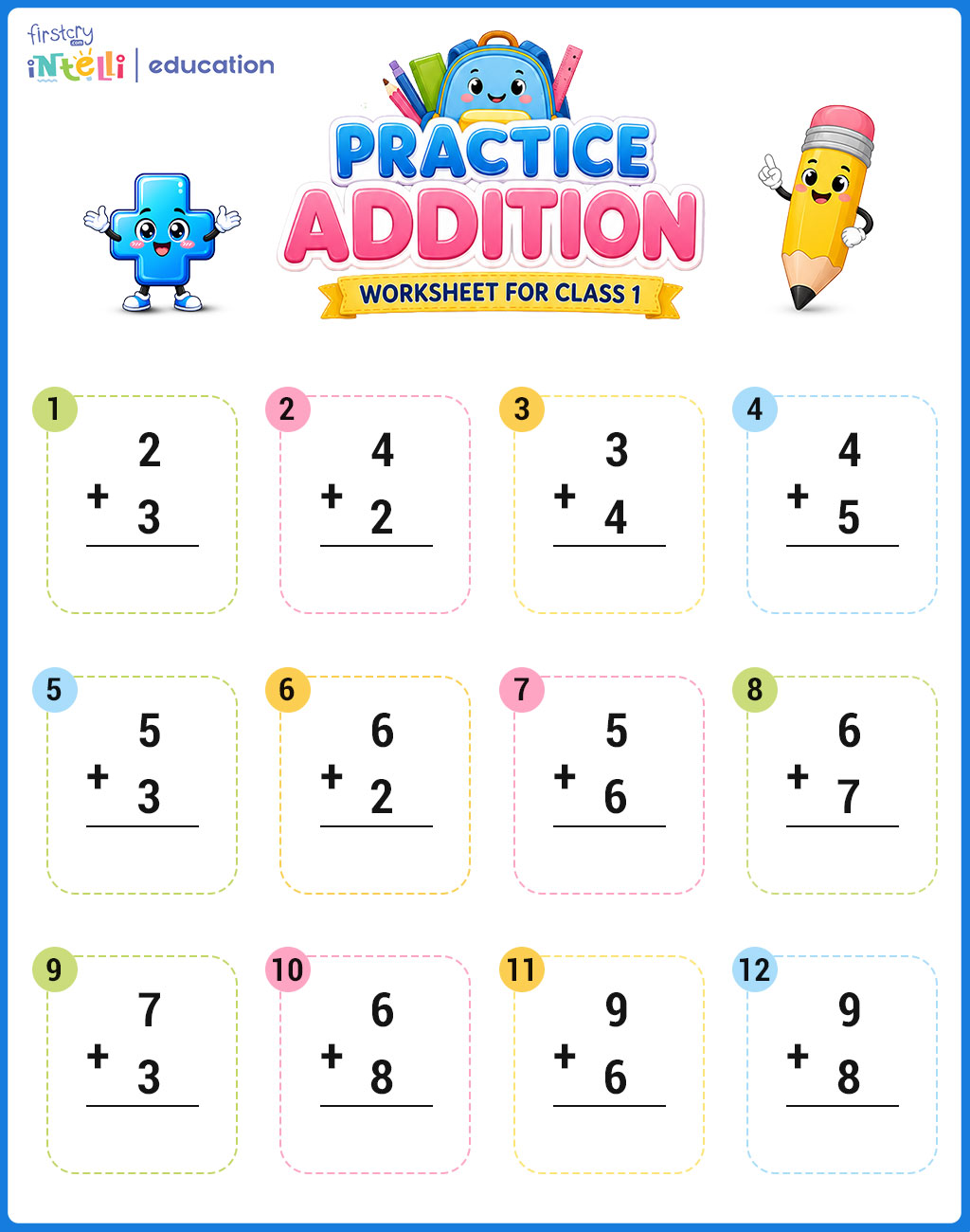
Practice Addition Worksheet For Class 1
This section features a class 1 maths addition worksheet for hands-on practice with basic sums. Kids can solve these exercises to improve their addition step by step.
FAQs
1. How Do I Check My Addition Answer?
Count the total objects or use fingers to add again, like for 3 + 4, count 7 items. If it matches, your answer is right!
2. Why Practice Addition Every Day?
Daily practice makes adding fast and easy, just like riding a bike. Try doing 5 sums each morning to help you remember them better.
3. Can I Add More Than Two Numbers?
Yes, add them one by one, like 2 + 3 + 1: first 2 + 3 = 5, then 5 + 1 = 6. Keep practising groups of three.
4. What If I Make A Mistake In Adding?
That’s okay! Erase and try counting slower or draw pictures. Mistakes help you learn and get stronger at addition.
Addition opens the door to exciting maths adventures for Class 1 children. Keep practising with these methods, examples, and worksheets to make adding second nature and build lasting confidence.
Also Read:
Subtraction for Kids
Even Numbers for Children
Missing Numbers for Preschooler and Kids