



- What is Multiplication?
- What are the Parts of a Multiplication Problem?
- Formula of Multiplication
- Multiplication Signs & Symbols
- Examples of Multiplications
- Rules of Multiplication
- How to Teach the Concept of Multiplication to Kids?
- Multiplication Word Problems
- Practice Multiplication Problems
- Multiplication Worksheet For Kids
Last Updated on August 31, 2026
Multiplication is one of the core building blocks of mathematics, a skill children rely on long after primary school. Once a child has a firm grasp on addition, multiplication is often the next step, helping them work with numbers more quickly and confidently. While it can feel daunting at first, breaking it down into simple rules and patterns makes it far easier to grasp.
Thank you for reading this post, don't forget to subscribe!
This article walks through the basics of multiplication, including key rules that simplify calculations, along with clear examples to show how each one works in practice. From understanding what multiplication means to recognising patterns in times tables, children can build a strong foundation step by step. Alongside the explanations, you will also find practice problems to test their understanding and build confidence. Whether your child is just starting or looking to strengthen their skills, this guide offers a clear, simple way to make multiplication easier to grasp.
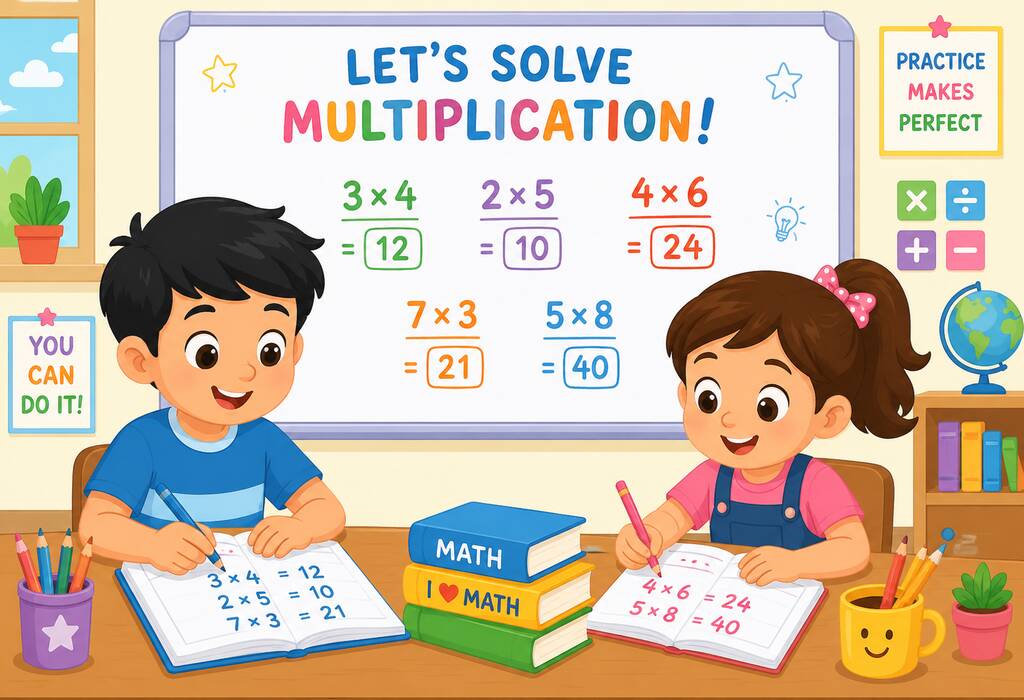
What is Multiplication?
A good multiplication definition for kids makes the concept far less intimidating from the start. Once children see what it actually means, the rest of multiplication becomes much easier to follow.
Multiplication is simply a quicker way of adding the same number repeatedly. For example, instead of writing 4 + 4 + 4, you can write 4 × 3, since you are adding the number 4 a total of three times. This shortcut becomes especially useful once numbers get larger, as it saves children from writing out long strings of addition. Once children understand that multiplication is just repeated addition, the rules and patterns that follow become much easier to pick up.
What are the Parts of a Multiplication Problem?
Every multiplication problem is made up of a few key parts, each with its own name and role. Knowing these terms makes it easier for children to follow along as multiplication gets more advanced.
1. Multiplicand
This is the number being multiplied, or the number that is repeatedly added to itself. In the equation 4 × 3 = 12, the multiplicand is 4 because it is the value being repeated 3 times.
2. Multiplier
This is the number that tells you how many times the multiplicand is being added to itself. In the equation 4 × 3 = 12, the multiplier is 3, since it shows how many groups of 4 are being added together.
3. Product
This is the final answer you get once the multiplication is complete. In the equation 4 × 3 = 12, the product is 12, since it is the result of multiplying 4 by 3.
4. Multiplication Sign (×)
This is the symbol placed between the multiplicand and multiplier to indicate that the two numbers are being multiplied. Without this sign, the equation would look like two separate numbers rather than a multiplication problem.
Formula of Multiplication
The basic formula for multiplication can be written as:
Multiplicand × Multiplier = Product.
This means that when one number, the multiplicand, is multiplied by another number, the multiplier, the result is called the product. For example, in 6 × 5 = 30, the multiplicand is 6, the multiplier is 5, and the product is 30. Once children are familiar with this formula, they can apply it to any pair of numbers, no matter how large or small.
Multiplication Signs & Symbols
Multiplication can be written in several ways, depending on the numbers or letters involved. Knowing these signs and symbols helps children recognise multiplication wherever it appears, even if it looks slightly different from what they are used to.
| SIGN/SYMBOL | WHAT IT MEANS |
| × (cross sign) | The most common symbol used to show multiplication, such as 5 × 4 = 20 |
| . (dot) | Sometimes used instead of the cross sign to show multiplication, such as 5 . 4 = 20 |
| (+) × (+) | When two positive numbers are multiplied, the answer is always positive |
| (+) × (−) | When a positive number and a negative number are multiplied, the answer is always negative |
| (−) × (+) | When a negative number and a positive number are multiplied, the answer is always negative |
| (−) × (−) | When two negative numbers are multiplied, the answer is always positive |
Examples of Multiplications
Multiplication helps us find the total when equal groups are put together. Let’s look at some simple examples of multiplication to better understand it.
- 2 × 3 = 6. Here, 2 is the multiplicand, 3 is the multiplier, and 6 is the product.
- 4 × 5 = 20. Here, 4 is the multiplicand, 5 is the multiplier, and 20 is the product.
- 6 × 2 = 12. Here, 6 is the multiplicand, 2 is the multiplier, and 12 is the product.
- 7 × 3 = 21. Here, 7 is the multiplicand, 3 is the multiplier, and 21 is the product.
- 8 × 4 = 32. Here, 8 is the multiplicand, 4 is the multiplier, and 32 is the product.
- 12 × 13 = 156. Here, 12 is the multiplicand, 13 is the multiplier, and 156 is the product. This is a 3-digit product.
Rules of Multiplication
Multiplication follows a few simple rules that make solving sums easier and more accurate. Learning these rules also supports kids’ understanding of concepts like the least common multiple in a clear, child-friendly way.
- The order does not change the product – When two numbers are multiplied, switching their order gives the same answer. For example, 3×4=4×33 \times 4 = 4 \times 33×4=4×3.
- Any number multiplied by 1 stays the same – If you multiply a number by 1, the product is the same number. For example, 7×1=77 \times 1 = 77×1=7.
- Any number multiplied by 0 gives 0- When a number is multiplied by 0, the product is always 0. For example, 9×0=09 \times 0 = 09×0=0.
- Multiplying by 10 adds a zero – When you multiply a number by 10, the result is the number with one zero added at the end. For example, 6×10=606 \times 10 = 606×10=60.
- The product of two negative numbers is positive – When two negative numbers are multiplied, the answer is positive. For example, (−3)×(−2)=6(-3) \times (-2) = 6(−3)×(−2)=6.
How to Teach the Concept of Multiplication to Kids?
Multiplication does not have to mean jumping straight into numbers and times tables. This section covers simple ways to help children understand the idea behind multiplication before they even realise they are learning maths.
- Start With Real Objects — Use everyday items like buttons, fruit, or toys to form equal groups, then count them together so children see multiplication in action before moving on to numbers.
- Connect It To Addition — Show children that multiplication is just a quicker way to add the same number repeatedly, so the concept feels familiar rather than entirely new.
- Use Arrays To Show Groups — Arrange objects or draw dots in equal rows and columns, such as 3 rows of 4, so children can see multiplication as organised groups rather than a single growing pile.
- Introduce Skip Counting — Practise counting in twos, fives, or tens, since this naturally builds the foundation for understanding times tables later on.
- Make It Playful — Turn multiplication into a game with dice, cards, or simple worksheets so children stay engaged rather than see it as a chore.
- Practise A Little Every Day — Set aside a few minutes each day for quick multiplication practice, since short, regular sessions help children retain what they learn far better than occasional long sessions.
Multiplication Word Problems
Word problems help children see how multiplication applies to everyday situations, rather than just numbers on a page. These math games for kids involving multiplication turn practice into something children actually enjoy solving.
1. Riya has 6 boxes of crayons, and each box contains 8 crayons. How many crayons does Riya have in total?
Solution: Number of boxes = 6, Number of crayons in each box = 8
Total number of crayons = 6 × 8 = 48
Therefore, Riya has 48 crayons in total.
2. A baker makes 9 trays of cupcakes, with 5 cupcakes on each tray. How many cupcakes did the baker make altogether?
Solution: Number of trays = 9, Number of cupcakes on each tray = 5
Total number of cupcakes = 9 × 5 = 45
Therefore, the baker made 45 cupcakes altogether.
3. There are 7 fish tanks at a pet shop, and each tank has 4 fish. How many fish are there in total?
Solution: Number of fish tanks = 7, Number of fish in each tank = 4
Total number of fish = 7 × 4 = 28
Therefore, there are 28 fish in total.
4. Arjun buys 4 packets of stickers, and each packet has 12 stickers inside. How many stickers does Arjun have in total?
Solution: Number of packets = 4, Number of stickers in each packet = 12
Total number of stickers = 4 × 12 = 48
Therefore, Arjun has 48 stickers in total.
5. A school has 8 classrooms, and each classroom has 25 students. How many students are there in the school?
Solution: Number of classrooms = 8, Number of students in each classroom = 25
Total number of students = 8 × 25 = 200
Therefore, there are 200 students in the school.
Practice Multiplication Problems
Practice is what makes multiplication stick, rather than letting it stay something children only memorise for a short while. Try these multiplication practice for kids problems to see how well the concept has been understood.
1. Find the product of 7 and 9.
Solution: 7 × 9 = 63
2. Multiply 12 by 6.
Solution: 12 × 6 = 72
3. What is 15 × 4?
Solution: 15 × 4 = 60
4. Find the product of 100 and 8.
Solution: 100 × 8 = 800
5. Multiply 3.5 by 2.
Solution: 3.5 × 2 = 7
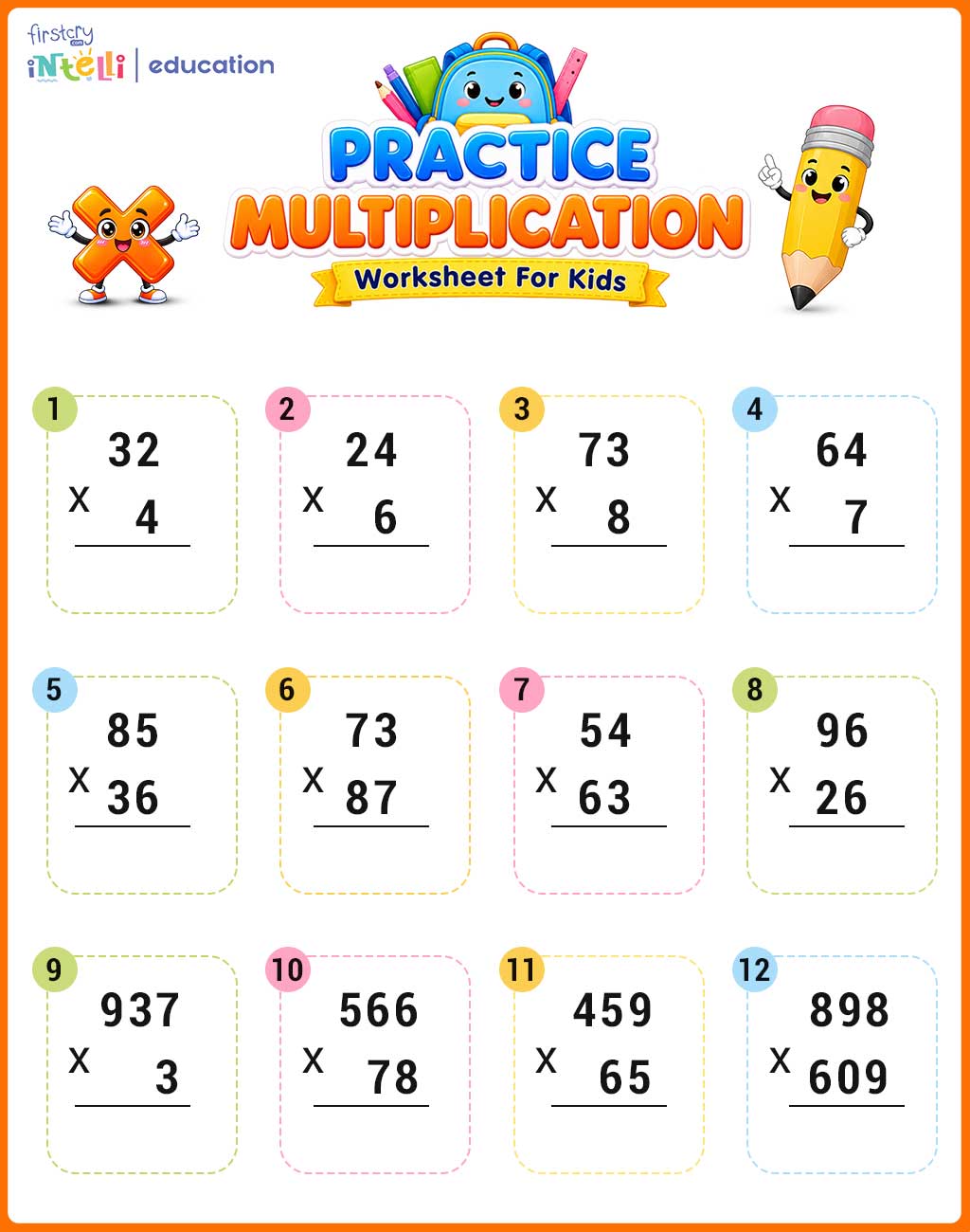
Worksheets give children a structured way to put everything they have learnt into practice. Use this multiplication worksheet to help reinforce the concept through repeated, hands-on solving.
Multiplication Worksheet For Kids
Multiplication might seem like just another maths topic at first, but it lays the groundwork for so much of what children will learn later on, from fractions to algebra. Understanding the rules, practising regularly, and working through real examples all help make the concept feel less like memorisation and more like something children genuinely grasp. With consistent practice and a bit of patience, multiplication can become one of the easier parts of maths for children to master, rather than one of the most daunting.
Also Read:
Addition for Class 1
Addition for Class 2
Addition for Class 3
Subtraction for Children