



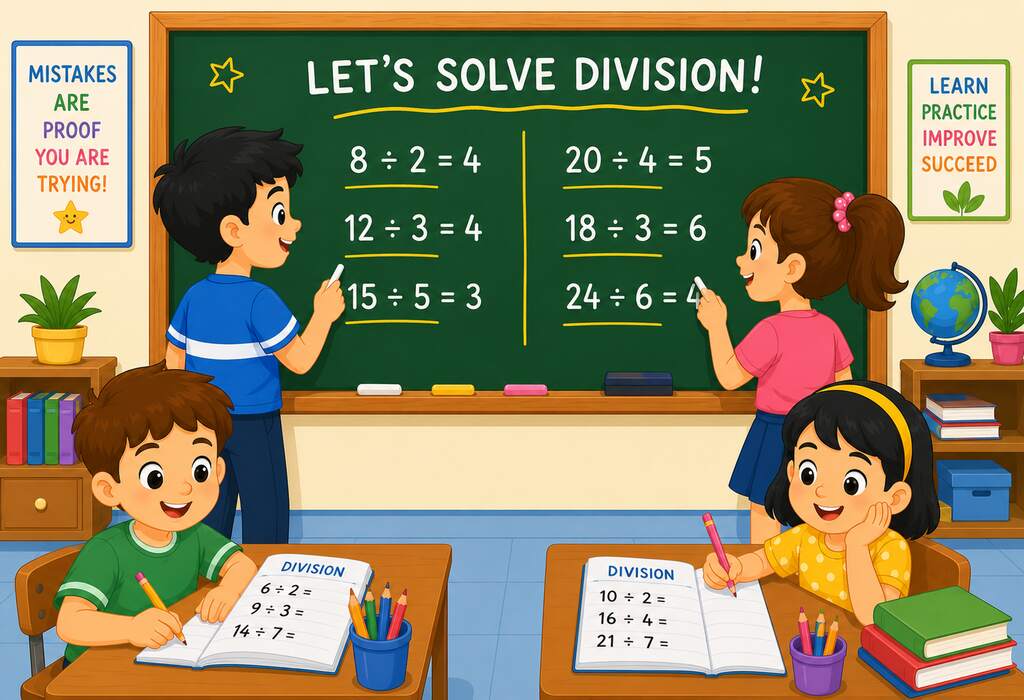
- What is Division?
- Why do we use Division?
- Types of Division
- Division Vocabulary for Kids to Know
- Formula of Division
- How to Teach Division to Grade 1?
- How to Teach Division to Grade 2
- How to Teach Division to Grade 3?
- Short and Long Division
- Solved Division Problems
- Practice Problems for Kids to Solve
- FAQs
Division is one of those maths milestones that can feel tricky at first, but with the right approach, it clicks quickly. This guide breaks down division for kids into simple, easy-to-follow steps, helping young learners build confidence with numbers.
Thank you for reading this post, don't forget to subscribe!
Whether your child is just starting or needs extra practice, understanding the basics of division sets the stage for stronger maths skills overall. Here, you will find clear explanations of the division formula, along with everyday examples that show how division works in real life. We have also included a variety of division sums for kids, ranging from beginner-friendly to slightly more challenging, so children can practise at their own pace.
If you have ever wondered how to do division for kids in a way that is both simple and engaging, this guide has you covered. With step-by-step methods, visual examples, and plenty of practice problems, children can master division while enjoying the learning process.
What is Division?
Division is one of the four basic operations in mathematics, along with addition, subtraction, and multiplication. In simple terms, this means splitting a number into equal parts or groups.
For example, if you have 12 sweets and want to share them equally among 4 friends, division helps you find out that each friend gets 3 sweets. Understanding basic division for kids starts with the idea of equal sharing, making the concept easy to grasp through everyday examples. Once children get comfortable with this idea, they can move on to learning the division formula and solving more sums with confidence.
Why do we use Division?
We use division whenever we need to split something into equal parts or figure out how many times one number fits into another. Think about sharing a packet of biscuits equally among friends, dividing a class into groups for a game, or working out how many days are left until a birthday.
Division makes everyday tasks like these simple and fair, ensuring nothing is left to guesswork. Beyond daily life, division also builds a strong foundation for other maths concepts, such as fractions, ratios, and averages, making it an essential skill for children to master early on.
Types of Division
Division can be approached in various ways, depending on the numbers involved and how comfortable a child is with math. This section breaks down each type of easy division for kids so that you can choose the method that suits your child best.
1. Long Division
Long division is used to divide larger numbers that cannot be easily solved through mental math. It involves breaking the problem down into smaller steps, working through the digits one at a time, and writing out each stage of the calculation.
For example: 156 ÷ 4 = 39
Step 1: Divide 15 by 4. It goes in 3 times (3 × 4 = 12), leaving 3 left over.
Step 2: Bring down the 6, making 36.
Step 3: Divide 36 by 4. It goes in exactly 9 times.
Answer: 39
2. Short Division
Short division is a quicker method used for simpler problems, usually involving smaller numbers or single-digit divisors. Most of the work is done mentally, with only the key steps written down.
For example: 84 ÷ 4 = 21
Step 1: Divide 8 by 4. It goes in exactly 2 times.
Step 2: Divide 4 by 4. It goes in exactly 1 time.
Answer: 21
Division Vocabulary for Kids to Know
Before diving into division sums, it helps to get familiar with a few key terms used throughout the process of division. Knowing these words makes it much easier to follow along and understand how division works.
1. Dividend
This is the number that is divided. For example, in 12 ÷ 3 = 4, the number 12 is the dividend, which is the total amount you start with before splitting it up.
2. Divisor
This is the number by which you are dividing. In 12 ÷ 3 = 4, the divisor is 3, which tells you how many equal groups the total is split into.
3. Quotient
This is the answer obtained after division. In 12 ÷ 3 = 4, the number 4 is the quotient, showing how many items are in each group.
4. Remainder
Sometimes, numbers do not divide evenly, and there is a bit left over. For example, in 13 ÷ 3, each group gets 4, but 1 is left over; that leftover amount is the remainder.
5. Equal Groups
This term refers to groups created when a number is divided, with each group containing the same amount. Understanding equal groups helps children see division as fair sharing rather than just a written equation.
Formula of Division
Every division problem follows a simple formula that connects all its parts. Understanding this division method for kids makes it easier to work through any division sum with confidence.
The basic formula for division is as follows:
Dividend ÷ Divisor = Quotient
Here:
- Dividend is the number being divided
- Divisor is the number you are dividing by
- Quotient is the answer you get after dividing
If the numbers do not divide exactly, there will be a remainder. In this case, the formula is written as
Dividend = (Divisor × Quotient) + Remainder
This helps check whether a division sum has been solved correctly, and it is the standard way division is presented in school textbooks.
How to Teach Division to Grade 1?
Grade 1 is often the first time children come across the idea of splitting things equally, so keeping it simple and hands-on makes all the difference. Here are a few easy division rules for kids to help introduce the concept at this stage.
1. Start With Real Objects
Use everyday items like sweets, toys, or crayons to show division in action.
For example: Give a child 8 crayons and ask them to share them equally between 2 friends. This hands-on approach helps them see division as fair sharing before introducing numbers or symbols.
2. Introduce Equal Grouping
Once children are comfortable sharing objects, move on to grouping them into sets.
For example: Arrange 10 apples into groups of 2 and count how many groups are formed. This helps children understand that division is really about finding out how many equal groups a number can make.
3. Use Simple Number Sentences
After grouping practice, introduce basic division sentences using small numbers.
For example: Show that 6 ÷ 2 = 3 by linking it back to the grouping exercise they just completed. This step helps children connect the hands-on activity to the written form of division.
4. Practise With Picture-Based Problems
Use pictures or drawings to represent division sums, making them easier to visualise.
For example: Show how 9 balloons divided into 3 equal groups, with each group circled to show 3 balloons per group. This visual method reinforces the concept without relying purely on numbers.
How to Teach Division to Grade 2
Grade 2 builds on the basics with slightly bigger numbers and a bit more independence in solving sums. Here are a few simple ways to help children take the next step in learning division.
1. Move to Two-Digit Numbers
Once children are confident with small numbers, introduce simple two-digit division problems.
For example: Show them how to solve 24 ÷ 4 = 6, linking it back to the grouping and sharing concepts that they already know.
2. Teach Skip Counting as a Strategy
Skip counting helps children divide numbers without relying on objects or pictures.
For example: To solve 15 ÷ 5, they can skip count by 5s — 5, 10, 15 — and see that it takes 3 steps to reach 15, so 15 ÷ 5 = 3.
3. Introduce Division With Remainders
At this stage, children can start learning that numbers don’t always divide evenly.
For example: Show them 13 ÷ 4 = 3, remainder 1, explaining that 4 fits into 13 three times with 1 left over.
4. Encourage Mental Maths Practice
Short, regular practice helps children build confidence in solving division sums in their heads.
For example: Ask them to quickly solve 18 ÷ 3 = 6 without writing it down, reinforcing the recall of basic division facts.
How to Teach Division to Grade 3?
Grade 3 is where children start handling larger numbers and slightly trickier sums with more confidence. Here are a few simple division tricks for kids to make this stage easier to understand.
1. Introduce Long Division for Bigger Numbers
At this stage, children can begin tackling numbers that are too large for mental math.
For example: Show them how to solve 156 ÷ 4 = 39 by breaking it down step by step, dividing digit by digit, and bringing down remainders as needed.
2. Teach Division and Multiplication as Related Facts
Help children see the connection between the two operations to make division easier for them.
For example: If they know 6 × 7 = 42, they can quickly work out that 42 ÷ 7 = 6, using multiplication facts to check or solve division problems.
3. Practise Estimation Before Solving
Estimating helps children to predict a reasonable answer before working through the full sum.
For example: Before solving 96 ÷ 3, they can estimate that the answer should be close to 30, because 3 × 30 = 90, making it easier to check their final answer.
4. Use Word Problems for Real-Life Application
Word problems help children apply division in everyday situations.
For example: “A baker has 84 cupcakes and wants to pack them into boxes of six. How many boxes will he need?” (84 ÷ 6 = 14 boxes), encouraging children to identify when and how to use division in such cases.
Short and Long Division
Division sums can be solved in two main ways, depending on how large the numbers are and how much work needs to be shown. Here is a quick look at how short and long divisions differ from each other.
Short Division
Here’s a quick example to show how short division works in practice.
72 ÷ 6 = 12
Step 1: Divide 7 by 6. It goes in 1 time, with 1 left over.
Step 2: Carry the 1 over to make 12.
Step 3: Divide 12 by 6. It goes in exactly 2 times.
Answer: 12
Long Division
Here’s a step-by-step example to show how long division is worked out.
245 ÷ 5 = 49
Step 1: Divide 24 by 5. It goes in 4 times (4 × 5 = 20), leaving 4 left over.
Step 2: Bring down the 5, making 45.
Step 3: Divide 45 by 5. It goes in exactly 9 times.
Answer: 49
Solved Division Problems
These worked examples show division being applied step by step, making it easier to follow the process from start to finish. Use them to practise and check your understanding of how division works.
1. 96 ÷ 8 = 12
Step 1: Divide 9 by 8. This gives 1, with a remainder of 1.
Step 2: Bring down the 6 to make 16.
Step 3: Divide 16 by 8. This gives exactly 2.
Answer: 12
2. 63 ÷ 7 = 9
Step 1: Divide 63 by 7. This gives exactly 9, with no remainder.
Answer: 9
3. 108 ÷ 4 = 27
Step 1: Divide 10 by 4. This results in 2, with a remainder of 2 (since 2 × 4 = 8).
Step 2: Bring down the 8 to make 28.
Step 3: Divide 28 by 4. This gives exactly 7.
Answer: 27
4. 39 ÷ 5 = 7,remainder4
Step 1: Divide 39 by 5. This gives 7, with a remainder of 4 (since 7 × 5 = 35).
Answer: 7, remainder 4
5. 144 ÷ 6 = 24
Step 1: Divide 14 by 6. This results in 2, with a remainder of 2 (since 2 × 6 = 12).
Step 2: Bring down the 4 to make 24.
Step 3: Divide 24 by 6. This gives exactly 4.
Answer: 24
Practice Problems for Kids to Solve
Now it’s time to put what you’ve learned into practice with a few problems of your own. Try solving these on your own, and check your answers against the working shown earlier.
- Rina has 84 stickers and wants to share them equally among 4 friends. How many stickers will each friend get?
- A farmer has 96 eggs and packs them into trays of 6. How many trays will he need?
- A teacher has 45 pencils and wants to give an equal number to 5 students. How many pencils does each student get?
- A baker made 132 cookies and packed them into boxes of 6. How many boxes did she use?
- Aman has 27 marbles and wants to divide them equally among 3 friends. How many marbles will each friend receive?
- A gardener planted 175 saplings in rows of 5. How many rows did he plant?
- A shopkeeper has 88 chocolates and wants to pack them into boxes of 8. How many boxes will he need?
- A school has 216 students and wants to divide them equally into 4 sections. How many students will be in each section?
- Meera has 63 crayons and wants to share them equally among 9 friends. How many crayons will each friend get?
- A library has 51 books and wants to arrange them equally on 6 shelves. How many books will go on each shelf, and how many will be left over?
FAQs
1. Why Do I Need to Learn My Multiplication Tables for Division?
Multiplication tables are closely linked to division, so knowing them well makes division much easier. If you know that 7 × 8 = 56, you can quickly work out that 56 ÷ 8 = 7 without having to calculate it from scratch. This saves time and reduces mistakes.
2. What Should I Do If I Get a Division Sum Wrong?
Don’t worry — getting a sum wrong is a normal part of learning. Go back and check each step slowly, especially your subtraction and multiplication, since small mistakes there often cause the wrong answer. You can also use multiplication to check your final answer, as it works in reverse.
3. How Long Does It Take to Get Good at Division?
This varies from child to child, but with consistent practice, most children start feeling confident within a few weeks. The key is not to rush — understanding each step properly is more important than solving sums quickly.
4. Is It Okay to Use Fingers or Objects While Practising Division?
Yes, absolutely! Using fingers, counters, or everyday objects is a great way to understand division, especially when you’re just starting. As you practise more, you’ll naturally rely on these tools less and be able to solve sums mentally.
Division might seem tricky at first, but with regular practice and a clear understanding of the steps, it becomes second nature. From learning the formula to working through short and long division, every bit of practice builds a stronger foundation for maths. Keep revisiting the examples and problems in this guide, and soon enough, solving division sums will feel simple and easy.
Also Read:
Pre-Concept for Kids
Subtraction for Children
Counting Activities for Preschoolers