



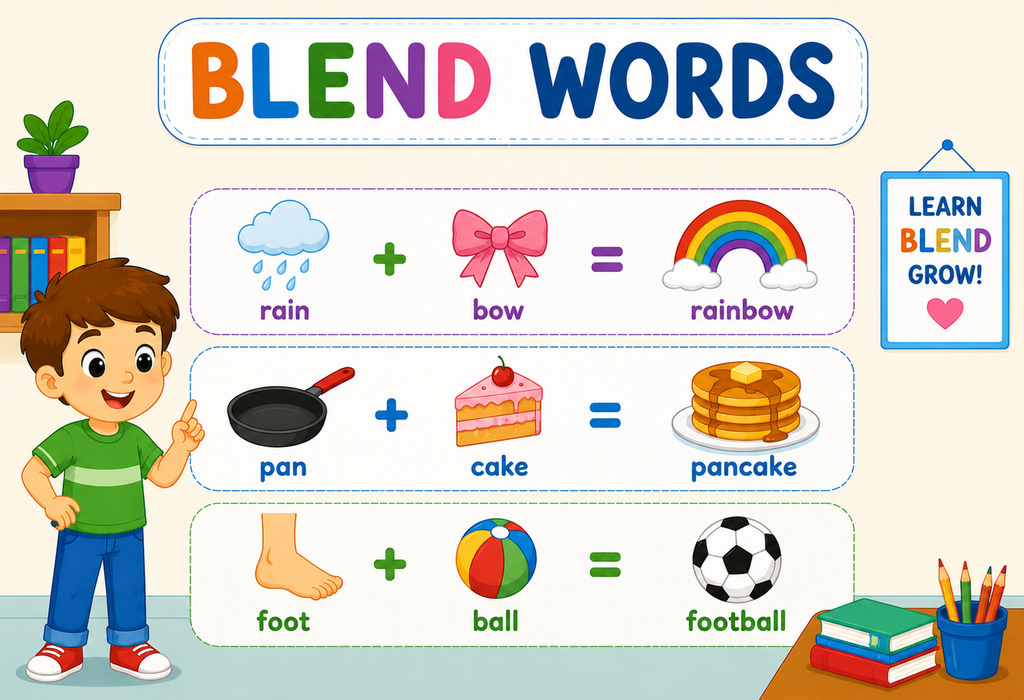
Learning to read is a journey filled with small but significant milestones, and understanding blends is one of the most important steps along the way. So, what is a blend? Simply put, a blend is a combination of two or three consonants that appear together in a word, with each letter retaining its own distinct sound. Unlike digraphs, where letters merge into a single new sound, blends allow children to hear each letter sound in quick succession—think of words like “stop,” “clap,” or “frog.”
Thank you for reading this post, don't forget to subscribe!
But what are blends in English, exactly, and why do they matter so much for early literacy? Blends form the building blocks of countless everyday words, helping children decode unfamiliar vocabulary with confidence and ease. For parents and educators alike, knowing how to teach blend words effectively can make a world of difference in a child’s reading fluency.
What is Blending in Phonics?
Blending in phonics refers to the process of combining individual letter sounds together to form a complete word. Rather than recognising a word as a whole, children learn to say each sound separately and then merge them smoothly to pronounce the word correctly—for instance, blending the sounds /c/, /a/, and /t/ to read “cat.” This skill is a cornerstone of early reading development, as it helps children move beyond memorising words to actually decoding new and unfamiliar ones. With consistent practice, blending becomes second nature, laying a strong foundation for confident, independent reading.
Why are Blends Important?
Blends form the building blocks of early literacy, helping children move confidently from individual sounds to fluent reading. Here’s why they matter so much in a child’s learning journey:
- Stronger Phonemic Awareness
Recognising and pronouncing blends helps children tune their ears to individual sounds within words, sharpening their overall phonemic awareness. - Improved Decoding Skills
With a solid grasp of blends, children can sound out unfamiliar words more accurately, rather than guessing or relying on memory alone. - Better Spelling
Understanding how sounds combine allows children to spell words correctly by connecting sounds to letters, rather than memorising each word individually. - Enhanced Reading Fluency
Once blending becomes second nature, children read more smoothly, spending less time decoding and more time understanding what they read. - Boosted Comprehension
As reading becomes more fluent, children can focus their attention on meaning rather than mechanics, leading to better overall comprehension.
Types of Blending
Blends can appear in different positions within a word, each serving a distinct purpose in pronunciation and spelling. Understanding what beginning blends are, along with middle and ending blends, helps children recognise patterns more easily as they read and write.
1. Beginning Blends (Initial Blends)
Beginning blends occur at the start of a word, where two or three consonants combine while each retains its own sound. Common examples include “bl” in “black,” “st” in “stop,” and “gr” in “green.” These are often the first blends children learn, as they appear frequently in everyday vocabulary.
2. Ending Blends (Final Blends)
Ending blends appear at the end of a word, combining consonant sounds to form the word’s final syllable. Examples include “nd” in “hand,” “st” in “fast,” and “mp” in “jump.” Recognising these blends helps children read and spell words more accurately, especially as vocabulary grows more complex.
3. Middle Blends (Medial Blends)
Middle blends occur within a word, often bridging two syllables. Words like “instruct” (str) or “sunflower” (fl) demonstrate how blends can appear mid-word, requiring children to break the word down further to identify each sound clearly.
4. Three-Letter Blends (Consonant Clusters)
Three-letter blends involve three consonants blending together, with each sound still distinctly audible. Examples include “scr” in “scream,” “spl” in “splash,” and “thr” in “three.” These are typically introduced after children have mastered simpler two-letter blends, as they require more advanced phonemic control.
When Should you Teach Blends?
Blends are typically introduced once children have developed a solid understanding of individual letter sounds, usually around the age of five to six, or during the early stages of Key Stage 1. By this point, most children can confidently recognise single consonant and vowel sounds, making them ready to combine these sounds into blends without feeling overwhelmed.
It’s important to introduce blends gradually, starting with simple two-letter beginning blends before progressing to ending blends and, eventually, more complex three-letter blends. Rushing this process can lead to confusion, so it’s best to ensure children are comfortable with basic phonics before layering in blending skills.
Every child learns at their own pace, so rather than sticking rigidly to an age, it helps to watch for readiness cues—such as a child confidently sounding out individual letters or showing curiosity about how words are formed. With the right timing and a patient approach, teaching blends can become an enjoyable and rewarding part of a child’s reading journey.
Difference Between Blends and Digraphs
Blends and digraphs might share letters, but they don’t share sounds—and that small distinction makes a big difference in how children read and spell. Here’s a quick breakdown to help tell them apart.
| BLENDS | DIAGRAPHS |
| Two or more consonants are put together, and each sound can still be heard. | Two letters work together to make one sound. |
| Example: bl in black. | Example: sh in ship. |
| Example: str in street. | Example: ch in chair. |
| The sounds are not fully blended into one new sound. | The letters create a single sound instead of separate sounds. |
| Children can usually sound out each consonant in a blend. | Children learn the pair as one unit of sound. |
Blended Words List
Here’s a handy list of common blend words, grouped to make practice and recognition easier for children. Use these examples to reinforce blending skills through reading, writing, or simple word games.
| BLEND | EXAMPLE WORDS |
| bl | black, blue, blob |
| br | bread, brown, brush |
| cl | clap, clock, clean |
| cr | crab, crown, cream |
| dr | drum, dress |
| fl | flag, flame |
| fr | frog, friend |
| gl | glass, glue |
| gr | green, great,grow |
| pl | plate, plane, plot,planet |
| pr | present, pray, prize |
| sc | scan, school, scab, scare |
| sk | skin, skate, skirt |
| sl | slide, slam, slim |
| sm | smile, smell, smooth, smash |
| sn | snail, sniff, snooze |
| sp | spoon, spider, spike |
| st | star, step, start, stop |
| sw | swim, sweet |
| tr | train, trust, truth |
| tw | twin, twirl, twenty |
| ch | chair, chalk, chain, choose |
| sh | ship, shop, shed |
| th | thin, then, think |
| wh | whale, when, what |
| shr | shrimp, shrink, shred |
| spl | splash, split, splendid |
| spr | spring, spray, spread |
| squ | square, squash, squeak |
| str | street, strong, stripe |
| thr | three, throw, thread |
| scr | scream, scratch, script |
| scr | screen, scroll, scrape |
| spl | splash, splinter, splendid |
| str | string, stripe, straw |
| thr | thread, throne, thrill |
| nd | hand, sand, find |
| nt | tent, plant, ant |
| mp | jump, lamp, camp |
| lk | milk, silk, talk |
| st | stop, star, step |
| sk | skate, skull, skin |
| sl | slide, sleep, slim |
| sm | smile, smoke, small |
| sn | snake, snow, snack |
| sp | spoon, spider, spell |
| sw | swim, sweet, swing |
| tw | twin, twist, twelve |
| fl | flower, flag, flame |
| fr | frog, fruit, frame |
| gl | glass, glow, globe |
| gr | grape, green, grass |
How to Teach Blends to Kids?
Teaching blends doesn’t have to feel like a chore — with the right approach, it can be a fun and engaging part of a child’s reading journey. Here are some simple, effective strategies to help blending click for young learners.
1. Start With Sound Recognition
Before jumping into full blends, help children become comfortable identifying individual letter sounds. Use flashcards, songs, or simple phonics games to strengthen their ability to recognise each sound quickly and confidently.
2. Use Word Families and Rhymes
Group blend words by common patterns, such as “-ack” or “-ing,” to help children spot similarities and predict sounds more easily. Rhyming games and word family charts make this process playful and memorable.
3. Practice With Visual and Auditory Cues
Combine visual aids—like colour-coded letters or picture cards—with auditory repetition to reinforce how blends sound and look together. Saying the sounds aloud while pointing to each letter strengthens the connection between sound and spelling.
4. Incorporate Fun Activities and Games
Turn learning into play with blend bingo, matching games, or scavenger hunts where children find objects starting with specific blends. Hands-on activities keep children engaged while reinforcing the skill naturally.
5. Encourage Reading and Writing Practice
Once children grasp the basics, encourage them to read simple books featuring blend words and try writing their own. Regular practice through stories and creative writing helps blending become second nature over time.
Blended Word Sentences
Seeing blends in action within full sentences helps children understand how these sounds work in everyday context. Below are some simple example sentences to practise reading and spotting blended words.
- The little frog jumped swiftly across the pond.
- She wore a black cloak to the party.
- The train made a stop at the next station.
- Please stack the blocks neatly on the shelf.
- The grass looked fresh after the rain.
Activities to Teach Blends to Kids
Hands-on activities make blending easier to grasp and far more enjoyable for young learners. Try these simple, engaging ideas to reinforce blend recognition through play.
1. Blend Bingo
Create bingo cards featuring different blend words instead of numbers. Call out the blends one by one, and have children mark the matching word as they hear it—a fun way to sharpen listening and recognition skills.
2. Blend Sorting Game
Write various blend words on cards and have children sort them into categories based on their beginning, middle, or ending blends. This activity reinforces pattern recognition while keeping learning interactive.
3. Scavenger Hunt
Send children on a hunt around the house or classroom to find objects whose names start with a specific blend, such as “cl” or “st.” This activity connects blending skills to real-world objects, making the concept more tangible.
4. Blend Puzzle Match
Create simple puzzles where children match a blend (like “gr” or “sp”) with the correct ending to form a complete word. This hands-on activity strengthens their ability to build words from individual sounds.
5. Storytime Blend Spotting
Read a short story or picture book aloud and have children raise their hands or clap every time they hear a blend word. This activity combines listening skills with real-time application, making blending both fun and practical.
FAQs
1. Why Do Some Words Have Blends While Others Don’t?
Not all words need blends—some words use just one consonant sound at the start or end, like “cat” or “sun.” Blends appear when two or three consonant sounds naturally sit together in a word, like “clap” or “jump.” As you read and write more, you’ll start noticing which words have blends and which don’t.
2. What Should I Do If I Get Confused Between Two Blends That Sound Similar?
It happens to everyone! Try writing both words side by side and saying them slowly to hear the difference, like “spin” and “swim.” Practising with word pairs like this helps train your ear to catch small sound differences over time.
3. Can I Use Blend Words When Writing My Own Stories?
Absolutely! Using blend words in your stories is a brilliant way to practise them naturally. Try picking two or three blend words you’ve learned and build a fun sentence or short story around them—it makes writing more creative and helps the words stick in your memory.
4. How Do I Know If I’ve Spelled a Blend Word Correctly?
A good trick is to say the word slowly, sound by sound, and check if what you’ve written matches each sound you hear. You can also keep a small list of tricky blend words to double-check, or ask a parent or teacher to help you practise until it feels easy.
Understanding blends is a small step that makes a big difference in a child’s reading and writing journey. With regular practice, fun activities, and a bit of patience, blending sounds will soon feel natural and effortless. Keep encouraging curiosity and celebrating small wins along the way—every word sounded out is a step closer to confident, joyful reading.
Also Read:
CVC Words for Children
Sight Words for Children
Vocabulary Words for Kids
High Frequency Words for Kids