



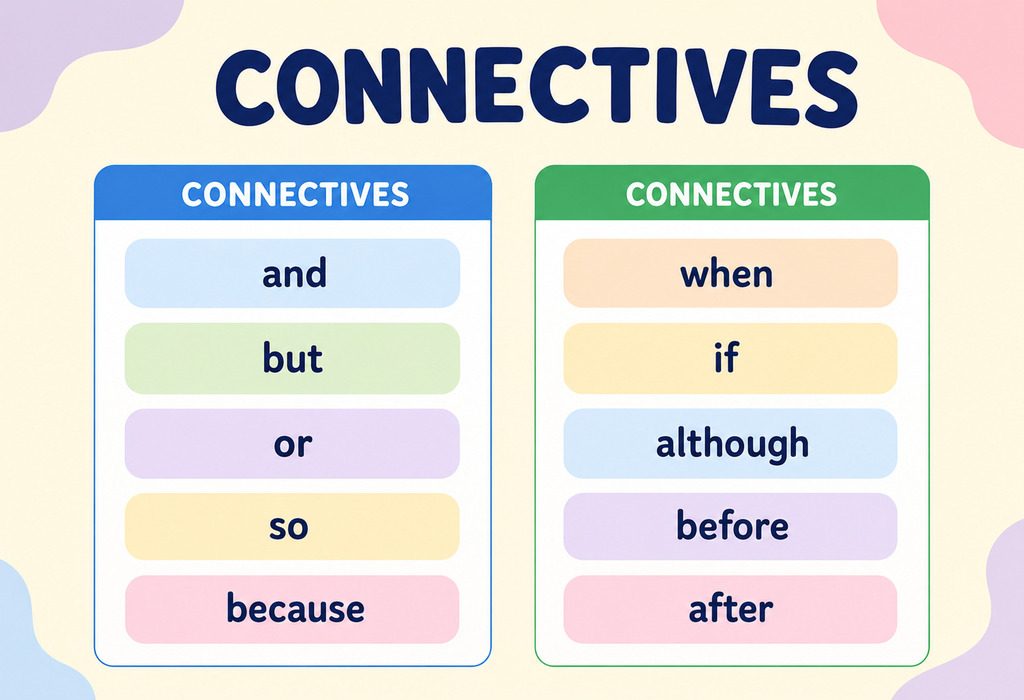
Connectives are an essential part of the English language, helping us link ideas, sentences and paragraphs together so our writing and speech flow smoothly. Without connectives in English, sentences would feel disjointed and difficult to follow, as these words act as a bridge between one thought and the next. Connective words show relationships such as addition, contrast, cause and effect, or sequence, allowing children to express more complex ideas as their writing develops.
Thank you for reading this post, don't forget to subscribe!
Learning to use good connectives is an important step for children, as it improves the clarity and structure of their sentences while strengthening their grammar and vocabulary. Whether your child is writing a story, an essay, or simply having a conversation, connectives help them organise their thoughts and communicate more effectively. In this article, we look at the different types of connectives, along with a helpful list and examples, to guide your child in using them confidently.
What are Connectives?
Before diving into the different types and examples, it helps to start with a clear definition of a connective. Let’s break down what this term means and why it matters.
Connectives are words or phrases used to link ideas, sentences or paragraphs together, helping a piece of writing or speech flow logically from one point to the next. They can join two clauses within a single sentence, or connect one sentence to another, showing how the ideas relate to each other. For example, words like “and,” “but,” “because” and “however” are all connectives, each serving a different purpose depending on whether the writer wants to add information, show contrast, explain a reason or introduce a result. Understanding connectives helps children write and speak with greater clarity, as it allows them to organise their thoughts in a structured and coherent way.
Why is it Important to Learn Connectives?
Learning connectives is more than just a grammar exercise; it shapes how clearly a child can express their thoughts. Here’s why this skill matters for young learners.
- Improves Sentence Structure – Connectives help children join short, simple sentences into longer, well-structured ones, making their writing more sophisticated.
- Enhances Clarity – Using the right connective helps children express exactly how their ideas relate to each other, whether it’s cause and effect, contrast or addition.
- Builds Better Writing Skills – Essays, stories and letters flow more smoothly when ideas are linked logically, which connectives help achieve.
- Strengthens Spoken Communication – Connectives aren’t just useful in writing; they also help children speak more fluently and organise their thoughts during conversations.
- Prepares Them for Advanced Grammar – Learning connectives lays the foundation for understanding more complex grammar concepts, such as conjunctions and clauses, in later years.
Types of Connectives
Connectives can be grouped into different categories based on the kind of relationship they show between ideas. Here’s a look at the main types your child will come across while learning.
1. Addition Connectives
These connectives are used to add extra information or ideas to a sentence. Common examples include “and,” “also,” “furthermore”, and “in addition.”
2. Contrast Connectives
These connectives are used to show a difference or contrast between two ideas. Common examples include “but,” “however,” “although” and “on the other hand.”
3. Cause and Effect Connectives
These connectives are used to explain the reason behind something or its result. Common examples include “because,” “so,” “therefore” and “as a result.”
4. Sequence Connectives
These connectives are used to show the order in which events or ideas occur. Common examples include “first,” “next,” “then” and “finally.”
5. Comparison Connectives
These connectives are used to compare two ideas or show similarity between them. Common examples include “similarly,” “likewise,” “as” and “just like.”
6. Condition Connectives
These connectives are used to show that one thing depends on another. Common examples include “if,” “unless,” “provided that” and “as long as.”
List of Common Connective Words
Having a handy list of connective words makes it easier for children to pick the right one while writing or speaking. Here are some commonly used connectives your child can start practising with.
| CONNECTIVE WORDS | CONNECTIVE WORDS |
| Meanwhile | And |
| Otherwise | But |
| Whereas | Because |
| Consequently | So |
| Furthermore | Although |
| Nevertheless | However |
| Whenever | Also |
| Wherever | Therefore |
| Regardless | First |
| Nonetheless | Next |
| Thus | Then |
| Hence | Finally |
| Additionally | If |
| Accordingly | Unless |
| Instead | Similarly |
| Besides | While |
| Still | Since |
| Likewise | Moreover |
| Indeed | Though |
| Henceforth | Yet |
Connecting Words Examples
Seeing connective sentences in action helps children understand how these words work in real writing. Here are some simple examples that show connecting words used correctly.
- I wanted to play outside, but it started raining.
- She finished her homework because she wanted to watch a movie.
- He was tired, so he went to bed early.
- Although it was cold, the children went out to play.
- First, we mixed the flour, then we added the eggs.
- She likes painting, and she also enjoys drawing.
- I studied hard; therefore, I did well in the exam.
- Since it was his birthday, we baked him a cake.
- While my mother cooked dinner, I set the table.
- Unless you finish your homework, you cannot watch television.
Fun Activities to Practise Connective Words
Learning connectives doesn’t have to feel like a grammar lesson. Here are some fun, hands-on activities that make practising connective words enjoyable for children.
1. Connective Word Cards
Write different connective words on small cards and ask your child to pick one and use it in a sentence. This helps them practise connectives one at a time in a fun, game-like way.
2. Sentence Joining Game
Give your child two short, simple sentences and ask them to join them using a connective word of their choice. This helps them see how connectives link ideas together smoothly.
3. Story Building
Encourage your child to tell or write a short story, using as many connective words as possible along the way. This helps them use connectives naturally within a longer piece of writing.
4. Fill in the Blanks
Create simple sentences with a connective word missing and ask your child to fill in the blank with the correct one. This helps reinforce their understanding of which connective fits best.
5. Connective Word Hunt
Read a short story or article together and ask your child to spot and circle all the connective words they can find. This helps them recognise connectives in real writing.
6. Connective Bingo
Create a simple bingo sheet with different connective words and call out sentences with a missing connective. Your child marks the word that best completes the sentence. This turns practice into a fun group activity.
Tips for Teaching Connectives to Kids
Teaching connectives can be made simple with the right approach and a bit of patience. Here are some helpful tips to guide your child through this important part of grammar.
- Start with Simple Connectives – Begin with commonly used words like “and,” “but”, and “because” before moving on to more advanced connectives, so your child isn’t overwhelmed early on.
- Use Everyday Conversations – Point out connectives naturally while talking to your child, such as saying “we can’t go out because it’s raining,” to show how they are used in real life.
- Read Together Often – Reading books and stories together helps children notice connectives in context and understand how they link ideas within sentences.
- Practise Through Writing – Encourage your child to use connectives while writing short stories, diary entries or sentences, as regular practice helps the words stick.
- Make Learning Interactive – Use games, flashcards or activities to teach connectives, as hands-on learning often helps children grasp and remember new concepts more easily.
Common Mistakes Kids Should Avoid
Even after learning connectives, children often make a few common errors while using them. Here’s what to watch out for and how to help your child avoid these mistakes.
- Overusing “And” in Every Sentence – Children often rely on “and” to join every idea, such as “I woke up and I ate breakfast, and I went to school,” instead of using varied connectives to make writing more interesting.
- Using the Wrong Connective for the Meaning – A child might write “I was tired, although I went to sleep,” when the correct connective is “so,” since the sentence shows a result, not a contrast.
- Starting Every Sentence with a Connective – Beginning too many sentences with words like “but” or “so” can make writing feel repetitive; encourage your child to also use connectives within sentences.
- Confusing Similar Connectives – Words like “because” and “so” are sometimes mixed up, as one gives a reason while the other shows a result, so it helps to practise them separately.
- Forgetting to Use a Comma with Certain Connectives – Connectives like “however” and “therefore,” when used at the start of a sentence, often need a comma after them, which children may forget while writing.
Practice makes learning stick, especially when it comes to grammar. This worksheet gives your child a fun way to test what they’ve learned about connectives.
FAQs
1. Are Connectives the Same as Conjunctions?
Not exactly. Conjunctions like “and,” “but,” and “because” are a type of connective, but connectives also include transition words and phrases, such as “however” or “as a result,” that link ideas across sentences.
2. Can a Sentence Have More Than One Connective?
Yes, a sentence can use more than one connective, such as “Although it was raining, we went outside because we wanted to play,” as long as the sentence still makes sense.
3. Do Connectives Always Go in the Middle of a Sentence?
No, connectives can appear at the beginning, middle or even end of a sentence, depending on the meaning and structure the writer wants to create.
4. Why Do Some Connectives Need a Comma After Them?
Connectives like “however” and “therefore” often need a comma after them when used at the start of a sentence, as this helps separate the connective from the rest of the idea for clarity.
Connectives play a small but powerful role in helping children express their ideas clearly and confidently, whether in speech or writing. With regular practice using the types, examples and activities covered in this article, your child will steadily learn to choose the right connective for the right moment, making their sentences flow more naturally over time.
Also Read:
Dictation Words for Kids
Root Words for Children
Transition Words for Kids
Word Building for Children