



- What Are Phonics Words And Sight Words?
- Why Are Both Important For Early Reading?
- Benefits Of Learning Phonics And Sight Words
- Phonics Vs. Sight Words
- Examples Of Phonics Versus Sight Words
- Which Should Be Taught First?
- Fun Activities To Practice Phonics And Sight Words
- Common Mistakes To Avoid
- FAQs
Last Updated on August 5, 2026
When it comes to teaching young children to read, two approaches often dominate the conversation: phonics and sight words. The debate around phonics versus sight words has been ongoing for years, with parents and educators trying to determine which method gives children the strongest foundation for reading. Phonics focuses on teaching children to sound out words by understanding the relationship between letters and their sounds, while sight word instruction encourages children to recognise common words instantly, without needing to decode them letter by letter.
Thank you for reading this post, don't forget to subscribe!
Rather than viewing these as competing methods, many early literacy experts now recognise that phonics and sight words often work best when used together, each supporting a different aspect of reading development. In this article, we take a closer look at how these two approaches differ, their respective benefits and limitations, and how combining them thoughtfully can help children become confident, fluent readers from an early age.
What Are Phonics Words And Sight Words?
Understanding the basics of learning to read sight words vs. phonics words helps clarify why both approaches exist in early literacy. Here’s a simple breakdown of what each term actually means.
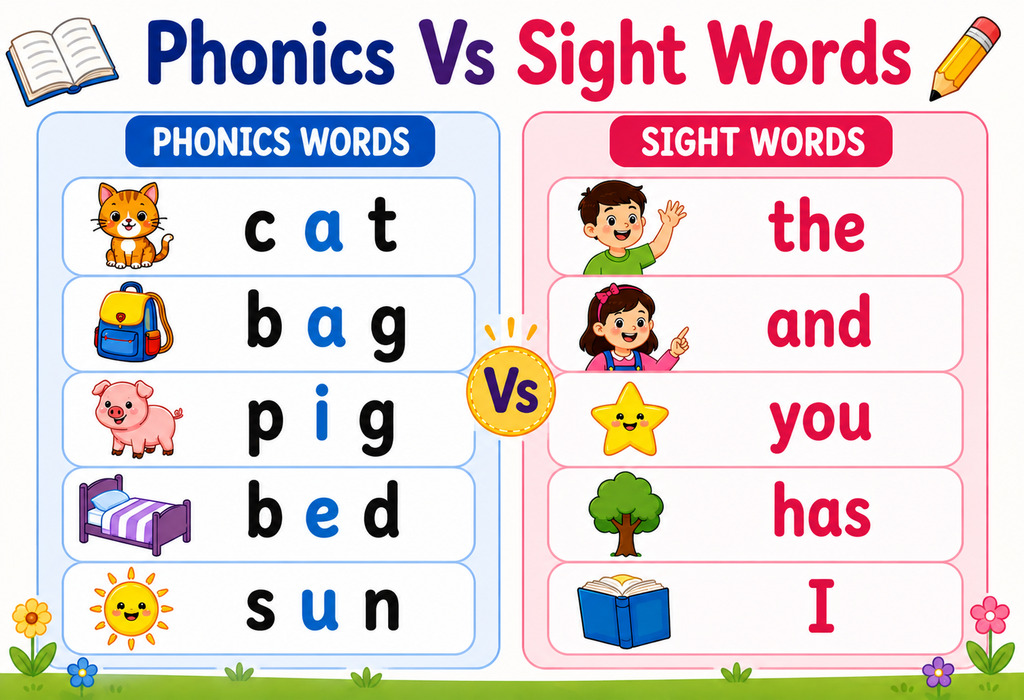
Phonics words are words that can be sounded out by breaking them down into their individual letter sounds, following predictable spelling patterns, such as “cat,” “dog”, or “sun.” These words help children understand the relationship between letters and sounds, allowing them to decode new, unfamiliar words on their own.
Sight words, on the other hand, are commonly used words that children are encouraged to recognise instantly by sight, without needing to sound them out, often because they don’t follow regular phonetic rules, such as “the,” “was” or “said.” Together, these two categories of words form the foundation of most early reading instruction, with phonics helping children decode and sight words helping them read fluently and quickly.
Why Are Both Important For Early Reading?
Understanding why phonics and sight words both matter helps explain why most early literacy programmes teach them together rather than in isolation. Here’s a closer look at how each one supports early reading differently.
Phonics gives children the tools to decode unfamiliar words by sounding them out, which is essential for building independence as a reader, especially when encountering new vocabulary. This skill becomes particularly valuable as children progress to longer, more complex texts where they can’t rely on memory alone. Sight words, on the other hand, allow children to read common, high-frequency words quickly and fluently, without needing to pause and decode every single word, many of which don’t follow standard phonetic rules anyway.
Without sight word recognition, reading would feel slow and effortful even for simple sentences, while without phonics, children would struggle to read anything beyond a memorised set of words. Together, they allow children to read both accurately and fluently, laying a well-rounded foundation for lifelong literacy.
Benefits Of Learning Phonics And Sight Words
Combining both approaches gives children a well-rounded set of reading skills rather than relying on just one method. Here’s a closer look at the key benefits this combination offers.
1. Builds Strong Decoding Skills
Phonics instruction teaches children to break down unfamiliar words into sounds, giving them the tools to read new vocabulary independently, even without prior exposure to the word.
2. Improves Reading Fluency
Sight word recognition allows children to read common words instantly, helping their reading flow more smoothly and naturally, rather than pausing to sound out every single word.
3. Strengthens Spelling Abilities
Understanding phonics patterns helps children spell words more accurately, as they learn to connect sounds with their corresponding letters and letter combinations.
4. Boosts Reading Confidence
When children can both decode unfamiliar words and instantly recognise common ones, they feel more capable and confident tackling new books and texts on their own.
5. Supports Comprehension
Fluent, accurate reading, supported by both phonics and sight words, frees up a child’s mental effort to focus on understanding the meaning of what they’re reading, rather than just decoding it.
6. Prepares Children for Advanced Reading
A strong foundation in both phonics and sight words equips children to handle more complex texts, vocabulary and sentence structures as they progress through school.
Phonics Vs. Sight Words
Understanding the difference between phonics and sight words makes it easier to see how each method contributes to early reading. Here’s a side-by-side comparison of the two approaches.
| PARAMETER | PHONICS | SIGHT WORDS |
| Definition | Teaches children to sound out words by connecting letters to their sounds | Teaches children to instantly recognise common words by memory |
| Approach | Decoding-based, breaking words into individual sounds | Recognition-based, relying on visual memory |
| Best Suited For | Words that follow regular spelling and sound patterns | Words that are irregular or don’t follow standard phonetic rules |
| Skill Developed | Builds decoding and spelling skills | Builds reading speed and fluency |
| Example Words | Cat, dog, sun, bat | The, was, said, of |
| Learning Method | Systematic instruction of letter-sound relationships | Repetition, flashcards and memorisation |
| Long-Term Benefit | Helps children read new, unfamiliar words independently | Helps children read common words quickly without pausing |
Examples Of Phonics Versus Sight Words
Seeing real examples side by side makes it easier to understand how these two types of words differ in practice. These are two separate lists, not matching pairs, since phonics and sight words serve different purposes.
| PHONICS WORD EXAMPLES | SIGHT WORD EXAMPLES |
| The cat sat on the mat. | The sun is shining today. |
| My dog likes to run. | I was at the park. |
| We saw the sun in the sky. | She said hello to me. |
| The bat flew at night. | This is a picture of a dog. |
| I have a blue pen. | Can you help me? |
| Look at the map on the wall. | They went to the shop. |
| The frog can hop fast. | We have a new toy. |
| That is a big balloon. | I am the one who did it. |
| I like to run in the park. | Please come here. |
| Put the toy on top. | I will do my homework. |
Which Should Be Taught First?
This is one of the most debated questions in early literacy, but current research offers a fairly clear answer. Here’s what most reading experts recommend.
Most reading specialists now agree that phonics should be taught first, as early readers need to understand how sounds and letters work before memorising whole words.
Once this foundation is in place, a small number of high-frequency words are often introduced so children can begin reading simple sentences before mastering every phonics pattern. These are usually treated as temporary “known words” rather than words for long-term memorisation.
Even irregular words like “said” are mostly regular when broken down, with only a small part behaving unpredictably, which is why many modern phonics programmes teach these words through a sound-based approach as well.
In short, phonics should form the foundation of early reading, with sight words playing a smaller, supporting role for genuinely irregular words.
Fun Activities To Practice Phonics And Sight Words
Learning to read doesn’t have to feel like hard work when the right activities are involved. Here are six fun ways to help your child practise both phonics and sight words.
1. Sound Hunt
Give your child a specific letter sound, such as “b” or “m,” and set a timer for a few minutes as they search the house or garden for objects that start with that sound. Encourage them to say each object’s name aloud slowly, emphasising the starting sound, which helps reinforce letter-sound relationships in a playful, low-pressure way.
2. Sight Word Bingo
Create simple bingo cards filled with common sight words your child is currently learning, then call out each word one at a time for them to find and mark. Unlike flashcards, the game format encourages quick recognition under a bit of friendly pressure, which helps these irregular words move from memory into instant recall.
3. Word Building with Letter Tiles
Use magnetic letters or letter cards to help your child build a simple phonetic word, such as “cat,” then challenge them to change just one letter at a time to form new words, like “bat,” “hat”, or “cot.” This hands-on manipulation helps children see how small changes in letters lead to entirely new sounds and words, reinforcing decoding skills in a very visual way.
4. Sight Word Flashcard Race
Flip through a stack of sight word flashcards quickly, encouraging your child to read each word aloud the moment they see it, without pausing to sound it out. Turning this into a timed challenge, either against themselves or a sibling, adds a bit of friendly competition that motivates faster, more automatic word recognition over time.
5. Silly Sentence Making
Ask your child to pick one phonics word and one sight word from a small pile of cards, then combine them into the silliest sentence they can think of, such as “The cat was on the moon.” This playful exercise encourages them to apply both types of words together naturally, rather than practising them in isolation.
6. Word Sorting Game
Prepare a mixed pile of word cards containing both phonics words and sight words, and ask your child to sort them into two separate piles based on whether the word can be sounded out or needs to be memorised. This activity strengthens their understanding of why these two categories exist and helps them start recognising the difference independently.
Common Mistakes To Avoid
Even with the best intentions, a few common missteps can slow down a child’s early reading progress. Here’s what to watch out for while teaching phonics and sight words.
- Relying Too Heavily on Sight Words Alone – Teaching children to memorise large numbers of words by sight, without a strong phonics foundation, can leave gaps in their ability to decode new or unfamiliar words later on.
- Introducing Sight Words Too Early – Presenting sight words before a child has developed basic phonemic awareness can encourage guessing rather than genuine reading, making it harder to build strong decoding habits.
- Skipping Systematic Phonics Instruction – Jumping between random letter sounds without a structured sequence can confuse children, rather than helping them build on previously learned patterns.
- Treating All Sight Words as Fully Irregular – Many so-called sight words are only partly irregular, so avoiding phonics-based explanations for these words altogether misses an opportunity to reinforce decoding skills.
- Overloading Children with Too Many Words at Once – Introducing too many phonics patterns or sight words in a short period can overwhelm young learners, making retention harder rather than easier.
- Not Practising Words in Context – Teaching words in isolation, without using them in sentences or stories, can make it harder for children to apply what they’ve learned during actual reading.
Sometimes a quick visual summary makes all the difference in understanding a topic at a glance. Here’s an infographic that brings together the key differences between phonics and sight words.
FAQs
1. Can a Word Be Both a Phonics Word and a Sight Word?
Yes, some high-frequency words that follow regular phonics patterns, such as “and” or “up,” are sometimes taught as sight words in schools simply because they appear so often, even though they can technically be sounded out.
2. Why Do Some Words Not Follow Phonics Rules at All?
English has borrowed words from many different languages over centuries, which is why some words, like “said” or “of,” don’t follow the usual letter-sound patterns we’d expect.
3. How Can I Tell if My Child Is Guessing Instead of Reading?
If a child looks at the first letter of a word and guesses based on its length or a picture nearby, rather than sounding it out, it’s a sign they may be relying on guessing instead of genuine decoding.
4. At What Age Should Children Start Learning Phonics and Sight Words?
Phonics instruction can begin as early as age three or four, while sight words are usually introduced gradually once a child has developed basic phonemic awareness, often around kindergarten age.
Phonics and sight words aren’t really competing methods; they’re two pieces of the same puzzle. With a strong phonics foundation to decode new words and a small set of sight words to handle the exceptions, children build the skills they need to read accurately, fluently and with confidence over time.
Also Read:
CVC Words
Dictation Words For Kids
Vocabulary Words for Kids
Pictionary Words for Children