



- Key Points To Include In Your Speech On Independence Day
- 5 Line Speech On Independence Day
- 10 Line Speech On Independence Day
- 1 Minute Speech On Independence Day
- 2 Minute Speech On Independence Day
- Short Speech On Independence Day
- Long Speech On Independence Day
- Quotes For Independence Day Speech
- FAQs
Last Updated on August 7, 2026
Independence Day is one of the most significant occasions celebrated across India, marking the day the country gained freedom from British rule in 1947. Preparing an English speech for Independence Day gives children a meaningful way to reflect on the sacrifices made by freedom fighters while building their confidence in public speaking, whether for a school assembly or a flag hoisting ceremony.
Thank you for reading this post, don't forget to subscribe!
A 15th August Independence Day speech doesn’t need to be lengthy to leave an impact; even a short, well-structured piece can convey deep respect for the nation’s history. In this article, we bring you a range of speeches, from short ten-line versions for younger students to longer, more detailed ones for older children, to help your child prepare a heartfelt speech for this important occasion.
Key Points To Include In Your Speech On Independence Day
Whether your child is preparing an Independence Day speech for classes 1, 2, and 3 or a higher grade, a few key points can help them structure their thoughts effectively. Here’s what to keep in mind while writing.
- Start with a Respectful Greeting – Begin the speech by addressing the audience, such as the principal, teachers and fellow students, before moving into the topic.
- Mention the Significance of the Day – Include why India celebrates Independence Day on the 15th of August and what freedom means to the nation.
- Talk About Freedom Fighters – Briefly mention the sacrifices made by freedom fighters, as this adds depth and respect to the speech.
- Keep the Language Simple – Use age-appropriate words and short sentences so the speech is easy to understand and deliver confidently.
- Include a Patriotic Thought – Add a line about love for the country or the importance of unity, which helps convey the spirit of the occasion.
- End with a Strong Closing – Conclude with a patriotic slogan or a respectful thank-you note to leave a lasting impression on the audience.
- Review and Practise – Read through the speech to check for mistakes, then rehearse it a few times aloud to build confidence and improve delivery.
5 Line Speech On Independence Day
This short speech for LKG, class 1, and class 2 students keeps things simple while still capturing the spirit of the occasion. Here are five easy lines your child can practise and deliver with confidence.
- Good morning, everyone. Today, we are celebrating Independence Day.
- India gained freedom from British rule on the 15th of August, 1947.
- We are free today because of the sacrifices of many brave freedom fighters.
- We should be proud to be citizens of our great country.
- Let us always work together to keep our country united and strong. Thank you.
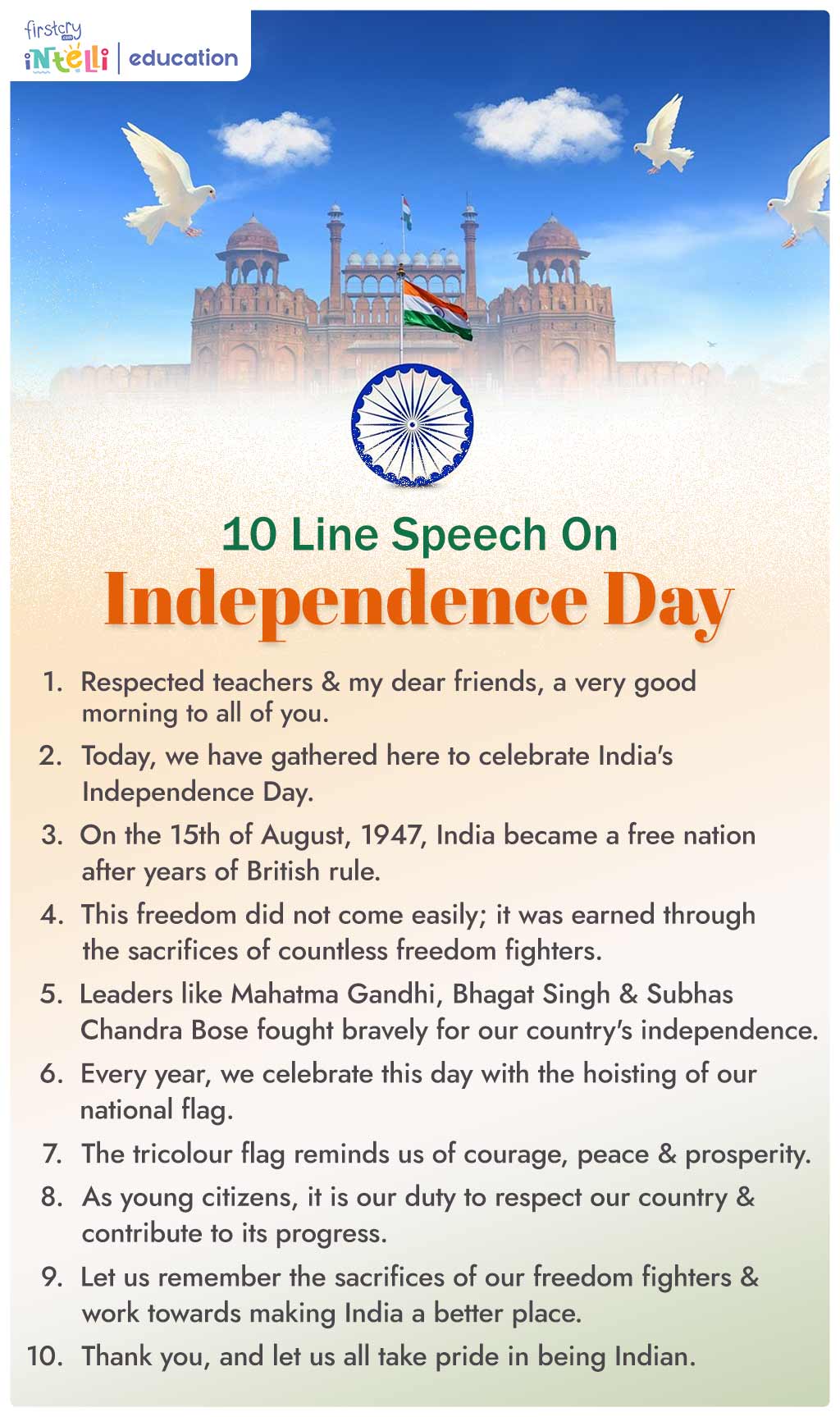
10 Line Speech On Independence Day
This slightly longer speech for class 3 gives young students a bit more room to talk about the day’s significance. Here are ten simple lines your child can use for their speech.
- Respected teachers and my dear friends, a very good morning to all of you.
- Today, we have gathered here to celebrate India’s Independence Day.
- On the 15th of August, 1947, India became a free nation after years of British rule.
- This freedom did not come easily; it was earned through the sacrifices of countless freedom fighters.
- Leaders like Mahatma Gandhi, Bhagat Singh, and Subhas Chandra Bose fought bravely for our country’s independence.
- Every year, we celebrate this day with the hoisting of our national flag.
- The tricolour flag reminds us of courage, peace and prosperity.
- As young citizens, it is our duty to respect our country and contribute to its progress.
- Let us remember the sacrifices of our freedom fighters and work towards making India a better place.
- Thank you, and let us all take pride in being Indian.
1 Minute Speech On Independence Day
For quick classroom slots, this 15th August speech in English for students covers the key points without taking up too much time. It works well when speaking time is limited, but the message still needs to land.
Respected teachers and my dear friends, a very good morning to all of you.
Today, we have gathered here to celebrate a very special day in our nation’s history, the 15th of August, Independence Day. On this day in 1947, India finally became free from British rule after years of struggle and sacrifice.
Countless freedom fighters, including Mahatma Gandhi, Bhagat Singh and Subhas Chandra Bose, dedicated their lives so that we could live in a free country today. Their courage and determination continue to inspire us even now. Every year, we honour their sacrifice by hoisting our national flag and remembering the values of unity, courage and freedom that our tricolour represents.
As young citizens, it is our responsibility to respect our nation and work towards its growth.
Let us take a moment to be grateful for our freedom and pledge to make our country proud. Thank you.
2 Minute Speech On Independence Day
Two minutes is enough time to move past the basic facts and actually reflect on what freedom means. This speech gives your child that extra space to speak a little more thoughtfully about the occasion.
Respected principal, teachers and my dear friends, a very good morning to all of you. Today, we have gathered here to celebrate one of the most important days in our nation’s history, the 15th of August, Independence Day.
On this day in 1947, India finally broke free from nearly two hundred years of British rule. This freedom was not handed to us easily; it was earned through decades of struggle, sacrifice and unwavering determination. Countless freedom fighters, both well-known and unnamed, gave up their comfort, their safety and, in many cases, their lives, so that future generations could live with dignity and choice.
Leaders like Mahatma Gandhi taught the power of peaceful resistance, showing the world that change doesn’t always require violence. Bhagat Singh and other young revolutionaries showed extraordinary courage in the face of great risk. Subhas Chandra Bose inspired thousands with his call for complete independence. Alongside these well-known names, there were also countless ordinary citizens, farmers, students, and workers who took part in protests and movements across the country, often at great personal cost.
Every year, on this day, we hoist our national flag as a tribute to their sacrifice. The tricolour stands for more than just a piece of cloth; it represents courage, peace and the hard-won unity of a diverse nation. When we look at it, we’re reminded that freedom is not something to take for granted.
As young citizens, our responsibility doesn’t end with celebration. It extends to how we treat one another, how we contribute to our communities, and how seriously we take the freedoms we’ve inherited. Respecting our country means striving to make it better, whether through education, honesty, or simply being a good citizen in our everyday lives.
On this Independence Day, let us take a moment to genuinely appreciate the freedom we often take for granted, and let us carry forward the spirit of those who fought for it. Thank you.
Short Speech On Independence Day
Not every occasion calls for a long address, and sometimes a brief speech says just as much. Here’s a shorter version that still covers the key points of the day.
Respected principal, teachers and my dear friends, a very good morning to all of you.
Today, we have gathered here to celebrate the 15th of August, Independence Day, one of the most significant days in our nation’s history.
Seventy-eight years ago, in 1947, India finally gained freedom after nearly two hundred years of British colonial rule. This wasn’t a sudden or easy achievement. It was the result of decades of resistance, protest, and sacrifice by people across the country who believed that India deserved to govern itself.
The road to independence was shaped by many different approaches. Mahatma Gandhi led the freedom movement through non-violent resistance, teaching the country that peaceful protest, through methods like the Salt March and the Quit India Movement, could challenge even the most powerful empire. Alongside him, revolutionaries like Bhagat Singh, Chandrashekhar Azad, and Rajguru took a more direct approach, willing to risk everything, including their own lives, for the cause of freedom. Subhas Chandra Bose formed the Indian National Army and rallied Indians abroad to fight for independence, famously declaring, “Give me blood, and I shall give you freedom.”
But independence wasn’t won by a handful of well-known leaders alone. It was the collective effort of millions of ordinary people, students who left their studies to join protests, women who marched alongside men despite social restrictions, and farmers and workers who went on strike, often facing arrest or worse. Many of their names are not recorded in history books, yet their contribution to India’s freedom was just as vital.
When the country finally became independent on the 15th of August, 1947, it marked the beginning of a new chapter, one where Indians would shape their own future rather than live under foreign rule. Since then, this date has been observed every year with flag hoisting ceremonies, cultural programmes, and moments of reflection across schools, offices and public spaces.
The tricolour flag we see hoisted today carries deep meaning. Its saffron represents courage and sacrifice, white stands for peace and truth, and green symbolises growth and prosperity, with the Ashoka Chakra at its centre representing progress and the eternal wheel of law. When we salute this flag, we’re not just following a tradition; we’re acknowledging everything it took to earn it.
As students, our role in nation-building may look different from that of the freedom fighters who came before us, but it matters just as much. Respecting the law, valuing education, treating others fairly, and taking pride in honest work are all ways we contribute to the country’s progress today. Freedom, after all, isn’t just about having rights; it’s also about the responsibility that comes with them.
On this Independence Day, let us take a moment to genuinely reflect on how far our country has come, and let us commit to being citizens who honour that legacy, not just today, but in how we live each day after.
Thank you, and happy Independence Day to all of you.
Long Speech On Independence Day
For assemblies with more speaking time, this longer speech takes a closer look at India’s freedom struggle and what independence continues to mean today. It gives older students room to explore the occasion in greater depth.
Respected principal, teachers and my dear friends, a very good morning to all of you.
Today, I stand before you to speak on an occasion that holds deep significance for every Indian, the 15th of August, our nation’s Independence Day.
This day is not just a holiday marked on the calendar; it represents the culmination of a long, difficult and often painful journey towards freedom, one that shaped the country we live in today.
Importance Of Independence Day
Independence Day matters because it reminds us that the freedoms we often take for granted- the right to vote, to speak our minds, to choose our own leaders- were not always guaranteed. For nearly two centuries, India was under British colonial rule, during which its resources were exploited, its people were denied basic rights, and its culture was often suppressed. The significance of this day lies in recognising that independence was not simply given; it was fought for, argued for, and in many cases, died for.
Beyond the historical weight, Independence Day also serves as an annual reminder of national identity. It’s a day when, regardless of our differences in language, religion or region, we’re united by a shared history and a shared responsibility toward the country’s future. Schools, offices and public spaces across India pause to hoist the national flag, sing the national anthem, and reflect on what it means to be a citizen of a free nation.
History Of Independence
India’s path to independence was neither quick nor straightforward. British rule in India began formally with the East India Company in the 18th century and was consolidated under direct British Crown control after the Revolt of 1857. For decades, Indian resources were extracted, local industries were weakened, and Indian citizens had little say in how their own country was governed.
Organised resistance grew steadily through the late 19th and early 20th centuries. The formation of the Indian National Congress in 1885 gave the independence movement a more structured voice. Over time, the movement evolved from polite petitions to mass civil disobedience, as leaders realised that meaningful change would require the active participation of ordinary citizens, not just political negotiation.
Key milestones included the Non-Cooperation Movement in the 1920s, the Civil Disobedience Movement and the Salt March in 1930, and finally the Quit India Movement in 1942, which demanded an unconditional end to British rule. After years of protest, negotiation and immense sacrifice, India finally gained independence on the 15th of August, 1947, though it came at the cost of Partition, which brought its own tragic chapter of displacement and loss.
Contributions Of Freedom Fighters
India’s independence was shaped by leaders and ordinary citizens who approached the struggle in very different ways. Mahatma Gandhi championed non-violent resistance, believing that moral courage and mass civil disobedience could dismantle even the most powerful empire. His methods, including the Salt March and the call for Swadeshi, encouraged Indians to reclaim their economic and political independence through peaceful means.
Alongside Gandhi’s approach, other leaders pursued more direct methods. Bhagat Singh, Chandrashekhar Azad and Rajguru believed that armed resistance was necessary to shake the foundations of colonial rule, and they paid for their convictions with their lives. Subhas Chandra Bose took yet another path, forming the Indian National Army and rallying support from Indians living abroad, famously urging his fellow countrymen with the words, “Give me blood, and I shall give you freedom.”
Equally important, though often less documented, was the contribution of countless ordinary Indians, students who left their education to join protests, women who defied social norms to march alongside men, and workers and farmers who staged strikes despite the risk of arrest or violence. Independence was not the achievement of a few individuals alone; it was the result of a nationwide movement sustained by people from every background and walk of life.
As we reflect on this Independence Day, it’s worth remembering that freedom is not a static achievement; it requires ongoing effort to protect and strengthen. The freedom fighters who came before us gave us the right to shape our own future, but what we do with that freedom is up to us. Respecting the law, valuing education, contributing honestly to our communities, and standing up for fairness are all quiet but meaningful ways we can honour their legacy today.
On this 15th of August, let us take pride not just in what our country has achieved, but in what we, as its citizens, choose to build going forward. With that thought, I would like to conclude my speech.
Thank you, and a very happy Independence Day to all of you.
Quotes For Independence Day Speech
A well-chosen quote can add depth and emotion to a speech, helping the audience connect with the occasion. Here are six quotes by prominent freedom fighters that work well for an Independence Day address.
- “Swaraj is my birthright, and I shall have it.” — Bal Gangadhar Tilak.
- “Give me blood, and I shall give you freedom.” — Subhas Chandra Bose.
- “The best way to find yourself is to lose yourself in the service of others.” — Mahatma Gandhi.
- “Every citizen of India must remember that he is an Indian and he has every right in this country, but with certain duties.” — Sardar Vallabhbhai Patel.
- “We want deeper sincerity of motive, a greater courage in speech, and earnestness in action.” — Sarojini Naidu.
- “One individual may die for an idea, but that idea will, after his death, incarnate itself in a thousand lives.” — Subhas Chandra Bose.
FAQs
1. Should I Mention the National Anthem or Flag Code in My Speech?
You don’t have to, but briefly mentioning the significance of the tricolour or the tradition of singing the national anthem can add a respectful touch to your speech.
2. Can I Talk About Independence Day Celebrations in My Own School or City?
Yes, describing how your school or city celebrates the day, such as flag hoisting or cultural programmes, can make your speech feel more personal and relatable.
3. How Can I Make My Speech Sound Less Like It Was Copied From A Book?
Try rephrasing facts in your own words and adding a personal thought or reflection, rather than reciting historical details exactly as they appear elsewhere.
4. Is It Okay to Mention Independence Day Alongside Republic Day in My Speech?
It’s best to keep the focus on Independence Day alone, as mixing the two occasions, which mark different events, can confuse the audience.
Independence Day is more than a school assignment; it’s a chance for children to reflect on the freedom they’ve inherited and the sacrifices behind it. Whether your child delivers a quick five-line speech or a longer, more detailed one, what matters most is that it comes from genuine understanding and respect for the occasion.
Also Read:
Essay on Red Fort
Speech on India for Kids
Essay on Independence Day
Speech on Freedom Fighters