



Last Updated on September 23, 2026
Tigers and turtles usually top the list when kids think of T animals, though the letter holds plenty more once you dig past the obvious. This guide works through animals with ‘T’ for kids, pairing familiar names with a few that rarely make an appearance outside a zoo brochure.
Thank you for reading this post, don't forget to subscribe!
Every entry under animal names that start with the ‘T’ in English carries a specific detail worth remembering, arranged from the most recognisable species down to some genuinely unusual finds.
List Of Animal Names Starting With T
This round-up of ‘T’-letter animal names runs through jungles, oceans, farms, and deserts. Twenty animals make the cut below, each paired with its animal type and typical habitat.
1. Tiger
A tiger’s stripe pattern is as individual as a human fingerprint; no two tigers share the exact same markings, and the pattern even continues through to the skin beneath the fur.
Type Of Animal: Mammal
Where It Is Found: Tigers are found across parts of India, Russia, and Southeast Asia, particularly in forests and grasslands.
2. Turkey
Wild turkeys can sprint at surprising speed and burst into short, powerful flights when startled, a far cry from the slow-moving image most people associate with the farmed version.
Type Of Animal: Bird
Where It Is Found: Turkeys are raised on farms worldwide, with wild populations found across North America.
3. Turtle
A turtle’s shell isn’t a separate object it retreats into; it’s fused directly to its spine and ribs, meaning the shell grows and moves as a living part of the animal’s own skeleton.
Type Of Animal: Reptile
Where It Is Found: Turtles are found in oceans, rivers, and lakes almost worldwide.
4. Tortoise
Some tortoise species live well past 150 years, making them among the longest-lived animals on the planet, with a few individuals reportedly outliving several generations of the same human family.
Type Of Animal: Reptile
Where It Is Found: Tortoises are found in deserts, grasslands, and forests across Africa, Asia, and the Americas.
5. Toad
Toads deal with predators using a bitter, mildly toxic secretion released from glands behind their eyes, enough to make most animals think twice after a single unpleasant bite.
Type Of Animal: Amphibian
Where It Is Found: Toads are found on every continent except Antarctica, particularly in damp gardens and woodlands.
6. Tarantula
Despite their fearsome reputation, most tarantula bites are no worse than a bee sting to humans, and several species are docile enough to be handled carefully by experienced keepers.
Type Of Animal: Arachnid
Where It Is Found: Tarantulas are found in deserts, forests, and grasslands across the Americas, Africa, and Asia.
7. Toucan
A toucan’s oversized, colourful beak looks heavy but is almost entirely hollow, making up nearly a third of the bird’s total length while adding very little to its actual weight.
Type Of Animal: Bird
Where It Is Found: Toucans are found in the rainforests of Central and South America.
8. Tuna
Tuna are among the fastest fish in the ocean; some species can reach bursts of over 70 kilometres per hour, and unlike most fish, they can partially regulate their own body temperature.
Type Of Animal: Fish
Where It Is Found: Tuna are found in warm and temperate oceans worldwide.
9. Tadpole
A tadpole starts life breathing through gills and swimming with a tail, then gradually grows legs, loses its tail, and develops lungs, one of the most complete transformations in the animal world.
Type Of Animal: Amphibian
Where It Is Found: Tadpoles are found in ponds, streams, and still water almost worldwide.
10. Tapir
A tapir’s short, flexible snout works almost like a mini trunk, letting it grab leaves and strip bark from branches it couldn’t otherwise reach with just its mouth.
Type Of Animal: Mammal
Where It Is Found: Tapirs are found in the rainforests of Central and South America, and parts of Southeast Asia.
11. Termite
A single termite mound can house millions of individuals working off a shared, decentralised system, with no single termite directing the colony’s complex tunnels and temperature-controlled chambers.
Type Of Animal: Insect
Where It Is Found: Termites are found in forests, grasslands, and deserts across nearly every continent.
12. Tasmanian Devil
Despite its small size, a Tasmanian devil has one of the strongest bites relative to body size of any living mammal, capable of crushing bone to access every part of a carcass.
Type Of Animal: Mammal
Where It Is Found: Tasmanian devils are found only on the Australian island of Tasmania.
13. Tree Frog
Sticky pads on a tree frog’s toes work through a combination of surface tension and tiny grooves, letting it cling to smooth leaves and glass alike without slipping.
Type Of Animal: Amphibian
Where It Is Found: Tree frogs are found in rainforests and wetlands across the Americas, Asia, and Australia.
14. Trout
A trout’s sense of smell is sharp enough to detect minute chemical traces in water, a skill some species rely on to navigate back to the exact stream where they hatched.
Type Of Animal: Fish
Where It Is Found: Trout are found in cold rivers, streams, and lakes across the Northern Hemisphere.
15. Tick
A tick can survive over a year without a single meal, slowing its body functions almost to a standstill while it waits, sometimes for months, for a host to pass close enough to latch onto.
Type Of Animal: Arachnid
Where It Is Found: Ticks are found in grasslands, forests, and woodlands almost worldwide.
16. Tiger Shark
A tiger shark’s stomach has been found holding an unusual mix of objects, from license plates to old tyres, earning it a reputation as one of the least picky eaters in the ocean.
Type Of Animal: Fish
Where It Is Found: Tiger sharks are found in tropical and subtropical oceans worldwide.
17. Tamarin
Tamarin troops share parenting duties unusually evenly, with fathers and even older siblings often carrying infants for most of the day, only handing them back to the mother to feed.
Type Of Animal: Mammal
Where It Is Found: Tamarins are found in the rainforests of Central and South America.
18. Tarsier
A tarsier’s eyes are so large that each one is roughly the size of its entire brain, and since they can’t move within their sockets, the animal rotates its whole head nearly 180 degrees instead.
Type Of Animal: Mammal
Where It Is Found: Tarsiers are found on islands across Southeast Asia, particularly in the Philippines and Indonesia.
19. Tern
Arctic terns undertake one of the longest migrations of any animal on record, travelling from one pole to the other and back again over the course of a single year.
Type Of Animal: Bird
Where It Is Found: Terns are found along coastlines and near large bodies of water almost worldwide.
20. Tegu
A tegu can regulate its body temperature to a degree unusual for a reptile, raising it several degrees above its surroundings during the breeding season, a trait more commonly seen in mammals.
Type Of Animal: Reptile
Where It Is Found: Tegus are found across South America, particularly in forests and grasslands.
More Animal Names Beginning With T
Twenty barely covers what T has to offer. A wider set of letter ‘T’ animal names stretches well beyond this list, and several wild animals with the letter ‘T’ here rarely show up outside specialist wildlife content.
- Tabby Cat
- Tamandua
- Tang Fish
- Tarpan
- Tawny Owl
- Termite Hawk
- Terrier
- Thorny Devil
- Thrush
- Tibetan Mastiff
- Tiger Beetle
- Tiger Salamander
- Titmouse
- Toadfish
- Tomcod
- Tragopan
- Trapdoor Spider
- Tree Kangaroo
- Trumpeter Swan
- Tusk Fish
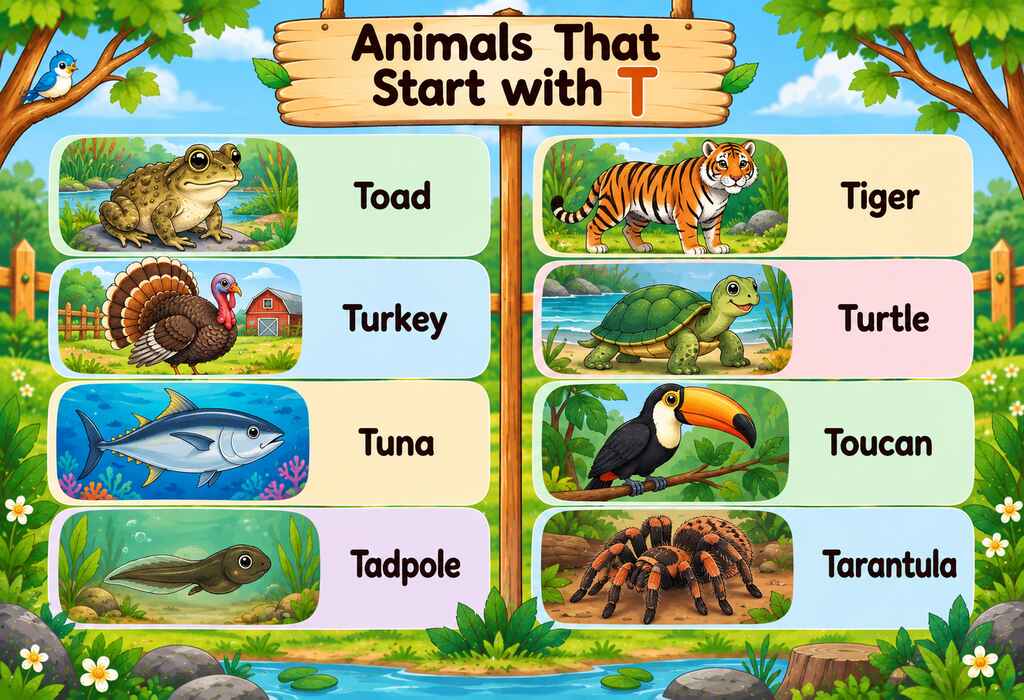
Animals That Start with ‘T’ – Chart
Looking to browse the letter ‘T’ animals covered in this guide all at once? The chart below lays out every name from the list above.
FAQs
1. Why Do Tigers Have Such Distinctive, Individual Stripe Patterns?
Stripe patterns form during early development in the womb and are unique to each tiger, similar to a human fingerprint, which researchers sometimes use to help identify and track individual animals in the wild.
2. Is It True A Tarantula’s Bite Isn’t As Dangerous As People Think?
Yes, for most species and most healthy adults, a tarantula bite causes only mild pain and swelling, comparable to a bee sting, though some people can have stronger reactions depending on sensitivity.
3. How Does A Tarsier See So Well If Its Eyes Can’t Move?
Since a tarsier’s enormous eyes are fixed in place, it compensates with an extremely flexible neck, allowing it to swivel its head almost all the way around to scan its surroundings instead.
4. Which Farm Animals Start With The Letter ‘T’?
The turkey is the best-known example among farm animals that start with the letter ‘T’, raised worldwide primarily for its meat, especially around seasonal holidays.
A stripe pattern as unique as a fingerprint and a frog that grows lungs from scratch are just two reasons T earns more attention than it usually gets. This set of animal names starting with T makes the case that even a mid-alphabet letter can hold its own against the flashier ones.