


Last Updated on September 25, 2026
The letter V introduces children to a distinctive set of animals, from scavenging vultures and venomous vipers to smaller, lesser-known species like the vicuña and vinegaroon. This collection of animals with ‘V’ for kids covers mammals, birds, reptiles, and insects, giving young learners a broad look at how differently animals can look, hunt, and survive.
Thank you for reading this post, don't forget to subscribe!
Each entry among these animal names that start with the ‘V’ in English includes a specific, memorable fact rather than a simple label, helping children connect a name with something real about how that animal lives.
List Of Animal Names Starting With ‘V’
This round-up of ‘V’-letter animal names spans forests, deserts, and oceans. Below are 12 animals starting with V, each with a description, animal type, and habitat.
1. Vulture
A vulture’s stomach is acidic enough to safely digest rotting meat that would sicken almost any other animal, and its bald head exists purely to stay clean while feeding on carcasses.
Type Of Animal: Bird
Where It Is Found: Vultures are found across Africa, Asia, the Americas, and parts of Europe.
2. Viper
Most vipers can strike and inject venom in well under half a second, one of the fastest reaction times of any predator, giving prey almost no chance to react.
Type Of Animal: Reptile
Where It Is Found: Vipers are found across Africa, Asia, Europe, and the Americas, particularly in forests and grasslands.
3. Vole
A single vole can produce dozens of offspring in a year, since females are capable of becoming pregnant again within hours of giving birth, making them one of the fastest-breeding mammals.
Type Of Animal: Mammal
Where It Is Found: Voles are found across grasslands, meadows, and woodlands throughout the Northern Hemisphere.
4. Vervet Monkey
Vervet monkeys use different alarm calls for different predators, one specific call for snakes, another for eagles, and another for leopards, each triggering a distinct escape response in the troop.
Type Of Animal: Mammal
Where It Is Found: Vervet monkeys are found across the savannas and woodlands of eastern and southern Africa.
5. Vampire Bat
Rather than sucking blood, a vampire bat makes a small, precise cut and laps up blood using its tongue, aided by an anticoagulant in its saliva that keeps the wound from clotting.
Type Of Animal: Mammal
Where It Is Found: Vampire bats are found across Mexico, Central America, and South America.
6. Vicuña
Prized for centuries for its exceptionally fine wool, the vicuña produces fibres so fine that historically only Incan royalty were permitted to wear garments made from it.
Type Of Animal: Mammal
Where It Is Found: Vicuñas are found in the high-altitude grasslands of the Andes Mountains in South America.
7. Vervain Hummingbird
One of the smallest birds in the world, the vervain hummingbird beats its wings so fast that they blur into an audible hum, allowing it to hover almost motionless in front of a flower.
Type Of Animal: Bird
Where It Is Found: Vervain hummingbirds are found only on the islands of Jamaica and Hispaniola.
8. Velvet Ant
Despite the name, the velvet ant is actually a wasp, and the female’s sting is considered so painful that it’s earned the nickname “cow killer” in parts of the United States.
Type Of Animal: Insect
Where It Is Found: Velvet ants are found across warm, dry regions in the Americas.
9. Vole Rat
Also known as the naked mole rat’s close relative, the vole rat spends nearly its entire life underground, relying on a network of tunnels rather than eyesight to navigate.
Type Of Animal: Mammal
Where It Is Found: Vole rats are found in burrows across parts of eastern Africa.
10. Vulture Bee
Unlike typical bees, the vulture bee has evolved to feed on rotting meat instead of nectar, using specially adapted gut bacteria to safely digest a diet closer to a scavenger’s than a pollinator’s.
Type Of Animal: Insect
Where It Is Found: Vulture bees are found in the tropical forests of Central and South America.
11. Violet-backed Starling
Male violet-backed starlings carry a shimmering, almost metallic purple sheen across their back, a colour so vivid it can look entirely different depending on the angle of the light.
Type Of Animal: Bird
Where It Is Found: Violet-backed starlings are found across sub-Saharan Africa, particularly in woodlands and forest edges.
12. Vinegaroon
Despite its fearsome, scorpion-like appearance, the vinegaroon has no venomous sting at all, instead defending itself by spraying a strong, vinegar-scented acid from its tail when threatened.
Type Of Animal: Arachnid
Where It Is Found: Vinegaroons are found in deserts and dry grasslands across the Americas and Asia.
More Animal Names Beginning With V
A few further letter ‘V’ animal names exist beyond the twelve covered above, including the Verreaux’s eagle-owl, Vietnamese pot-bellied pig, and Von der Decken’s hornbill. The Vietnamese pot-bellied pig stands out as one of the only widely recognised farm animals that start with the letter ‘V’, kept both for farming and increasingly as a household pet.
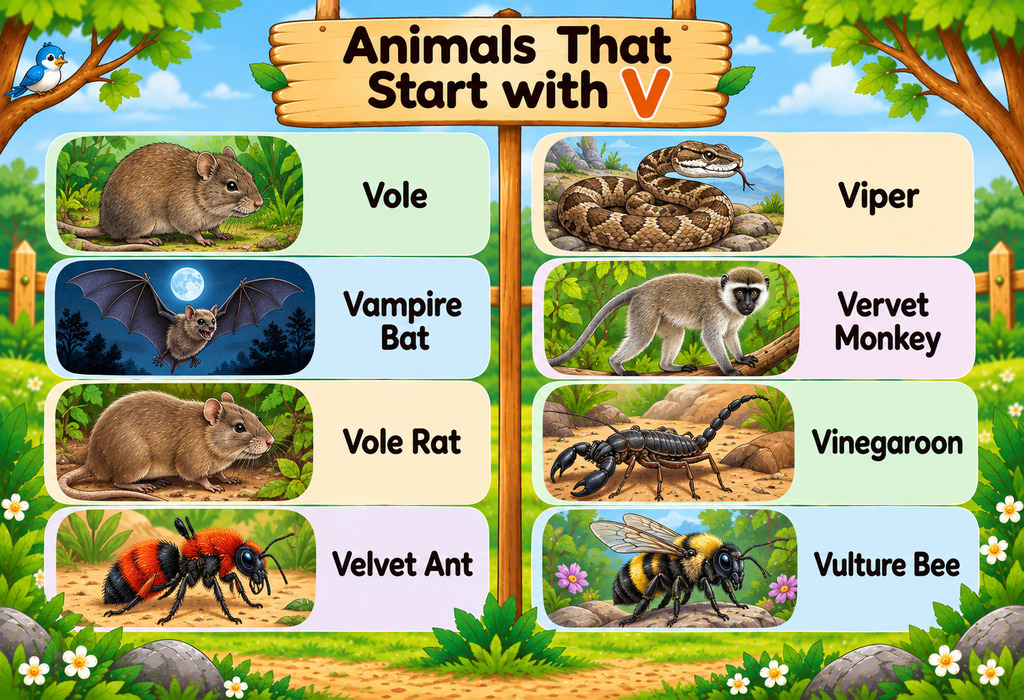
Animals That Start with V – Chart
The chart below covers every animal name featured among the letter ‘V’ animals in this guide.
FAQs
1. Why Do Vampire Bats Need An Anticoagulant In Their Saliva?
Blood clots quickly once exposed to air, so without something to stop that process, a vampire bat wouldn’t be able to feed for long. The anticoagulant keeps the wound open just long enough for it to finish its meal.
2. Is The Vinegaroon Actually Dangerous To Humans?
No, despite looking intimidating, it has no venom or sting capable of seriously harming a person; its vinegar-like spray mainly irritates the eyes and mucous membranes rather than being dangerous.
3. Why Did Only Incan Royalty Get To Wear Vicuña Wool?
Vicuña fibre is exceptionally fine and rare, since the animals produce very little wool and were historically difficult to farm, making garments made from it a genuine luxury reserved for the highest social classes.
4. How Do Vervet Monkeys Learn Their Different Alarm Calls?
Vervet monkeys, among the more social wild animals with the letter ‘V’, aren’t born knowing their alarm calls; they learn by observing and imitating older members of the troop, gradually refining their responses as they gain experience with real threats.
Between the acid-spraying vinegaroon and the vervet monkey’s finely tuned alarm system, this collection of V animals shows just how much detail hides behind a letter most people underestimate. Whether it’s a familiar face like the vulture or a genuine surprise like the vulture bee, each entry offers children something specific worth remembering.