



Last Updated on August 30, 2026
The letter E brings together an impressive range of birds, from towering, flightless giants to tiny, jewel-toned songbirds found across gardens and forests. Kids curious about bird names that start with the letter ‘E’ will come across everything from the majestic emu to the vibrant European robin, each with its own set of surprising traits.
Thank you for reading this post, don't forget to subscribe!
Below is a handpicked collection of birds that start with ‘E’ for preschoolers and kids, complete with pictures and simple facts to make learning memorable. Exploring these ‘E’ letter bird names gives children an easy way to build their vocabulary while discovering how different species live, hunt, and adapt to their surroundings. Here’s a closer look at some notable birds starting with E.
List Of Bird Names That Start With ‘E’
From powerful hunters to cheerful garden visitors, birds beginning with ‘E’ offer plenty to discover. Here is a selection of well-known species, along with facts and sightings to help kids recognise them.
1. Emu
The emu is a large, flightless bird native to Australia, known for its long legs and impressive speed on open ground.
Did You Know?
- Emus can run at speeds of up to 50 kilometres per hour.
- They have small, useless wings but powerful legs built for running.
- Male emus are responsible for incubating the eggs and raising the chicks.
- Emus can go without water for several days if needed.
Where You Might See : Emus are found across most of mainland Australia, particularly in open grasslands and woodlands.
2. Eagle
The eagle is a powerful bird of prey known for its sharp talons, keen eyesight, and impressive wingspan.
Did You Know?
- Eagles can spot prey from several kilometres away thanks to their exceptional vision.
- They build some of the largest nests of any bird, often reused and expanded over many years.
- Eagles are found on every continent except Antarctica.
- Many cultures regard the eagle as a symbol of strength and freedom.
Where You Might See : Eagles are found across a wide range of habitats worldwide, including mountains, forests, and coastlines.
3. Emperor Penguin
The emperor penguin is the largest of all penguin species, known for surviving in some of the harshest conditions on Earth.
Did You Know?
- Emperor penguins can dive deeper than any other bird, reaching depths of over 500 metres.
- Male emperor penguins incubate the egg on their feet for around two months without eating.
- They huddle together in large groups to stay warm during freezing temperatures.
- Emperor penguins can hold their breath underwater for over 20 minutes.
Where You Might See : Emperor penguins are found only in Antarctica, particularly along its icy coastline.
4. European Robin
The European robin is a small, friendly songbird easily recognised by its bright orange-red chest.
Did You Know?
- European robins are known for being unusually bold around humans, often approaching gardeners closely.
- They sing throughout the year, including during the colder winter months.
- Both male and female robins look almost identical.
- Robins are fiercely territorial and will defend their space from other robins.
Where You Might See : European robins are widely found across the United Kingdom and much of Europe, particularly in gardens and woodlands.
5. Egret
The egret is a tall, elegant wading bird known for its bright white feathers and slow, graceful movements near water.
Did You Know?
- Egrets were once hunted heavily for their decorative feathers, which were used in fashion.
- They often stand perfectly still for long periods while waiting to catch fish.
- Egrets are closely related to herons and share many similar features.
- Some egret species develop long, delicate plumes during the breeding season.
Where You Might See : Egrets are commonly found near wetlands, rivers, and coastlines across the world, including parts of the United Kingdom during summer.
6. Eastern Bluebird
The eastern bluebird is a small songbird known for its brilliant blue feathers and soft, warbling song.
Did You Know?
- Eastern bluebirds nest in tree cavities or specially built nesting boxes.
- Their bright blue colour comes from the structure of their feathers, not from pigment.
- They mainly feed on insects during summer and switch to berries in colder months.
- Eastern bluebirds are considered a symbol of happiness in some cultures.
Where You Might See : Eastern bluebirds are commonly found across the eastern United States, particularly in open fields and orchards.
7. Eider
The eider is a large sea duck known for its soft, insulating down feathers, historically used to fill pillows and jackets.
Did You Know?
- Eider down is considered one of the best natural insulators due to its lightweight warmth.
- Female eiders line their nests with feathers plucked from their own bodies.
- Eiders are strong divers, often feeding on shellfish underwater.
- They can be seen in large rafts floating together on the sea.
Where You Might See: Eiders are commonly found along coastlines in the United Kingdom, Scandinavia, and other parts of Northern Europe.
8. Emerald Toucanet
The emerald toucanet is a small, brightly coloured member of the toucan family, known for its striking green feathers and colourful beak.
Did You Know?
- Despite its large-looking beak, the emerald toucanet is lightweight due to its hollow structure.
- It mainly feeds on fruit, though it occasionally eats insects and small lizards.
- Emerald toucanets often travel in small, noisy groups.
- Their green feathers help them blend into the dense forest canopy.
Where You Might See: Emerald toucanets are found in the forests of Central America and parts of South America.
9. European Starling
The European starling is a glossy, dark-feathered bird known for its remarkable ability to mimic sounds and songs.
Did You Know?
- Starlings can imitate car alarms, other birds, and even human speech.
- Large flocks of starlings perform stunning aerial displays known as murmurations.
- Their feathers shimmer with shades of purple and green in the sunlight.
- Starlings are highly social birds and rarely seen alone.
Where You Might See : European starlings are widely found across the United Kingdom and Europe, and have also spread to parts of North America.
10. Elf Owl
The elf owl is the smallest owl species in the world, known for its tiny size and surprisingly loud call.
Did You Know?
- Elf owls are roughly the size of a sparrow.
- They often nest in old woodpecker holes inside cacti.
- Despite their size, elf owls are skilled hunters of insects and scorpions.
- Their call is much louder than expected for such a small bird.
Where You Might See : Elf owls are found in the desert regions of the southwestern United States and Mexico.
11. Eastern Meadowlark
The eastern meadowlark is a songbird known for its bright yellow chest marked with a bold black V-shaped band.
Did You Know?
- Eastern meadowlarks are known for their clear, flute-like song.
- They build well-hidden, dome-shaped nests directly on the ground.
- Meadowlarks mainly feed on insects and seeds found in grasslands.
- Despite their bright colouring, they can be surprisingly difficult to spot in tall grass.
Where You Might See : Eastern meadowlarks are commonly found across grasslands and farmland in the eastern United States.
12. Eclectus Parrot
The eclectus parrot is a striking bird known for the dramatic colour difference between males and females of the species.
Did You Know?
- Male eclectus parrots are bright green, while females are red and purple, a rare trait among parrots.
- Early bird watchers once mistook males and females for entirely different species.
- Eclectus parrots have a longer lifespan than many other parrot species, sometimes living over 30 years.
- They are known for their calm and gentle nature.
Where You Might See : Eclectus parrots are native to the rainforests of New Guinea, northern Australia, and nearby islands.
13. Eurasian Wren
The Eurasian wren is a tiny, energetic bird known for its surprisingly loud, powerful song for such a small body.
Did You Know?
- Despite weighing only a few grams, the Eurasian wren has one of the loudest songs relative to its size of any bird.
- Male wrens often build several nests before a female chooses her favourite.
- Wrens tend to hold their short tails upright while hopping through undergrowth.
- They are one of the most common birds across the United Kingdom.
Where You Might See : Eurasian wrens are widely found across the United Kingdom and much of Europe, often in gardens, hedgerows, and woodlands.
14. Eastern Kingbird
The eastern kingbird is a bold flycatcher known for fearlessly chasing away much larger birds that stray too close to its nest.
Did You Know?
- Eastern kingbirds are known to attack hawks and crows in mid-air to defend their territory.
- They catch insects mid-flight with quick, precise movements.
- Their black and white feathers make them easy to spot perched on wires or branches.
- Kingbirds migrate long distances to South America during the winter months.
Where You Might See : Eastern kingbirds are commonly found across North America during the breeding season, particularly in open fields and near water.
15. Emerald Dove
The emerald dove is a small, ground-feeding dove known for its shimmering green wing feathers.
Did You Know?
- The emerald dove’s bright green feathers help it blend into dense forest shadows.
- It usually forages alone or in pairs along the forest floor.
- Emerald doves have a soft, low cooing call.
- They are considered strong, fast fliers despite their small size.
Where You Might See: Emerald doves are found across parts of South and Southeast Asia, as well as northern and eastern Australia.
More ‘E’ Letter Birds
Beyond this list, the letter E covers many more ‘E’ starting bird names worth adding to your child’s bird-watching vocabulary. The table below rounds up 20 additional species.
| Eastern Phoebe | Eastern Screech Owl |
| Eastern Towhee | Eastern Wood Pewee |
| Elegant Trogon | Elepaio |
| Emu-wren | Ethiopian Bushcrow |
| European Bee-eater | European Goldfinch |
| European Nightjar | European Pied Flycatcher |
| European Shag | Evening Grosbeak |
| Eyebrowed Thrush | Egyptian Goose |
| Egyptian Vulture | Eastern Rosella |
| Elegant Quail | Everglades Snail Kite |
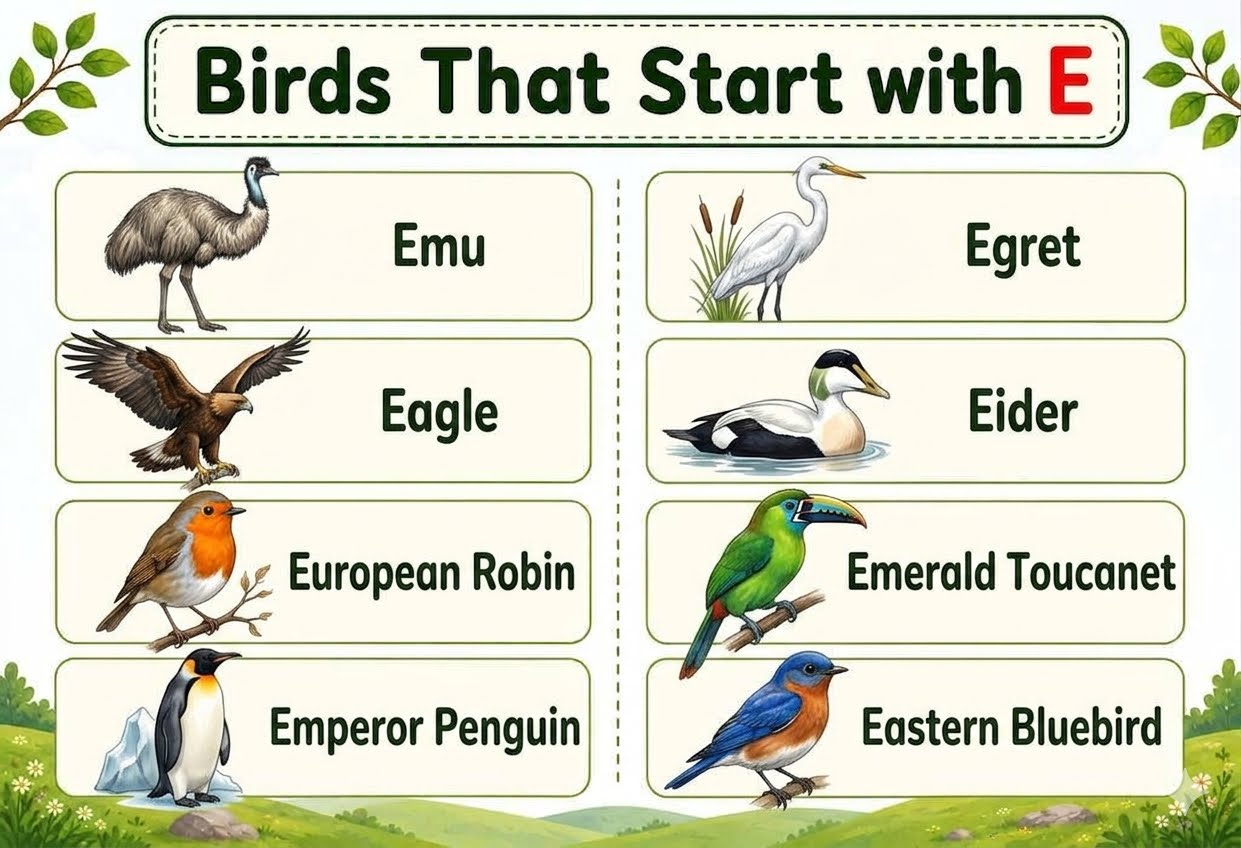
Birds That Start With ‘E’ – Chart
For a quick answer to what bird starts with the letter ‘E’, this chart pulls together every name mentioned in the article, making it easy to revisit any bird at a glance.
FAQs
1. Which ‘E’ Bird Is The Largest Penguin Species In The World?
The emperor penguin is the largest penguin species in the world and is known for surviving extremely cold conditions in Antarctica.
2. Which Bird Starting With ‘E’ Is Known For Its Remarkable Mimicry?
The European starling is well known for its ability to mimic a wide range of sounds, including other birds, car alarms, and even human speech.
3. Are All Birds Starting With ‘E’ Able To Fly?
No, the emu is a flightless bird, while most other birds on this list, such as the eagle and eastern bluebird, are strong fliers.
4. Which ‘E’ Bird Is The Smallest Owl Species In The World?
The elf owl is the smallest owl species in the world, roughly the size of a sparrow, despite having a surprisingly loud call.
From the towering emu to the world’s smallest owl, the elf owl, bird names starting with ‘E’ introduce children to some truly remarkable species. Along the way, this list also helps build kids’ vocabulary, turning each new bird into a small, memorable lesson about the natural world.