



Last Updated on September 7, 2026
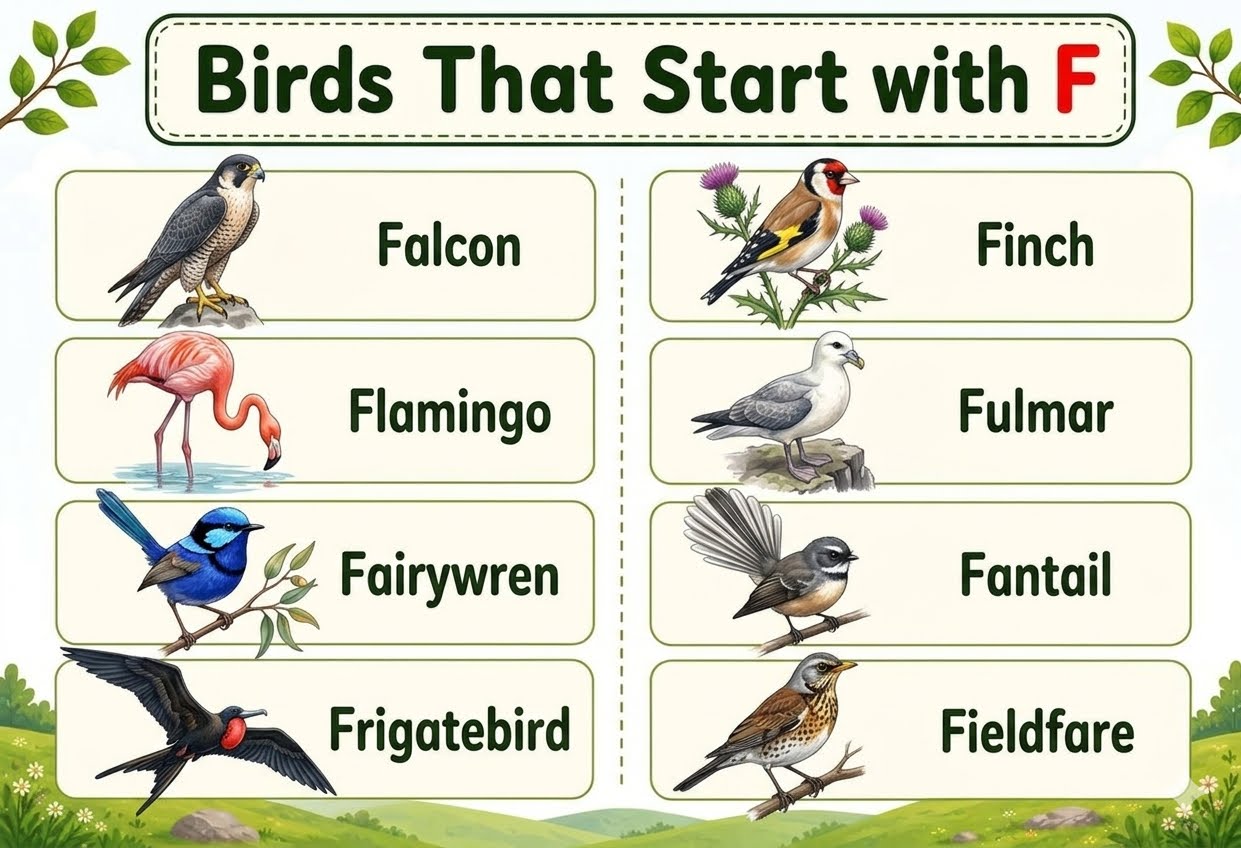
The letter F introduces kids to some genuinely striking birds, from swift aerial hunters to birds prized for their brilliant colours and unusual habits. Anyone searching for bird names that start with the letter ‘F’ will come across everything from the lightning-fast falcon to the tropical flamingo, each bringing something memorable to the list.
Thank you for reading this post, don't forget to subscribe!
Here is a curated set of birds that start with ‘F’ for preschoolers and kids, paired with pictures and easy-to-remember facts that make learning fun. Getting familiar with these ‘F’ letter bird names helps children expand their vocabulary while discovering how different species hunt, migrate, and survive in the wild. Take a look at some notable birds starting with F below.
List Of Bird Names That Start With ‘F’
Whether soaring at incredible speeds or wading through shallow lagoons, birds beginning with ‘F’ cover an impressive range of skills and habitats. Here is a selection of well-known species, along with facts and sightings to help kids recognise them.
1. Falcon
The falcon is a fast, sharp-eyed bird of prey known for being one of the quickest animals on the planet during its hunting dive.
Did You Know?
- The peregrine falcon can dive at speeds of over 300 kilometres per hour, making it the fastest bird in the world.
- Falcons have exceptionally sharp eyesight, allowing them to spot prey from great distances.
- Unlike some birds of prey, falcons kill with their beaks rather than their talons.
- Falcons have been used in falconry, a traditional form of hunting, for thousands of years.
Where You Might See : Falcons are found on nearly every continent, often nesting on cliffs, tall buildings, and open plains.
2. Flamingo
The flamingo is a tall, pink wading bird known for standing on one leg and feeding with its head turned upside down in shallow water.
Did You Know?
- Flamingos get their pink colour from pigments found in the algae and shrimp they eat.
- They often stand on one leg to help conserve body heat.
- Flamingo chicks are actually born grey or white, not pink.
- They live in large, noisy flocks that can number in the thousands.
Where You Might See: Flamingos are commonly found in shallow lakes and lagoons across Africa, South America, and parts of Asia.
3. Fairywren
The fairywren is a small, brightly coloured songbird, with males often displaying vivid blue feathers during the breeding season.
Did You Know?
- Male fairywrens change into duller feathers outside the breeding season.
- Fairywrens live in small family groups that help raise young together.
- They are known for their quick, hopping movements through dense shrubs.
- Male fairywrens are known to gather flower petals to present to females.
Where You Might See : Fairywrens are commonly found across Australia, particularly in gardens, woodlands, and grasslands.
4. Frigatebird
The frigatebird is a large seabird known for its impressive wingspan and the male’s ability to inflate a bright red throat pouch.
Did You Know?
- Male frigatebirds inflate their red throat pouch like a balloon to attract mates.
- Frigatebirds cannot swim and rarely land on water, as their feathers are not waterproof.
- They often steal food from other seabirds mid-flight, a behaviour known as kleptoparasitism.
- Frigatebirds can stay airborne for weeks at a time without landing.
Where You Might See: Frigatebirds are found across tropical and subtropical oceans, including the Galápagos Islands.
5. Fulmar
The fulmar is a sturdy seabird resembling a gull, known for its stiff-winged gliding flight low over ocean waves.
Did You Know?
- Fulmars can spit a foul-smelling oil at predators or intruders as a form of defence.
- They spend most of their lives at sea, only coming to land to breed.
- Fulmars can live for several decades, with some reaching over 40 years old.
- They lay just a single egg each breeding season.
Where You Might See: Fulmars are commonly found along coastal cliffs in the United Kingdom, Iceland, and other North Atlantic regions.
6. Fantail
The fantail is a small, energetic bird known for its habit of fanning out its tail feathers while flitting after insects.
Did You Know?
- Fantails are extremely agile fliers, twisting and turning quickly to catch flying insects.
- They often follow larger animals or people to catch insects stirred up from the ground.
- Fantails build small, cup-shaped nests often decorated with spider webs.
- Their constant tail movement makes them easy to identify.
Where You Might See: Fantails are commonly found across Australia, New Zealand, and parts of Southeast Asia.
7. Finch
The finch is a small songbird known for its short, sturdy beak, which is well suited for cracking open seeds.
Did You Know?
- Finches played an important role in Charles Darwin’s studies on evolution in the Galápagos Islands.
- Different finch species have beak shapes suited to the specific foods available in their habitat.
- Many finches are popular pets due to their cheerful songs.
- Finches often travel in small, sociable flocks.
Where You Might See: Finches are found almost worldwide, particularly in gardens, woodlands, and grasslands.
8. Fieldfare
The fieldfare is a large, colourful thrush known for its grey head, chestnut back, and bold, spotted chest.
Did You Know?
- Fieldfares often travel in large, noisy flocks during winter.
- They mainly feed on berries and fallen fruit during colder months.
- Fieldfares can be aggressive, sometimes chasing away other birds from feeding areas.
- They breed further north and migrate south as temperatures drop.
Where You Might See : Fieldfares are commonly seen across the United Kingdom and Europe during the winter months, particularly in fields and orchards.
9. Firecrest
The firecrest is one of the smallest birds in Europe, known for the bright orange stripe on top of its head.
Did You Know?
- Firecrests are so light that they can perch on the very tips of thin branches.
- They constantly flick their wings while foraging for insects.
- Firecrests are often confused with the similarly small goldcrest.
- Despite their size, they can survive cold winters if food remains available.
Where You Might See: Firecrests are found across parts of the United Kingdom and much of Europe, often in coniferous and mixed woodlands.
10. Fish Eagle
The fish eagle is a powerful bird of prey known for its distinctive call and skill at snatching fish directly from the water’s surface.
Did You Know?
- Fish eagles can spot fish from high above the water before diving down to catch them.
- Their sharp, curved talons help grip slippery fish firmly.
- The African fish eagle’s call is considered one of the most recognisable sounds of the African wilderness.
- Fish eagles often mate for life and reuse the same nest for many years.
Where You Might See: Fish eagles are commonly found near lakes and rivers across Africa, with related species found in Asia and Australia.
11. Flycatcher
The flycatcher is a small, quick bird known for catching insects mid-air with sudden, darting flights from a perch.
Did You Know?
- Flycatchers often return to the exact same perch after catching an insect in flight.
- They have wide, flat beaks that help them snap up insects efficiently.
- Many flycatcher species migrate long distances between breeding and wintering grounds.
- Their sharp eyesight helps them track fast-moving insects.
Where You Might See: Flycatchers are found across the United Kingdom, Europe, Asia, and the Americas, often in woodlands and gardens.
12. Frogmouth
The frogmouth is a nocturnal bird known for its wide, gaping mouth and uncanny ability to disguise itself as a broken tree branch.
Did You Know?
- Frogmouths freeze in a stiff, upright position during the day to look like part of a tree.
- Despite resembling owls, frogmouths are more closely related to nightjars.
- They catch insects, small mammals, and reptiles using their wide mouths.
- Frogmouths have excellent camouflage thanks to their mottled grey and brown feathers.
Where You Might See: Frogmouths are commonly found across Australia and parts of Southeast Asia.
13. Fody
The fody is a small, brightly coloured songbird, with males often turning a vivid red or orange during the breeding season.
Did You Know?
- Male fodies change colour dramatically depending on the breeding season.
- Fodies mainly feed on seeds, insects, and nectar.
- They are known for their loud, chattering calls.
- Several fody species are found only on specific island groups.
Where You Might See: Fodies are commonly found on Madagascar and several nearby Indian Ocean islands.
14. Fairy Tern
The fairy tern is a small, delicate seabird known for its pale feathers and graceful, hovering flight over water.
Did You Know?
- Fairy terns often lay their single egg directly on a bare branch, without building a nest.
- They hover skilfully above the water before diving to catch small fish.
- Fairy terns are considered rare in several parts of their range.
- Their light, buoyant flight makes them appear almost weightless in the air.
Where You Might See: Fairy terns are found across parts of the Pacific and Indian Oceans, including Australia and New Zealand.
15. Ferruginous Hawk
The ferruginous hawk is a large bird of prey known for its rich, rust-coloured feathers and broad, powerful wings.
Did You Know?
- Ferruginous hawks are the largest hawk species found in North America.
- They often hunt ground squirrels and other small mammals from the air.
- These hawks sometimes nest on the ground when trees are scarce.
- Their name comes from the Latin word for “rust,” referring to their reddish feathers.
Where You Might See: Ferruginous hawks are commonly found across the open grasslands and plains of the western United States.
More ‘F’ Letter Birds
Beyond this list, the letter F covers many more ‘F’ starting birds’ names worth adding to your child’s bird-watching vocabulary. The table below rounds up 20 additional species.
| Fairy Bluebird | Fairy Penguin |
| Fer-de-lance Owl | Ferruginous Duck |
| Ferruginous Pygmy Owl | Field Sparrow |
| Fiery-billed Aracari | Fiery-throated Hummingbird |
| Flame Robin | Flightless Cormorant |
| Florida Scrub Jay | Forest Kingfisher |
| Forster’s Tern | Franklin’s Gull |
| Franklin’s Grouse | Fringed-lipped Bat Falcon |
| Frilled Coquette | Fruit Dove |
| Fulvous Whistling Duck | Fischer’s Lovebird |
Birds That Start With ‘F’ – Chart
If you’re wondering what bird starts with the letter ‘F’, this chart brings together every name mentioned in the article, making it simple to revisit any bird at a glance.
FAQs
1. Which ‘F’ Bird Is Considered The Fastest Animal In The World?
The peregrine falcon is considered the fastest animal in the world, capable of diving at speeds of over 300 kilometres per hour while hunting.
2. Which Bird Starting With ‘F’ Is Known For Disguising Itself As A Tree Branch?
The frogmouth is known for its remarkable camouflage, freezing in a stiff, upright position during the day to resemble a broken branch.
3. Are All Birds Starting With ‘F’ Found Near Water?
No, while birds like the flamingo and fish eagle are closely tied to water, others, such as the fairywren and finch, are commonly found in gardens and woodlands instead.
4. Which ‘F’ Bird Helped Inspire Charles Darwin’s Studies On Evolution?
Finches played an important role in Charles Darwin’s studies, as the different beak shapes he observed among finch species in the Galápagos Islands helped shape his ideas on evolution.
From the lightning-fast falcon to the strikingly pink flamingo, bird names starting with ‘F’ offer children a memorable mix of speed, colour, and curious behaviour to explore. Along the way, this list also helps build kids’ vocabulary, turning each new bird into a small, engaging lesson about the natural world.