



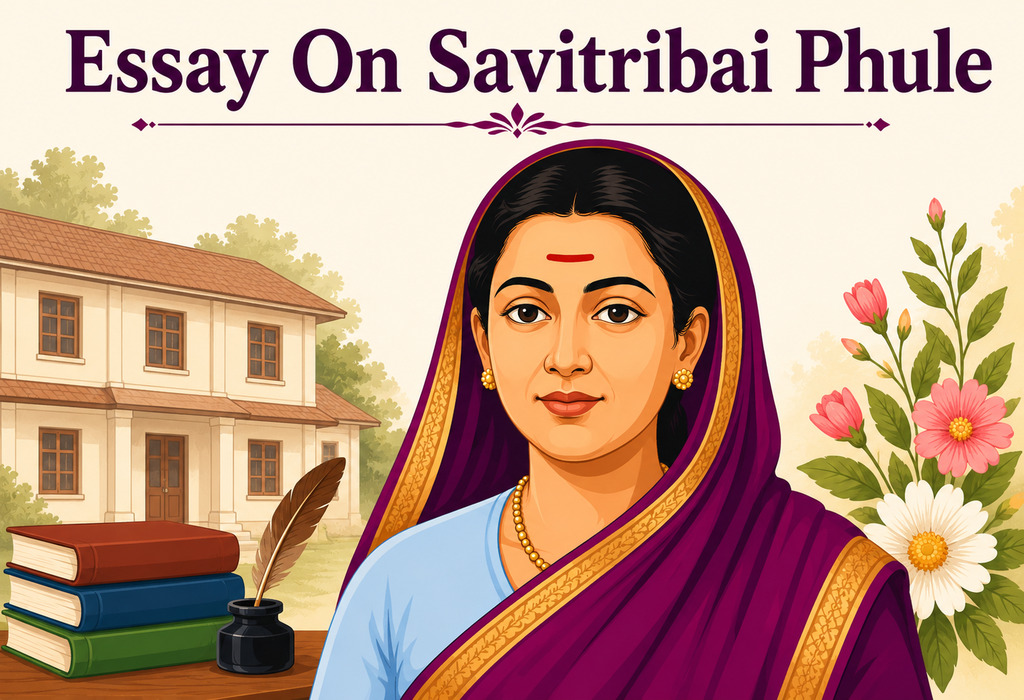
An essay on Savitribai Phule in English is one of the most meaningful pieces a student can write, honouring a woman who transformed Indian society through education and relentless courage. Born on 3rd January 1831 in Maharashtra, Savitribai Phule dedicated her life to dismantling caste-based discrimination and championing the rights of marginalised communities. Alongside her husband, Jyotirao Phule, she established the first school for girls in Pune in 1848 — a revolutionary act in a deeply conservative society.
Thank you for reading this post, don't forget to subscribe!
A Savitribai Phule essay allows students and scholars to explore her extraordinary contributions as a social reformer, poet, and educator. Whether you require 10 lines for a class assignment or a detailed long-form piece for competitive examinations, this collection offers a comprehensive range of writing formats suited to every need.
From her courageous struggle against patriarchy to her enduring legacy that continues to inspire generations, this article covers every format to help you express her remarkable story with clarity and confidence.
10 Lines on Savitribai Phule
This essay for classes 1, 2, and 3 offers simple, easy-to-understand lines about Savitribai Phule, perfect for young learners to grasp her remarkable legacy.
- Savitribai Phule was born on 3rd January 1831 in Maharashtra, India.
- She was the first female teacher in modern India.
- She opened a school for girls in Pune in 1848 so that all girls could study.
- She believed that every child, regardless of caste, deserved to go to school.
- She wrote poems in Marathi to teach people about kindness and equality.
- She worked hard to help women live better and safer lives.
- She stood up for widows and made sure they were treated with respect.
- When many people fell ill during a plague in 1897, she helped look after them.
- She passed away on 10th March 1897 after helping sick people in Pune.
- We remember her today as a kind and brave woman who changed many lives.
Paragraph on Savitribai Phule
These few lines on Savitribai Phule offer a brief yet meaningful overview of her life, ideal for students who need a short paragraph for school assignments.
Savitribai Phule was born on 3rd January 1831 in Maharashtra, India. She is remembered as the first female teacher of modern India, who worked tirelessly to educate women and marginalised communities. Along with her husband Jyotirao Phule, she opened the first school for girls in Pune in 1848, defying strong opposition from society. She also wrote powerful poetry in Marathi to spread the message of equality and justice. Savitribai dedicated her life to helping widows, fighting caste discrimination, and uplifting the poor. She passed away on 10th March 1897, leaving behind a legacy that continues to inspire millions across India.
Short Essay on Savitribai Phule
This short essay on Savitribai Phule outlines the key milestones of her extraordinary life in a concise, easy-to-read format. It is well-suited for students who need a quick yet informative piece for school assignments or examinations.
Savitribai Phule was an extraordinary woman who worked tirelessly to make India a better, fairer place. Born on 3rd January 1831 in Naigaon, Maharashtra, she grew up at a time when girls were not allowed to go to school, and people from lower castes were treated very poorly.
Together with her husband Jyotirao Phule, she opened a school for girls in Pune in 1848. This was a very brave thing to do, because many people in society opposed it. Some people even threw stones and mud at her as she walked to school. But Savitribai never gave up. She carried a spare sari and changed into it upon arrival.
She also cared deeply for widows and worked to stop child marriage. She believed that every person, no matter their caste or gender, deserved to be treated with kindness and respect. She wrote poems in Marathi to encourage poor and marginalised people to seek education and stand up for themselves.
In 1897, when a terrible plague spread across Pune, she opened a centre to care for the sick. Sadly, she caught the illness herself and passed away on 10th March 1897.
Savitribai Phule’s life teaches us that kindness, bravery, and education can truly change the world.
Long Essay on Savitribai Phule
This long essay on Savitribai Phule offers an in-depth look at her life, struggles, and lasting contributions to Indian society. It is ideal for students appearing in competitive examinations or those seeking a thorough understanding of one of India’s most celebrated social reformers.
Savitribai Phule was one of the most courageous and compassionate women in Indian history. At a time when society placed severe restrictions on women and marginalised communities, she chose to challenge every barrier placed before her. Through education, poetry, and selfless service, she dedicated her entire life to building a more equal and just society. Her work laid the foundation for women’s rights and social reform in India, making her a figure of enduring national importance.
Life And Education
Early Life
- Savitribai Phule was born on 3rd January 1831 in Naigaon, a small village in Maharashtra.
- She belonged to the Mali community, which was considered a lower caste in the rigid social hierarchy of 19th-century India.
- At the age of nine, she married Jyotirao Phule, who was thirteen at the time.
- Her family, like most families of the era, did not consider education necessary or appropriate for girls.
- Despite these limitations, Savitribai showed a keen curiosity and eagerness to learn from a very young age.
- The poverty and inequality she witnessed around her during her childhood deeply influenced her outlook and fuelled her desire to bring about change.
Education
- Jyotirao Phule recognised his wife’s intelligence early on and took it upon himself to teach her to read and write at home.
- Savitribai went on to receive formal training at two teacher training institutions in Pune.
- She earned her teaching qualification and became one of the first trained female teachers in modern India.
- Her pursuit of education was met with strong disapproval from conservative sections of society, yet she pressed on with quiet determination.
- She later pursued further study and continued to expand her knowledge throughout her life, believing deeply in the value of lifelong learning.
- The education she received not only equipped her to teach others but also gave her the tools to challenge oppression through writing and poetry.
Contribution To Women’s Education
In 1848, Savitribai and Jyotirao opened the first school for girls in Bhide Wada, Pune, marking a historic moment in Indian education. The school welcomed girls from all castes and backgrounds, which was unheard of at the time. Savitribai taught the classes herself, nurturing young minds and showing society that girls were just as capable of learning as boys. Over time, the couple established several more schools across Pune, expanding access to education for hundreds of children who had previously been denied it.
Struggles And Obstacles
The path Savitribai chose was far from easy. Conservative members of society viewed her work as a threat to established traditions and actively tried to stop her. She was frequently subjected to verbal abuse, and people would throw stones, mud, and dung at her as she walked to school each day. Rather than being defeated by this hostility, she responded with quiet resilience, carrying a spare sari so she could change upon arrival. Her husband and close supporters stood firmly by her side, but the couple also faced pressure from their own families, who initially disapproved of their reformist activities.
Role During The Plague Epidemic
In 1897, a severe bubonic plague swept through the Pune region, claiming thousands of lives. Whilst many fled in fear, Savitribai moved towards the suffering. She set up a care centre on the outskirts of Pune to treat and shelter those affected by the disease, particularly children and people experiencing poverty who had nowhere else to turn. She personally nursed the sick without any concern for her own safety, embodying the spirit of selfless service that had defined her entire life.
Death
Whilst carrying a sick child to the care centre, Savitribai contracted the plague herself. She passed away on 10th March 1897 in Pune. She was 66 years old. Her death was mourned deeply across Maharashtra, and tributes poured in from those whose lives she had touched through her tireless work.
Savitribai Phule’s life is a shining example of what one person can achieve through courage, love, and an unshakeable belief in equality. She broke barriers that had stood for centuries and opened doors for countless women and marginalised communities. Today, she is rightly celebrated as the mother of modern Indian education, and her legacy continues to guide and inspire all those who strive for a fairer world.
Points To Remember When Writing An Essay on Savitribai Phule
Before you begin writing, it is helpful to keep a few key points in mind to ensure your essay is accurate, well-structured, and impactful. The following pointers will guide you in presenting Savitribai Phule’s life and legacy in the most effective and meaningful way.
- Research Thoroughly – Learn as much as you can about Savitribai Phule’s life, her work, and the historical context in which she lived before you begin writing.
- Follow A Clear Structure – Organise your essay with a proper introduction, body, and conclusion to ensure your writing flows logically and is easy to follow.
- Use Simple Language – Write in a clear and straightforward manner, especially if the essay is intended for younger students or a general audience.
- Highlight Key Contributions – Make sure to cover her most significant achievements, such as opening the first school for girls and her role during the plague epidemic.
- Avoid Repetition – Present each point only once and ensure every paragraph adds something new and valuable to the essay.
- Include Relevant Dates And Facts – Accurate dates, places, and events lend credibility to your essay and demonstrate a thorough understanding of the subject.
- Acknowledge Her Struggles – Do not overlook the obstacles she faced, as they are central to understanding the true significance of her achievements.
- End With A Strong Conclusion – Close your essay with a thoughtful reflection on her legacy and the lessons her life offers to readers today.
- Review And Proofread – Once your essay is complete, read it carefully to check for any spelling mistakes, grammatical errors, or factual inaccuracies before submitting it.
FAQs
1. How Can Parents Help Their Child Write An Essay On Savitribai Phule?
Parents can start by reading a short story or watching a simple video about Savitribai Phule together with their child. Once the child has a basic understanding, encourage them to speak about what they learned before putting anything down on paper, as talking helps organise thoughts before writing.
2. What Writing Activities Can Help Kids Prepare For Essay Writing?
Ask your child to draw a picture of Savitribai Phule and write one sentence describing it. Gradually build this into two sentences, then a short paragraph. This step-by-step activity makes the transition to full essay writing feel natural and manageable.
3. How Can Children Improve Their Vocabulary When Writing About Historical Figures?
Encourage children to keep a small notebook to record new words they encounter while reading about Savitribai Phule, along with their meanings. Using one or two of these new words in their essay helps build confidence and enriches their writing over time.
4. Are There Any Fun Activities To Make Learning About Savitribai Phule More Engaging?
Role-playing is a wonderful activity — ask your child to imagine they are Savitribai Phule and write a diary entry about their first day of teaching. This creative exercise builds empathy and makes historical figures feel real and relatable to young learners.
Savitribai Phule’s life is a story that every child deserves to know, and every student should feel inspired to write about. From her fearless pursuit of education to her selfless service during the plague epidemic, she demonstrated that one person’s courage can truly change the world.
The essays, points, and activities in this article are designed to help students of all ages connect with her remarkable legacy whilst developing their own writing skills. Whether you are a young learner writing your first few lines or a student crafting a detailed long-form essay, let Savitribai Phule’s story be the inspiration that gives your words meaning and purpose.
Also Read:
Essay On Mahatma Gandhi
‘Bhagat Singh’ Essay for Kids
Essay On Lal Bahadur Shastri
Essay on Jawaharlal Nehru for Children