



Last Updated on September 15, 2026
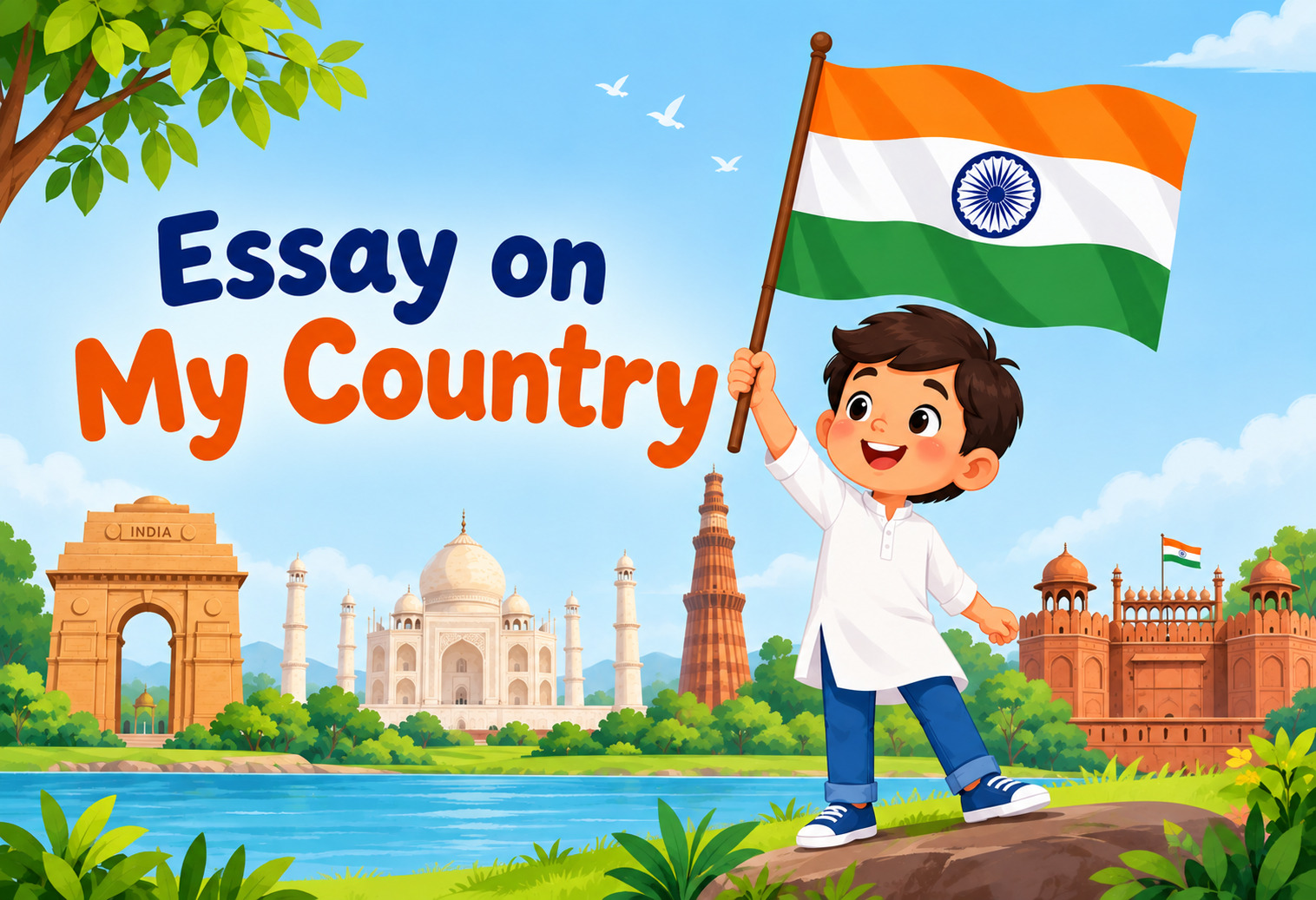
Our country has a rich history, diverse culture, and a valuable heritage that makes it truly unique. Learning about these aspects lays the foundation for patriotism in children, and the pride they feel motivates them to become good citizens who see themselves as part of a larger community. Writing a ‘My Country’ Essay in English helps students build on this sense of belonging while sharpening their writing skills.
Thank you for reading this post, don't forget to subscribe!
In school, students are often asked to write about their country to boost their general knowledge and articulate their thoughts clearly. This can be a fairly challenging topic, as it requires weaving together facts with genuine emotion. To make this easier, here are some sample essays on ‘My Country’ for classes 1, 2, and 3.
Key Points To Remember When Writing An Essay On ‘My Country’
Writing an essay about their country requires students to strike a balance between factual information and their own genuine perspective. Here are some tips to help structure an essay on ‘My Country’ effectively:
- Keep Short Essays Factual — For essays in a few simple lines, stick to essential, well-known facts that clearly define the country, such as its capital, flag, or national symbols.
- Add Personal Thoughts To Paragraphs — For short paragraph essays, children should go beyond facts and include their own thoughts and feelings about different aspects of their country, such as its culture or festivals.
- Balance Facts With Perspective In Longer Essays — For longer essays, students will need to recall more detailed facts about the country’s history, geography, or achievements, while weaving in their personal reflections to keep the essay engaging.
- Use Simple, Clear Language — Avoid overly complex words or sentences, especially for younger students, so the essay remains easy to read and understand.
- Review And Proofread — Read through the essay once after writing to check for spelling and grammar mistakes and ensure the ideas flow smoothly from one point to the next.
10 Lines On My Country
A short essay for Class 1 and Class 2 can include facts about the country and its important accomplishments. Here is an example of a simple one-line essay on our country:
- India is my motherland, and I am its proud citizen.
- India has a large population with diverse people.
- India is peninsular, forming the southern tip of Asia.
- My country is vast and beautiful, surrounded by great seas to the south and the tallest mountain peaks to the north.
- India got its independence from the British in 1947. It is now the world’s largest democracy.
- India is popular worldwide for farming and agriculture, as many different varieties of fruits and vegetables are cultivated here.
- India has the Taj Mahal, which is one of the wonders of the world.
- India is a popular tourist destination for people around the world.
- India has a rich and diverse culture with various cuisines that are loved by people across the globe.
- Our country is considered a holy land, as many spiritual seekers come to find inspiration here.
Paragraph On ‘My Country’
Writing a simple ‘Our Country’ paragraph helps children express their thoughts about their homeland in a clear, structured way. Here is a short 100-word paragraph to guide them.
My country is India, a land known for its rich culture, diverse traditions, and warm-hearted people. India has many states, each with its own language, festivals, and food, yet we all live together as one nation. Our country is home to beautiful places like the Taj Mahal, the Himalayas, and the Ganges River. We celebrate festivals like Diwali, Holi, and Eid with equal joy and unity. India is also known for its freedom fighters, who worked hard to gain independence for our country. I feel proud to be an Indian and love learning more about my country every day.
‘My Country’ Essay In 200 Words
A short essay in the form of a paragraph on our country can talk about various aspects such as the culture, history, geography or anything else your child wishes to write. Here is an example:
My country, India, is an ancient land with a history that stretches back thousands of years, home to some of the world’s earliest civilisations. Our rich cultural heritage, reflected in its art, architecture, music, and philosophy, continues to be respected and admired across the globe. India has also made remarkable contributions to science and technology, from ancient advancements in mathematics and astronomy to more recent achievements in space exploration.
Geographically, India is part of the Asian continent and is peninsular in shape, surrounded by the Bay of Bengal to the east, the Arabian Sea to the west, and the vast Indian Ocean to the south. To the north, the country is bordered by the mighty Himalayas, home to some of the tallest mountain peaks in the world, including Kanchenjunga.
India has a vast and remarkably diverse population, making it the world’s most populous country as well as its largest democracy. Within its borders, India embraces a wide range of cultures, traditions, faiths, languages, and cuisines, all existing together in harmony. This diversity is often described as India’s greatest strength, uniting millions of people under one shared identity. I feel immense pride in my country’s rich heritage, its many achievements, and the values of unity it continues to stand for.
‘My Country’ Essay In 300 Words
A longer essay about our country gives students the chance to explore India’s history, culture, and achievements in greater depth. Here is a 300-word essay to guide them.
India, my country, is a land of immense history, diversity, and cultural richness. With a civilisation dating back thousands of years, India has been home to some of the world’s oldest known cultures, having given the world contributions in mathematics, medicine, astronomy, and philosophy that continue to be studied and admired today.
Geographically, India is a peninsula located in southern Asia, bordered by the Arabian Sea to the west, the Bay of Bengal to the east, and the Indian Ocean to the south. To the north, the towering Himalayan mountain range forms a natural boundary, home to some of the highest peaks in the world, including Mount Kanchenjunga. India’s landscape is remarkably varied, ranging from snow-capped mountains and dense forests to vast deserts and long coastlines.
As the world’s most populous country and its largest democracy, India is home to over a billion people belonging to different religions, castes, and communities. This diversity extends to language as well, with 22 officially recognised languages and hundreds of dialects spoken across various states. Despite these differences, India’s people are bound together by a shared sense of national identity, celebrating festivals like Diwali, Eid, Christmas, and Pongal with equal enthusiasm and respect for one another’s traditions.
India’s freedom struggle, led by figures like Mahatma Gandhi, Jawaharlal Nehru, and countless other freedom fighters, remains a defining chapter in its history, having secured independence from British rule in 1947. Since then, India has grown into a rapidly developing nation, making significant strides in fields like space research, technology, and renewable energy.
I feel a deep sense of pride in being an Indian, not just for the country’s achievements, but for the values of unity, diversity, and resilience that define it. My country will always hold a special place in my heart.
Long Essay On ‘My Country’
To write a long paragraph on ‘My Country’ for Class 3, students will need to recall several important facts about India, from its geography to its cultural identity. The essay can begin with an introductory note on modern India and its ancient roots, before moving on to its geographical features, governance, and cultural richness. Here is an example:
India is my country, a land where diverse cultures, languages, and religions live together in unity and harmony. Known in its native languages as ‘Bharat’ or ‘Hindustan’, India carries a sense of pride in every name it is called by. The Indian flag is tricoloured, with saffron at the top symbolising courage and sacrifice, white in the middle representing peace and truth, and green at the bottom standing for growth and fertility, with the Ashoka Chakra placed at its centre to represent the eternal wheel of law. India is an ancient civilisation, with a culture and way of life that has evolved continuously over thousands of years while still holding onto many of its oldest traditions.
India is the world’s largest democracy and the most populous country, home to over a billion people. It is made up of 28 states and 8 union territories, each with its own distinct language, cuisine, and customs, yet all united under one constitution and national identity. Covering a vast landmass, India is the seventh-largest country in the world by area. To the north, it is bordered by the towering Himalayan mountain range, while vast oceans surround it to the south, the Arabian Sea to the west and the Bay of Bengal to the east. India shares its land borders with several neighbouring countries, including China, Pakistan, Bangladesh, Nepal, Bhutan, and Myanmar.
Historically, the name ‘India’ can be traced back to the river Indus, derived from the ancient word ‘Sindhu’, which was used by early travellers and traders to refer to the land beyond the river. Over centuries, this name evolved and spread across different languages and cultures, eventually becoming the country’s most widely recognised name internationally. India’s national animal is the tiger, a symbol of strength and grace, while the national bird is the peacock, admired for its beauty and elegance.
India is also known across the world as a land of spirituality and deep philosophical thought. For centuries, people from different corners of the globe have travelled to India in search of spiritual guidance, drawn by its ancient texts, temples, and traditions of meditation. Yoga, a practice now embraced and celebrated worldwide for its physical and mental benefits, originated in ancient India thousands of years ago and remains one of the country’s most valuable gifts to the world.
I am a proud Indian, grateful for the rich heritage, diversity, and values that my country stands for. India’s journey, from an ancient civilisation to a modern, rapidly developing nation, reflects the resilience and spirit of its people. If we continue to strive together with unity and purpose, I believe India can rise to become a true leader on the world stage in the years to come.
What Will Your Child Learn From this Essay?
This essay helps children build a deeper understanding of India’s history, geography, and cultural diversity, while also encouraging them to reflect on what it means to belong to such a vast and varied nation. Kids will pick up key facts, from national symbols to important geographical landmarks, along with practice structuring their thoughts clearly across essays of different lengths. By the end, they’ll have a stronger sense of national pride, along with the writing skills needed to express it confidently on paper.
FAQs
1. What If My Child Doesn’t Know Many Facts About India Yet?
Encourage them to start with what they already know, like festivals, food, or family traditions, and gradually build on this with simple facts from books or trusted sources as they write.
2. Can My Child Include Personal Experiences In An Essay About Their Country?
Yes, sharing personal experiences, such as visiting a historical monument or celebrating a festival, can make the essay feel more genuine and help balance facts with real emotion.
3. How Can I Help My Child Remember Facts Like State Names Or Historical Dates?
Simple memory aids like rhymes, flashcards, or relating facts to something familiar, such as a state they’ve visited, can make remembering these details much easier.
4. Should The Essay Focus Only On Positive Aspects Of The Country?
While it’s natural to focus on strengths and achievements, older children can also be encouraged to briefly acknowledge challenges the country faces, showing a more balanced and thoughtful perspective.
Writing about their country gives children a meaningful way to explore India’s rich history, diversity, and values, while strengthening their essay-writing skills along the way. Whether through a short paragraph or a longer, detailed essay, this topic helps young learners take pride in their identity while learning to express it clearly and confidently.
Also Read:
Essay On Soldiers in English for Children
Essay On Nature for Lower Primary Classes
How to Write An Essay On ‘My Motherland’ for Kids