


- What Is A Sentence?
- Benefits of Learning 1st Grade Sentences for your Child
- Types Of Simple Sentences For Kids
- Small And Simple Sentences For Class 1
- Daily Use Sentences for Class 1
- Jumbled Sentences For Class 1
- Action Word Sentences For Class 1
- Noun Sentences For Class 1
- Pronoun Sentences For Class 1
- Adjective Sentences For Class 1
- ‘A’ and ‘An’ Sentences For Class 1
- Tips to Teach Sentence Writing to Children in Class 1
- FAQs
Language is the essential building block of any learning process. One cannot communicate or understand any subject without a proper understanding of language. Developing language skills can help kids academically. Constructing proper English sentences for class 1 can help student polish their writing skills. Once children learn to construct definitive, meaningful sentences while maintaining correct tense and spelling, they can become masters of language in the future. So, where should you begin? Begin by explaining what a sentence is.
Thank you for reading this post, don't forget to subscribe!
This article covers everything you need to know about sentences for class 1, from understanding basic sentence structure to practising reading sentences for class 1 through engaging activities. It offers helpful tips, examples, and exercises to guide young learners on their path to mastering English.
What Is A Sentence?
A sentence is a group of words arranged in a specific order to express a complete thought or idea. A sentence can be referred to as a set of words containing a subject and a predicate. A subject indicates the topic of the sentence, while a predicate defines what is said about the subject. For example, in the sentence ‘You speak English’, ‘You’ is the subject while ‘speak English’ is the predicate. Another fact about sentences is that they always contain a verb. The children must know the sentence definition for class 1 to become familiar with proper sentence structure and learn to construct grammatically correct sentences. Dictation sentences can be used to model speech for children to write down, helping them more easily grasp the essence of sentence writing.
Benefits of Learning 1st Grade Sentences for your Child
A strong knowledge of proper sentence structure can help children interpret and understand various forms of English literature more easily. Learning to handle different sentence structures not only improves composition skills but also enhances reasoning, fluency, and overall grammatical accuracy. Practising building sentences in class 1 helps young learners comprehend sentences and even complex paragraphs much faster and more confidently. Furthermore, the ability to write sentences for class 1 gives children a significant competitive edge in their academic performance, laying a solid foundation for effective communication and advanced language skills in the years to come.
Types Of Simple Sentences For Kids
This section explores the different types of sentences that form the foundation of early language learning. The following breakdown of simple English sentences for class 1 will help young learners understand and identify each sentence type with clarity and ease.
1. Declarative Sentences
These are the most common types of sentences that make a statement or share information. They always end with a full stop. For example, “The sun rises in the east.”
2. Interrogative Sentences
These are sentences that ask a question and always end with a question mark. They are used to seek information or clarification. For example, “What is your favourite colour?”
3. Imperative Sentences
These are sentences that give a command, instruction, or request. They usually begin with a verb and can end with either a full stop or an exclamation mark. For example, “Please close the door.”
4. Exclamatory Sentences
These are sentences that express strong emotions such as joy, surprise, or excitement. They always end with an exclamation mark. For example, “What a beautiful day it is!”
5. Negative Sentences
These are sentences that deny or contradict a statement using words such as “not”, “never”, or “no.” They help children express disagreement or the absence of something. For example, “I do not like spinach.”
Small And Simple Sentences For Class 1
This section presents a collection of short sentences for class 1 that are easy to read, understand, and practice. These short, simple sentences are carefully crafted to help young learners build confidence in reading and writing from the very beginning.
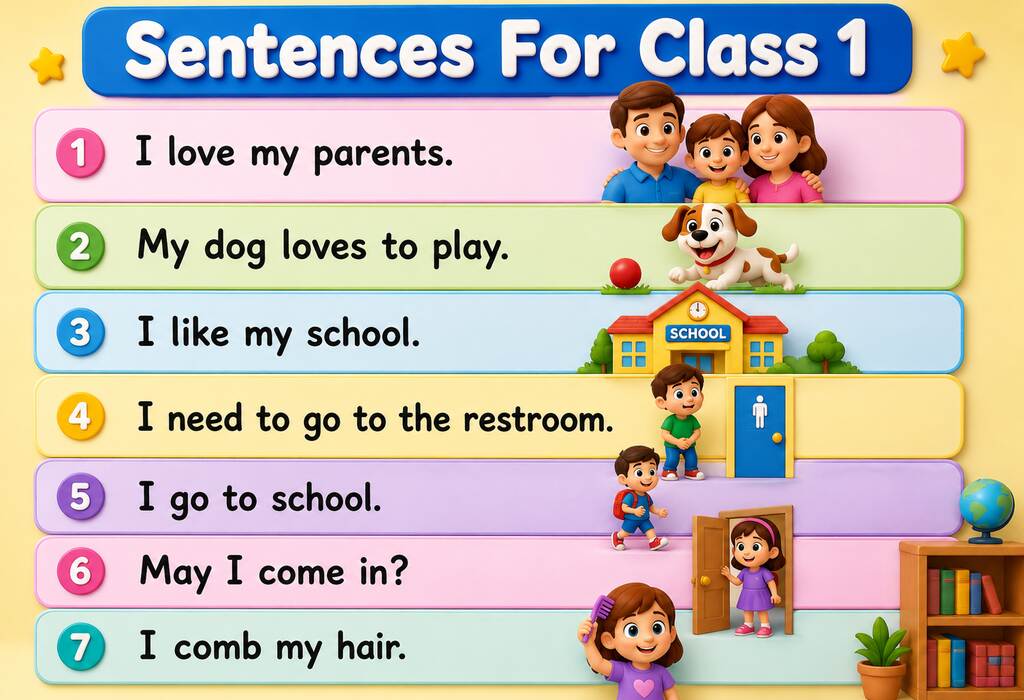
- I love my parents.
- My dog loves to play.
- I like my school.
- I need to go to the restroom.
- I go to school.
- May I come in?
- I comb my hair.
- Happy birthday to you!
- I tie my shoes.
- That is a pen.
- See you tomorrow.
- How old are you?
- What is your name?
- I open the door.
- What is your favourite colour?
- It is eight o’clock.
- I am hungry.
- I like to eat apples.
- Your dress is beautiful.
- Where do you live?
- I wake up early in the morning.
- Which is your favourite subject?
- Who is your best friend?
- My father is in his office.
- I walk to my school.
- Today is a sunny day.
- My favourite colour is yellow.
- There is a cat.
- Where is your sister?
- I love playing football.
- My mother cooks delicious food.
- I have a pet cat.
- I enjoy dancing.
- I have four friends.
- I study in the evening.
Daily Use Sentences for Class 1
Every-day communication plays a vital role in helping children apply their language skills in real-life situations. This section covers commonly used daily use sentences that class 1 students can practice and incorporate into their routine conversations with ease.
- Good morning, how are you today?
- May I please go to the washroom?
- Can you help me with this question?
- I have completed my homework.
- Please pass me the water bottle.
- Thank you for helping me.
- I am ready for school today.
- Can I borrow your pencil, please?
- I did not understand this lesson.
- I will be back in a few minutes.
- I am feeling very hungry now.
- Can we go out to play today?
- I like reading storybooks very much.
- Please speak slowly, I cannot hear you.
- I want to drink some water.
- My favourite subject is English.
- I will try my best today.
- Can you please repeat that?
- I am sorry, I made a mistake.
- I have already packed my school bag.
Jumbled Sentences For Class 1
Jumbled sentences are a fun and engaging way to help children sharpen their understanding of sentence structure and word order. This section provides a variety of jumbled sentences for class 1 students to rearrange into correct, meaningful sentences, making learning both interactive and enjoyable.
1. Dog catches stick The the.
Answer: The dog catches the stick.
2. The student chair sat the on.
Answer: The student sat on the chair.
3. Cat to park the walked The.
Answer: The cat walked to the park.
4. The reads story teacher students the to a.
Answer: The teacher reads a story to the students.
5. Toy Please away your put.
Answer: Please put away your toy.
6. Lamp on turned the Mom.
Answer: Mom turned on the lamp.
7. Dog love I my.
Answer: I love my dog.
8. Exam is tomorrow my.
Answer: My exam is tomorrow.
9. Late comes home Father.
Answer: Father comes home late.
10. Pretty are Those butterflies.
Answer: Those butterflies are pretty.
Action Word Sentences For Class 1
- My father is working.
- I am going to sleep.
- What are you eating?
- I am revising the chapters.
- The swans are swimming in the pond.
- The bees collect nectar from flowers.
- I am waiting for a friend at the bus stop.
- I am learning new words to grow my vocabulary.
- I play with my friends during recess.
- I am eating a cake.
Noun Sentences For Class 1
Nouns are one of the most fundamental building blocks of the English language, and learning to use them correctly is essential for young learners. This section provides simple, easy-to-understand noun sentences for class 1 students to help them confidently identify and use nouns in their everyday writing and speaking.
- He cannot play the guitar.
- Do you live in India?
- My mother works in a hospital.
- The sun rises in the East.
- The ball smashed the window.
- Dogs are very faithful animals.
- Cow milk is beneficial for health.
- My grandmother works in the garden daily.
- She completes her homework every day.
- Our dog fell ill today.
Pronoun Sentences For Class 1
Pronouns are words that replace nouns, making sentences shorter and easier to read. This section offers simple pronoun sentences for class 1 students to help them understand and use pronouns correctly in their everyday writing and speaking.
- They are good players.
- The bird was staring at herself in the mirror.
- He asked me to complete the task by noon.
- You have to come to the picnic.
- She has many toffees in her pocket.
- He had forgotten his wallet in the room.
- Everybody was present at the inauguration.
- I have not eaten anything yet.
- I do not know them.
- He is very strong.
Adjective Sentences For Class 1
Adjectives are words that describe or add more detail to a noun, making sentences more vivid and expressive. This section provides simple adjective sentences for class 1 students to help them understand how to use describing words effectively in their writing and speaking.
- They live in a beautiful house.
- She is an adorable baby.
- Sweta’s hair is gorgeous.
- He writes incomplete letters.
- We are enjoying the scenic beauty.
- She wore a pretty dress.
- This store is much nicer.
- This soup is not edible.
- You are wearing a sleeveless dress today.
- John has an awesome car.
‘A’ and ‘An’ Sentences For Class 1
‘A’ and ‘An’ are articles used before nouns, and learning to use them correctly is an essential grammar skill for young learners. This section provides simple sentences to help class 1 students understand and apply these articles with confidence.
- This is an excellent pen.
- Alex is training to be an engineer.
- I saw an accident involving a car.
- I need a kilogram of sugar.
- A tiger ran towards the lake.
- I ate an apple.
- The dog chewed on a bone.
- This is a mango.
- There is a store nearby.
- I saw a deer in the forest.
Tips to Teach Sentence Writing to Children in Class 1
There are certain ways to teach your child to write sentences properly.
- Dictate the sentence: Dictating sentences can enhance the learning experience. Parents, guardians, and teachers can dictate sentences to children to improve their writing skills. This activity helps kids understand the language, improves comprehension, boosts cognitive development, and enhances focus, concentration, and imagination.
- Reading Sentences: Reading sentences for class 1 is an effective way to improve sentence construction. Sight sentences for class 1, noun sentences, pronoun sentences, action word sentences, and small and simple sentences can help your child identify different sentences and enhance the ability to comprehend sentences and articles faster.
- Charts: Hang small sentence charts in the kids’ room and ask them to keep reading and writing the sentences mentioned in the chart. Also, explain the meaning of those simple sentences so your child can better understand them.
- Connecting the words: Write words of a sentence on different pieces of paper and then arrange them to form the sentence for your child. Then, teach the child which words are the subject and predicate and where they are placed in the sentence. Repeat this exercise with as many different sentences as you can. Once they understand the concept, ask them to write the sentences in a notebook.
FAQs
1. How Can I Help My Child Practice Writing Sentences At Home?
You can help your child practice writing sentences at home by setting aside a few minutes each day for simple writing exercises. Encourage them to write about their day, describe a picture, or complete fill-in-the-blank sentence activities to make practice fun and consistent.
2. What Are Some Fun Ways To Teach Sentence Writing To Kids?
Some fun ways to teach sentence writing include using flashcards, storytelling activities, picture-based writing prompts, and word jumble games. These interactive methods keep children engaged while helping them understand how words come together to form proper sentences.
3. How Does Practising Sentences Help A Child’s Overall Development?
Practising sentences regularly helps children improve their vocabulary, spelling, grammar, and communication skills. It also boosts their confidence in expressing thoughts clearly, which benefits them across all subjects in school.
4. How Can Teachers Make Sentence Writing Practice More Effective In The Classroom?
Teachers can make sentence writing more effective by using dictation exercises, group writing activities, and interactive board games that focus on sentence formation. Providing regular feedback and celebrating small achievements also encourages children to stay motivated and keep improving.
All these methods are necessary and are highly recommended for kids to develop their linguistic skills. Children learn better when they use interactive techniques, and these methods will help them learn sentence formation as quickly as possible.
Also Read:
Compound Sentences
Punctuation for Class 2
Sight Words for Children