

- What Are Vehicles?
- Why Is Learning Vehicle Names Important For Children?
- A-Z List Of Vehicle Names
- Examples And Uses Of Vehicles
- Common Vehicle Names With Pictures
- Vehicle Names Popular In India
- Types Of Means Of Transport
- Vehicle Names Quiz With Answers
- Activities To Teach Vehicle Names To Kids
- FAQs
Last Updated on August 20, 2026
Learning vehicle names in English for kids is one of the most engaging ways to build early vocabulary, as children naturally show curiosity towards cars, trains, planes and everything in between. From spotting a fire truck racing down the street to a plane soaring overhead, children are eager to know what these machines are called and how they work. Introducing them to different types of vehicles at an early age expands their vocabulary while helping them understand how transportation shapes the world around them.
Thank you for reading this post, don't forget to subscribe!
Vehicles can be grouped into several categories of vehicles, based on where they travel, such as on land, in water or through the air, making it easier for children to organise and remember what they learn. In this article, we explore a wide range of vehicle names, complete with pictures and simple explanations, to help your child recognise the vehicles they encounter in everyday life.
What Are Vehicles?
Before exploring the different types, it helps to understand what a vehicle actually is. Here’s a simple explanation to set the foundation.
Vehicles are machines or devices used to transport people, goods or materials from one place to another. They can move on land, through water or in the air, and range from simple, human-powered options like bicycles to complex, engine-driven machines like aeroplanes and ships. Vehicles have become an essential part of daily life, helping people travel to work or school, transport goods across cities and countries, and even explore places that would otherwise be difficult to reach.
Understanding the different types of vehicles helps children make sense of the world of transportation around them, from the family car to the aeroplanes they see flying overhead.
Why Is Learning Vehicle Names Important For Children?
Beyond simple curiosity, learning vehicle names offers real developmental benefits for young children. Here’s a closer look at why this topic matters so much in early learning.
Learning vehicle names helps children expand their vocabulary while also building categorisation skills, as they begin to understand how different vehicles are grouped based on where or how they travel. This topic also connects naturally to real-world experiences, since children encounter vehicles constantly in their daily lives, whether on the road, at the airport, or even in picture books and cartoons.
As they learn to identify and name different vehicles, children also develop observational skills, noticing details like wheels, wings or sails that distinguish one vehicle from another.
Beyond vocabulary, this early exposure often sparks curiosity about how things work, laying the groundwork for later interest in science, engineering and the world of transportation.
A-Z List Of Vehicle Names
This handy vehicle vocabulary list brings together common vehicle names in one place, arranged from A to Z. Use it as a quick reference to introduce your child to different modes of transport.
| VEHICLE NAMES | VEHICLE NAMES |
| Aeroplane | Kayak |
| Ambulance | Limousine |
| Bicycle | Minivan |
| Boat | Moped |
| Bulldozer | Motorbike |
| Bus | Pickup Truck |
| Cab | Police Car |
| Camper Van | Rickshaw |
| Canoe | Rocket |
| Car | Sailboat |
| Caravan | Scooter |
| Cart | School Bus |
| Coach | Ship |
| Crane | Skateboard |
| Cruise Ship | Sledge |
| Dumper Truck | Snowmobile |
| Ferry | Speedboat |
| Fire Truck | Submarine |
| Forklift | Tanker |
| Glider | Taxi |
| Golf Cart | Tractor |
| Helicopter | Train |
| Hot Air Balloon | Tram |
| Jeep | Truck |
| Jet Ski | Van |
Examples And Uses Of Vehicles
Seeing how different vehicles are used in everyday sentences helps children connect the word to its real-world purpose. Here are ten examples that show common vehicles in action.
- A car is used to drive to work, school or the market for everyday travel.
- The bus carries many passengers along a fixed route at once.
- A fire truck rushes to the scene of a fire, carrying equipment to put it out.
- An ambulance transports sick or injured people to the hospital quickly.
- A boat is used to travel across rivers, lakes or short stretches of sea.
- An aeroplane flies passengers and cargo over long distances through the sky.
- A train carries large numbers of people or goods along railway tracks.
- A tractor helps farmers plough fields and carry out other farming tasks.
- A bicycle is a simple, human-powered vehicle used for short-distance travel or exercise.
- A crane is used at construction sites to lift and move heavy materials.
Common Vehicle Names With Pictures
Seeing a picture alongside a word makes it much easier for young children to remember and recognise different vehicles. Here are ten common vehicles your child can learn to identify.
1. Car
A car is a four-wheeled, engine-powered vehicle designed mainly to carry a small number of passengers over roads. Most cars run on petrol, diesel or electricity, and children usually recognise them first, since they’re often the vehicle families use most in daily life.
2. Bus
A bus is a large, elongated vehicle built to carry many passengers at once along a set route, whether for school runs, city travel or longer journeys between towns. Its size and multiple rows of seats make it easy for children to distinguish from smaller vehicles like cars.
3. Bicycle
A bicycle is a lightweight, human-powered vehicle with two wheels, moved forward by pedalling rather than an engine. Because it requires balance and effort to ride, it’s often one of the first vehicles children learn to operate themselves, making it a favourite among younger kids.
4. Aeroplane
An aeroplane is a large aircraft with fixed wings and powerful engines that allow it to fly at great heights and speeds, carrying passengers or cargo across long distances. Children often spot these overhead before recognising most other vehicles, thanks to their size and the sound they make.
5. Fire Truck
A fire truck is a specially built emergency vehicle equipped with hoses, ladders and water tanks, designed to help firefighters respond quickly to fires. Its bright red colour and loud siren make it one of the most recognisable and exciting vehicles for young children.
6. Boat
A boat is a vehicle designed to float and travel across water, ranging from small paddle-powered versions to larger motorised ones used for fishing, transport or leisure. Unlike land vehicles, boats rely on their shape and buoyancy to stay afloat rather than wheels or wings.
7. Train
A train consists of multiple connected carriages that move together along fixed railway tracks, often carrying far more passengers or cargo than a bus or car ever could. Its length and the rhythmic sound of its wheels on the tracks make it easy for children to identify.
8. Helicopter
A helicopter is an aircraft that uses spinning rotor blades on top, instead of fixed wings, allowing it to take off vertically, hover in place and even fly backwards. This ability to stay still in the air sets it apart from aeroplanes and often fascinates young children.
9. Tractor
A tractor is a sturdy, slow-moving vehicle with large rear wheels, primarily used by farmers to plough fields, pull equipment or transport heavy loads across uneven ground. Its size and unusual wheel design often make it stand out to children compared to typical road vehicles.
10. Ambulance
An ambulance is a specially equipped emergency vehicle used to transport sick or injured people to the hospital as quickly and safely as possible. Along with its flashing lights and siren, its distinct markings help children recognise it as a vehicle meant to help people in urgent situations.
Vehicle Names Popular In India
Some vehicles hold a special place in Indian daily life, often seen far more frequently on local roads than elsewhere. Here are ten vehicles that are especially common and well-known across India.
- Auto Rickshaw – A compact, three-wheeled vehicle widely used for short-distance travel in Indian cities and towns.
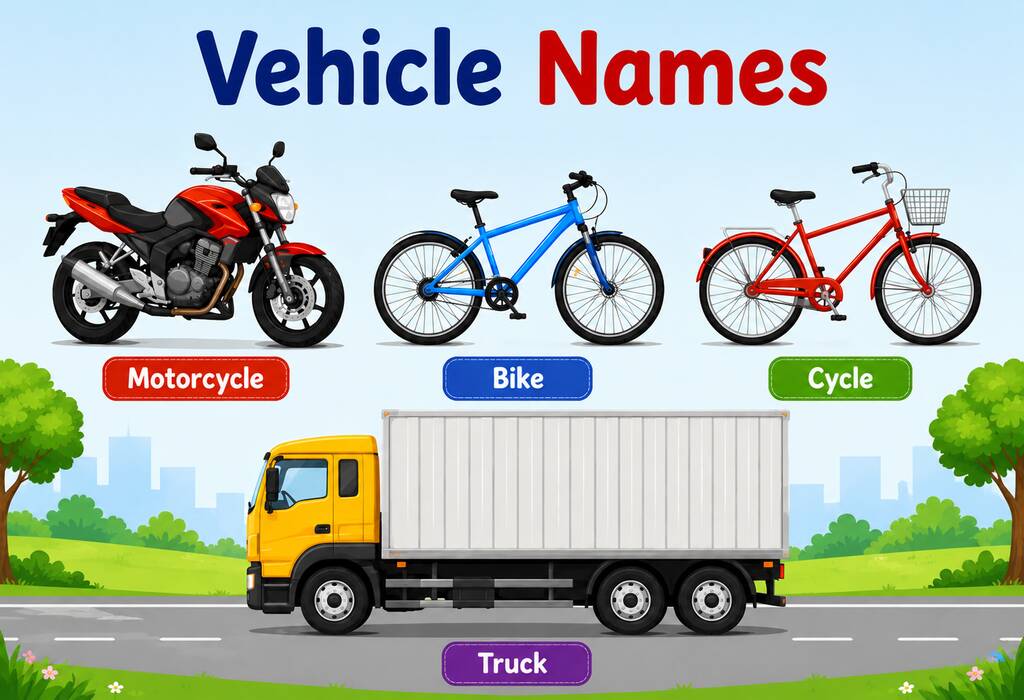
- Bike (Motorcycle) – One of the most common personal vehicles in India, popular for its affordability and ease of navigating traffic.
- Cycle Rickshaw – A pedal-powered rickshaw still used in many Indian towns and cities for short local trips.
- Tempo – A small, load-carrying vehicle commonly used to transport goods within cities and nearby areas.
- Bullock Cart – A traditional, animal-drawn cart still used in many rural parts of India for transporting goods.
- School Bus – A common sight during weekday mornings and afternoons, transporting children to and from school.
- Local Train – Widely used in cities like Mumbai and Kolkata, known for carrying large numbers of daily commuters.
- Tractor – Frequently seen in rural India, used extensively for farming and, at times, for local transport.
- Metro Train – A modern, fast and increasingly popular mode of transport in major Indian cities like Delhi and Bengaluru.
- Truck (Lorry) – Commonly seen on highways, used to transport goods across cities and states.
Types Of Means Of Transport
Vehicles can be grouped based on where they travel, making it easier for children to understand and remember them. Here’s a simple breakdown of the main types of transport.
| TYPES OF TRANSPORT | EXAMPLES OF VEHICLES |
| Land/Road Transport | Car, Bus, Bike, Truck, Tractor, Van, Auto Rickshaw, Bicycle |
| Water Transport | Boat, Ship, Yacht, Canoe, Motorboat |
| Air Transport | Aeroplane, Helicopter, Hot Air Balloon |
| Rail Transport | Train, Metro, Tram |
Vehicle Names Quiz With Answers
A quick quiz is a fun way to check how many vehicle names your child has learnt so far. Try these ten questions together and see how many they get right.
1. This vehicle takes children to school every day.
Answer: School Bus
2. This vehicle flies in the sky and has wings.
Answer: Aeroplane
3. This vehicle helps farmers plough their fields.
Answer: Tractor
4. This vehicle takes sick people to the hospital quickly.
Answer: Ambulance
5. This vehicle travels on water and can be small or large.
Answer: Boat
6. This vehicle has spinning blades on top and can hover in the air.
Answer: Helicopter
7. This vehicle runs on railway tracks and carries many passengers.
Answer: Train
8. This vehicle has two wheels and is powered by pedalling.
Answer: Bicycle
9. This vehicle has a loud siren and rushes to put out fires.
Answer: Fire Truck
10. This vehicle is used to lift heavy objects at construction sites.
Answer: Crane
Activities To Teach Vehicle Names To Kids
Learning vehicle names becomes much easier when paired with hands-on activities. Here are five fun ways to help your child learn and remember them.
1. Vehicle Flashcards
Create simple flashcards with pictures of different vehicles on one side and their names on the other. Show your child a card and ask them to name the vehicle, gradually building up to vehicle parts’ names, like wheels or wings, as they get more confident.
2. Vehicle Sound Matching
Play different vehicle sounds, such as a car horn, a train whistle or a helicopter’s whirring blades, and ask your child to guess which vehicle makes that sound. This helps them connect names with real-world sensory cues.
3. Build-Your-Own Vehicle Craft
Use simple household items like boxes, bottle caps and paper to help your child build a model vehicle, such as a car or a boat. While building, talk about each part, like wheels, windows or a steering wheel, which naturally introduces vehicle parts’ names alongside the main vocabulary.
4. Vehicle Sorting Game
Give your child a set of vehicle picture cards and ask them to sort them into categories, such as land, water, air or rail vehicles. This strengthens both vocabulary and their understanding of vehicle types.
5. Vehicle Spotting Walk
Take your child on a short walk or car ride and ask them to spot and name different vehicles they see along the way. This turns everyday outings into a fun, real-world vocabulary lesson.
FAQs
1. Why Do Some Vehicles Have More Than One Name?
Some vehicles have different names depending on the region or country, such as a “lorry” in the UK being called a “truck” in the US, though they refer to the same type of vehicle.
2. Can a Vehicle Belong to More Than One Category?
Yes, some vehicles, like amphibious cars or seaplanes, are designed to travel on both land and water, or water and air, making them fit into more than one category.
3. Why Do Vehicle Names Sometimes Change as They Get Bigger or Smaller?
Size and purpose can affect naming, such as a small water vehicle being called a “boat” while a much larger one is called a “ship,” even though both travel on water.
4. Why Is It Useful to Learn Vehicle Names in More Than One Language?
Learning vehicle names in multiple languages helps children communicate more easily while travelling and builds a broader vocabulary, especially useful in multilingual households.
5. Do All Countries Use the Same Vehicles?
No, some vehicles are more common in certain countries due to geography, culture or need, such as auto rickshaws being widely used in India but less common elsewhere.
From the family car to aeroplanes soaring overhead, vehicles are woven into a child’s everyday world, making them a natural and engaging starting point for building vocabulary. With the names, categories and activities covered in this article, your child can confidently recognise and talk about the vehicles they encounter, both on the road and in their imagination.
Also Read:
Essay on Car for Kids
Means of Transport for Kids
Essay on Road Safety for Children