


Have you ever watched a snail glide slowly across the garden, or a snake slither through the grass? Welcome to the fascinating world of crawling animals for kids! These creatures move without legs or with tiny ones, wiggling, inching, or sliding in amazing ways. From crawling animals’ examples like caterpillars munching on leaves to millipedes with hundreds of legs scooting along, there’s so much to discover.
Thank you for reading this post, don't forget to subscribe!
In this article, we’ll explore different types of crawling animals, share fun lists, and include a colourful chart perfect for young explorers. You’ll find images of crawling animals to spot their unique patterns and habitats – think shiny beetles, speedy centipedes, and wiggly worms! Crawling animals teach us about nature’s clever tricks for getting around. Ready to crawl into adventure? Keep reading to learn more!
What are Crawling Animals?
Crawling animals are fascinating creatures that move close to the ground by slithering, inching, or using numerous small legs rather than walking upright on four legs. The meaning of ‘crawling animals’ describes these ground-huggers such as worms, snails, and spiders—that travel low to the ground through soil, grass, or intricate webs. Their unique body shapes allow them to squeeze into tight spaces in gardens, forests, or rocky areas, making them adept at staying hidden and finding food efficiently.
Types Of Crawling Animals
Crawling animals come in many forms, each with a unique way of moving along the ground. Here, you’ll discover crawling animals’ names like snails, worms, and centipedes, organised by their habitats and body features. Explore the variety among these fascinating creatures!
1. Molluscs
Refers to soft-bodied invertebrates, such as snails and slugs, that glide smoothly on a muscular foot, often leaving a distinctive slime trail. Many possess protective shells that shield them from predators and environmental stress, and most move slowly and deliberately in moist environments. Molluscs also play a vital role in ecosystem health by recycling nutrients and serving as a food source for other animals.
2. Annelids
Refers to segmented worms, including earthworms, that tunnel through soil with the help of bristly hairs called setae. Their movement aerates the soil and helps decompose organic matter, enriching the earth with nutrient-rich castings. Annelids are also crucial for improving soil structure and water retention, making environments more fertile for plant growth.
3. Myriapods
Refers to long, multi-segmented arthropods, such as centipedes and millipedes, each sporting numerous pairs of legs. Centipedes are agile predators that use venom to hunt insects, while millipedes are slow-moving detritivores that feed on decaying plant matter, distinguishing themselves by their diet and defence strategies. Additionally, myriapods help break down leaf litter, helping maintain soil health.
4. Insects
Six-legged arthropods, like caterpillars and beetles, move in larval or adult stages and exhibit remarkable diversity. Their defining characteristic is metamorphosis, which transforms them dramatically from crawling larvae to winged adults or other forms. Insects are vital pollinators, decomposers, and a primary food source for countless other species, making them essential to nearly every ecosystem.
5. Arachnids
Eight-legged arthropods, such as spiders and scorpions, scuttle low to the ground using jointed legs. Arachnids are known for spinning silk webs to capture prey and are highly adaptable, living in environments ranging from deserts to human dwellings. Some species also help control pest populations, contributing to ecological balance.6.
6. Crustaceans
Refers to hard-shelled arthropods, including crabs, shrimp, and woodlice, recognisable by their segmented bodies and jointed limbs. Most are aquatic, but some, like woodlice, live on land. Crustaceans are essential for nutrient cycling in aquatic systems and serve as a major food source for many animals, including humans.
7. Reptiles
Includes snakes and lizards, which are vertebrates covered with dry, scaly skin. Snakes slither smoothly without limbs, while lizards crawl using strong legs. Reptiles inhabit diverse environments, from arid deserts to lush forests. They play a crucial role as predators, helping to control insect and rodent populations, and their adaptability makes them successful in a variety of climates.
Why Should Kids Learn About Crawling Animals?
Studying crawling animals gives children a deeper appreciation for nature’s ingenious adaptations and the essential roles these creatures play in ecosystems. Earthworms enrich the soil, supporting healthy plant growth, while spiders help control insect populations, demonstrating important principles such as recycling, camouflage, and survival. Gaining this knowledge not only encourages scientific curiosity but also sharpens observational skills and nurtures a lasting respect for the environment, especially through hands-on exploration in gardens and parks.
Common Crawling Animals
Discover a handy crawling animals list featuring everyday crawlers from gardens to oceans. This guide includes crawling animals’ names and pictures to help kids identify and learn about their unique traits!
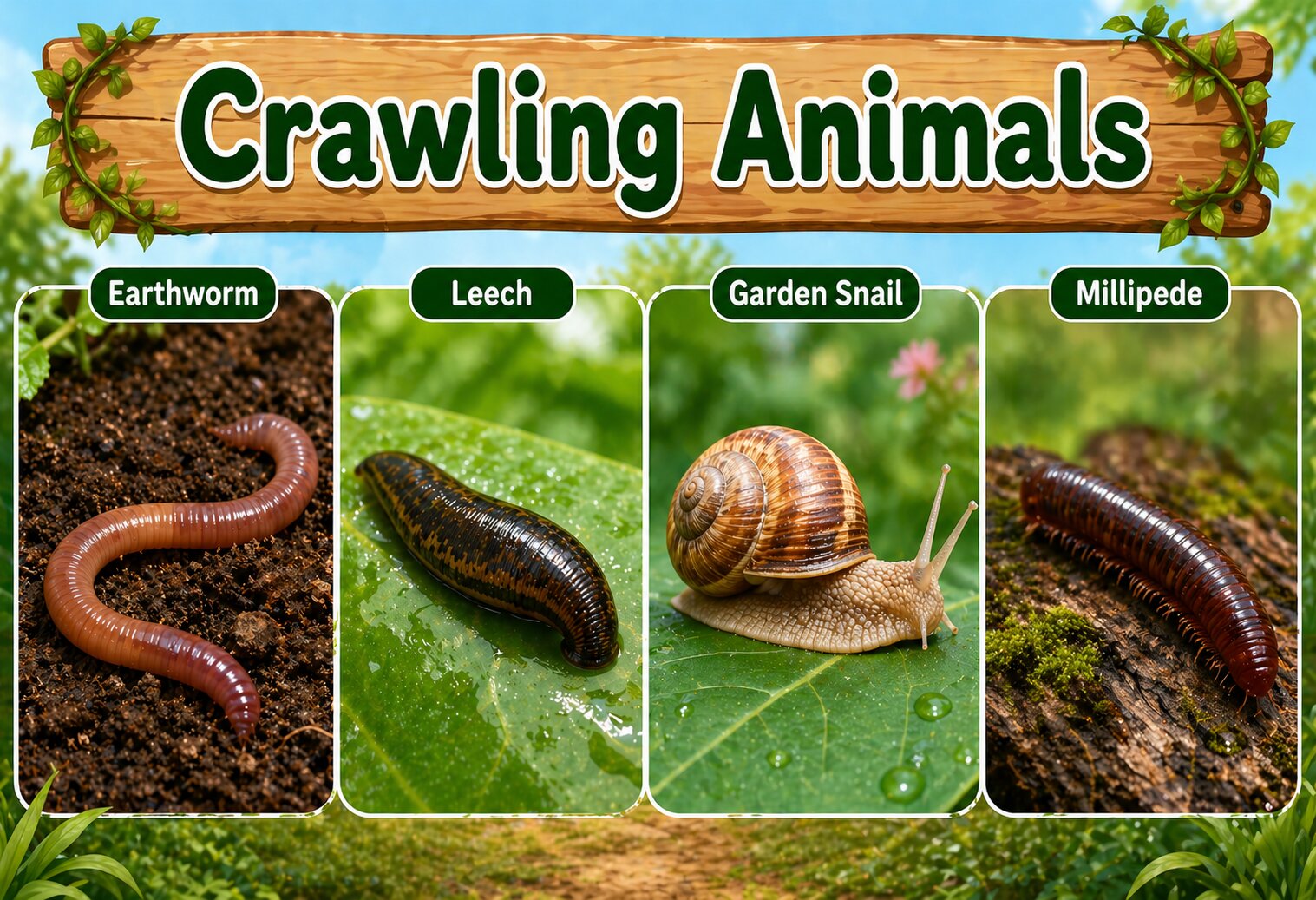
1. Earthworm
This segmented worm wiggles through soil with the help of tiny bristles, loosening the earth so plant roots can grow. It changes old leaves and food scraps into rich soil, serving as a natural fertiliser. Remarkably, it can regrow its tail if it gets hurt. After heavy rain, you might spot them on the surface.
2. Leech
Leeches use suckers at both ends of their bodies to attach to other animals in freshwater. They make a small cut in the skin with many tiny teeth and release a special substance that stops blood from clotting. Leeches can survive for months without food and are sometimes used in hospitals to help heal people.
3. Ragworm
This bristly sea worm digs tunnels in sandy beaches using strong, jaw-like mouthparts. It builds safe tubes to live in and swims out with flat feet to catch small creatures at high tide. People often see their sandy piles on the beach when the tide is low.
4. Garden Snail
A garden snail moves slowly on a single, strong foot covered in slippery slime, and its spiral shell keeps it safe. At night, it eats leaves using a tongue covered in tiny teeth. When it’s dry outside, the snail hides in its shell and closes the opening to stay moist.
5. Sea Slug
Called nudibranchs, these bright sea slugs crawl along the ocean floor. Some can use stinging cells from jellyfish for protection. Their frilly body parts help them breathe, and sometimes they hold tiny algae inside to make food from sunlight. They are often found on coral reefs.
6. Land Snail
Land snails slide over rocks and dirt by making a trail of slime, and they breathe using a special lung inside their bodies. Each snail can lay eggs, and their twisting bodies help them move. To stay safe and wet during dry times, they close their shells tightly.
7. Centipede
Centipedes race after insects and spiders with one pair of legs on each body segment. They use special fangs to inject venom into their food. Their long feelers help them sense smells, and they hide under rocks during the day. Some tropical centipedes can grow as long as a school ruler!
8. Millipede
Millipedes have two pairs of legs per body segment, and some have hundreds of legs in total, which they use to slowly search for rotting plant matter to eat. When scared, they curl up into a tight ball and let out a smelly liquid to keep enemies away. Millipedes have been around for hundreds of millions of years.
9. Krill
These tiny ocean creatures called krill move in huge groups. They crawl on the sea floor or swim quickly using their tail fans. Krill eat tiny plants and animals by catching them with feathery legs. They can glow in the dark, and because there are so many, they provide food for whales and many other sea animals.
10. Caterpillar
Caterpillars crawl along leaves using real legs and extra stumpy ones, munching lots of leaves to help them grow. Some make silk threads or use smelly horns to scare away animals that want to eat them. They are choosy eaters, often eating only certain plants that match the flowers they visit as butterflies or moths.
11. Grub
Grubs are the young forms of beetles, shaped like the letter “C,” and live underground. They chew on roots to grow, using special bacteria in their tummies to help digest food. When they feel threatened, grubs curl up tightly. They can remain hidden for up to three years before becoming adult beetles.
12. Inchworm
Inchworms move in a funny way, arching their bodies up and down as if they are measuring the ground. They don’t have legs in the middle of their bodies, which helps them look like twigs and hide from birds. If scared, they drop down on a silk thread. Inchworms grow up to be moths and often eat the leaves of trees that lose their leaves each year.
13. Spider
Spiders move quickly on eight legs and can make different kinds of silk for building webs, lining their homes, or wrapping up prey. They breathe with special organs called book lungs, and their small front limbs help them taste and touch things. Some spiders live alone, while others live in groups, and you can find them almost anywhere.
14. Scorpion
Scorpions use special comb-like parts to feel vibrations in the ground and can sting with their tails to defend themselves or catch food. They glow under certain lights, such as ultraviolet light, and give birth to live babies. Mother scorpions look after their young, and some can live for several years.
15. Corn Snake
Corn snakes move smoothly by sliding their overlapping belly scales along the ground. They catch small animals like mice by wrapping around them. Their red markings resemble those of dangerous coral snakes, which help keep them safe from predators. Corn snakes lay lots of eggs and are popular as pets in many places.
16. Gecko
Geckos can climb walls and ceilings because their toes are covered in millions of tiny hairs that help them stick. They chirp to communicate with others and can drop their tails when grabbed by a predator. Geckos like warm places and are most active at night when they hunt for insects.
17. Slow Worm
Even though slow worms have no legs, they are actually lizards. They move in a wavy way and can give birth to as many as 12 live babies at once. Slow worms eat lots of slugs and snails, and in winter, they dig into the ground to sleep. In the UK, they are protected animals.
18. Woodlouse
Woodlice have 14 legs and can roll up into a ball for protection. They breathe through gill-like parts that need to stay damp, so they’re most active at night or when it’s wet. Woodlice help break down dead leaves, turning them into soil.
19. Sowbug
Sowbugs, which are close relatives of woodlice, eat fungus and have tough, plate-like bodies to keep moisture in. Unlike woodlice, they don’t roll up as easily. Sowbugs need damp places and help recycle old plant matter at night.
20. Tarantula
Tarantulas are big, hairy spiders that wait in their burrows to catch prey. They can flick tiny, itchy hairs from their bodies to protect themselves and make warning sounds by rubbing body parts together. Female tarantulas can live for over 20 years and look after their eggs. They use silk to line their burrows, making them stronger.
List Of Crawling Animals
Meet some of the most familiar crawling animals you might spot in gardens, parks, near or in water bodies, or even at home. This section features simple tables to help you memorise worms, snails, and more!
Crawling Insects
| Caterpillar | Grub |
| Inchworm | Mealworm |
| Ladybug Larva | Wireworm |
| Cutworm | Armyworm |
| Maggot | Earwig |
Crawling Reptiles
| Corn Snake | Gecko |
| Slow Worm | Skink |
| Legless Lizard | Worm Snake |
| Glass Snake | Blind Snake |
| Python | Boa |
Crawling Sea Creatures
| Sea Slug | Sea Cucumber |
| Nudibranch | Sea Star |
| Hermit Crab | Lobster |
| Shrimp | Barnacle |
| Abalone | Chiton |
Land Crawling Animals
| Earthworm | Snail |
| Slug | Centipede |
| Millipede | Woodlouse |
| Spider | Scorpion |
| Sowbug | Ant |
Crawling-Animal Activities For Kids
Get hands-on with nature through fun, crawling-animal activities for kids, like garden hunts and craft models. These simple games and experiments help young explorers observe, draw, and learn about these ground-dwellers up close!
1. Crawl & Compare Movement Lab
Lay out different textured surfaces in a line — a towel, bubble wrap, a smooth tray, some grass or soil. Show kids a picture of a crawling animal, then challenge them to move across each surface the way that animal would. A snail goes slow and smooth; a crab goes sideways; a caterpillar arches and inches along. Ask: Which surface was hardest? This gets kids thinking about why different animals prefer different habitats.
2. Slime Trail Mapping
Dip a finger in watered-down PVA glue or washable paint and drag it slowly across dark paper to make a “slime trail.” Then show real photos of snail trails and try to copy the patterns — spirals, loops, zigzags. Give kids three trail cards and ask them to guess which crawling animal made each one. Teaches kids that crawling animals move with purpose, not randomly.
3. Exoskeleton Armour Challenge
Show kids close-up photos of a beetle shell or woodlouse armour — notice how it is made of segments, not one solid piece. Then give them index cards, tape, and elastic bands to wrap a small ball or toy. Test it by dropping it from a low height. The rule: it must still roll or move after impact. This directly connects to why animals with exoskeletons can squeeze through tight spaces without breaking.
4. Camouflage Crawl Hunt
Draw or print small crawling animals — a stick insect, a caterpillar, a spider, a beetle — and colour them to blend in with natural materials like leaves, bark, or gravel. Hide them around a table or small outdoor space. Kids get two minutes to find them all. Turn each one over afterwards to reveal its “correct” habitat. A caterpillar found on bark instead of a leaf sparks the key question: why does camouflage only work in the right place?
5. Predator Response Relay
Give each child a crawling animal card — a fast centipede, a curling woodlouse, a freeze-still caterpillar, a hard-shelled beetle. When you call “predator!”, each child responds as their animal: the centipede runs, the woodlouse curls up, the caterpillar freezes. Swap cards and repeat. Quick debrief: Which strategy worked best? Children learn that each crawling animal has a unique defence, and none is perfect for every situation.
Fun Facts about Crawling Animals
Get ready to be amazed — the world of crawling animals is full of surprises. From bizarre body parts to clever survival tricks, these incredible creatures have some of the most fascinating secrets in the animal kingdom.
- Snails can sleep for up to three years if the weather is too dry or cold.
- Centipedes always have an odd number of leg pairs, so no centipede ever has exactly 100 legs.
- A garden snail has around 14,000 tiny teeth on its tongue.
- Spiders are not insects — they are arachnids, which means they have eight legs instead of six.
- Caterpillars have up to 4,000 muscles in their bodies — humans have around 650.
- Woodlice are not insects at all; they are crustaceans, making them more closely related to crabs than to beetles.
- A scorpion can slow its metabolism down so much that it can survive on just one meal a year.
- Millipedes can have anywhere between 40 and 750 legs, depending on the species.
- Slugs have four noses — two tentacles for sensing light and two for smelling.
- Some beetles can carry up to 850 times their own body weight.
- Earthworms have five hearts and breathe entirely through their skin.
- A tarantula can regrow a lost leg during its next moult.
- Stick insects are among the best camouflaged creatures on Earth and can even sway gently to mimic a twig moving in the breeze.
- Leeches have 32 brains — or more precisely, 32 connected nerve segments that each control part of the body.
- The pistol shrimp can snap its claw so fast it creates a flash of light and a shockwave strong enough to stun prey.
Crawling Animals Chart
Below is a handy chart packed with key facts about some of the most interesting crawling animals from around the world. Use it to compare, explore, and discover just how different these remarkable creatures really are.
FAQs
1. How Can I Tell Different Crawling Animals Apart?
Start by counting legs — insects have six, spiders have eight, and woodlice have fourteen. From there, look at body shape, colour, and size, and use a simple identification guide or a free wildlife app to help match what you see to the correct species.
2. What Books Or Resources Are Best For Learning About Crawling Animals?
Field guides specific to your local area are a great starting point, as they focus on animals you are actually likely to encounter. Organisations such as the Royal Entomological Society and the Wildlife Trusts also offer excellent free resources, activity packs, and identification sheets designed for children.
3. How Can I Learn About Crawling Animals Through Art And Craft?
Drawing, sculpting with clay, or even making models from recycled materials are fantastic ways to closely study the anatomy of crawling animals. When you try to recreate a woodlouse from clay, for example, you naturally start paying attention to how its body is segmented and how many legs it has.
4. Are There Any Games That Help You Learn About Crawling Animals?
Activities like the Camouflage Crawl Hunt and Predator Response Relay — described earlier in this guide — make learning feel like play. Board games, wildlife bingo, and online identification quizzes are also brilliant for reinforcing what you have already learnt in a fun and memorable way.
5. How Can Visiting A Museum Or Wildlife Centre Help Me Learn More?
Many natural history museums have dedicated insect and invertebrate exhibits where you can see preserved specimens up close and learn about species from around the world. Some wildlife centres even offer live handling sessions where you can hold tarantulas, millipedes, or giant snails safely under supervision.
Crawling animals are some of the most fascinating and important creatures on Earth, and they are closer than you think. Whether you start by lifting a rock in the garden or browsing a field guide, there is always something new to discover. Keep exploring, keep observing, and let the miniature world of crawling animals surprise you.
Also Read:
Mammals Names for Kids
Aquatic Animals for Children
Names of Endangered Animals