


- Key Points To Remember When Writing An Essay On Makar Sankranti
- 5 Lines On Makar Sankranti
- 10 Lines On Makar Sankranti
- Paragraph On Makar Sankranti
- Short Essay On Makar Sankranti
- Essay On Makar Sankranti In 150 Words
- Makar Sankranti Essay In 300 Words
- Long Essay On Makar Sankranti
- What Will Your Child Learn From This Essay?
- FAQs
Last Updated on December 23, 2025
Every year, Makar Sankranti is celebrated on the 14th of January. The festival includes two words, ‘Makar’ and ‘Sankranti’. Makar means the Capricorn zodiac, and Sankranti means transition. So, putting it together, Makar Sankranti marks the change of the Sun into Makar or Capricorn Zodiac. According to Hindu tradition, it is a very auspicious occasion. On this day, several devotees offer prayers to the Sun God after taking a dip in holy rivers across the country.
Thank you for reading this post, don't forget to subscribe!
Since it is such a sacred festival, why not learn a little more about it? We can do this by writing an essay on Makar Sankranti in English. Essay writing is easy to understand because there are no rules that bind it, making it simpler for children to follow. It is the best way to introduce writing a Makar Sankranti essay in English for classes 1,2, and 3. Let’s begin!
Key Points To Remember When Writing An Essay On Makar Sankranti
No major writing rules govern essay writing; you can write an essay by learning some basic facts and pieces of information. Here are some tips to write a few lines on Makar Sankranti that are simple and yet leave a mark:
- Start your essay on the Sankranti festival by writing a good introduction.
- Decide on the number of words and the flow of your writing.
- Divide the article into a suitable number of paragraphs.
- Break the section at the right time to keep the reader’s interest intact.
- Write down the remaining paragraphs, continuing with the idea and the flow.
- Always be systematic while writing.
5 Lines On Makar Sankranti
Makar Sankranti is a vibrant festival celebrated across India, marking the sun’s transition into the zodiac sign of Capricorn. Here are a few lines on Makar Sankranti to highlight its significance and customs.
- Makar Sankranti is a festival celebrated in January every year.
- It marks the day when the sun starts to move north, bringing longer days.
- People fly colourful kites and eat tasty sweets made from sesame and jaggery.
- Families gather to pray, share food, and enjoy each other’s company.
- Makar Sankranti is a time of joy and celebration with friends and family!
10 Lines On Makar Sankranti
We’ll first learn to write down points about a given topic. Here are 10 lines on the Makar Sankranti festival in English that can serve as an essay on Makar Sankranti for classes 1 and 2:
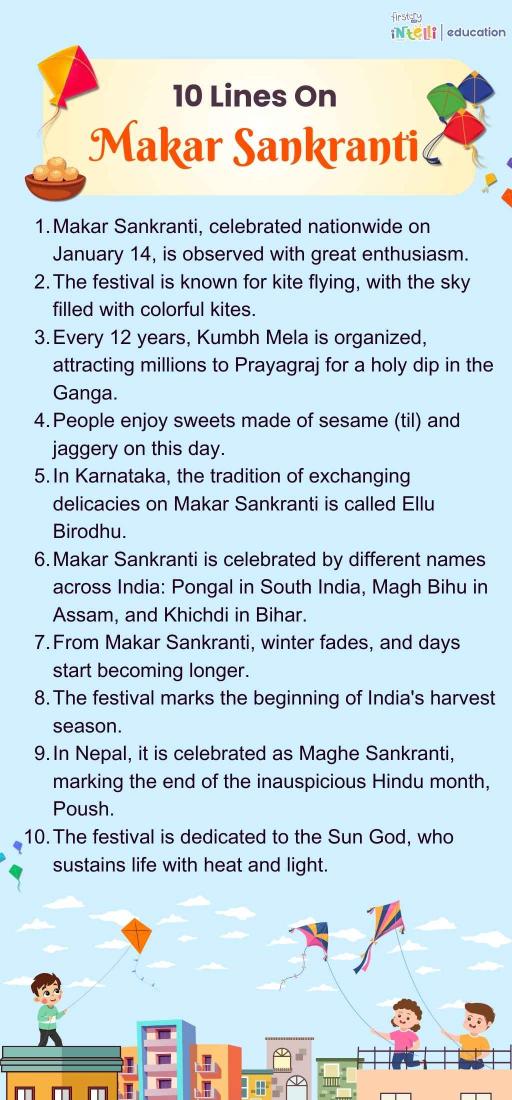
- Makar Sankranti is celebrated with great vigour throughout the nation and falls on the 14th of January every year.
- The festival is famous for flying kites. You will witness the sky painted with beautiful kites on this day.
- Every 12 years, the Kumbh Mela is organised to celebrate this grand festival. Millions of people visit Prayagraj to witness this huge mela and take a bath in the holy river Ganga.
- People devour delicious sweets made of til and jaggery on this day.
- In Karnataka, on Makar Sakranti, the tradition of exchanging delicacies is called Ellu Birodhu.
- People celebrate Makar Sankranti with different names in different states of India. ‘Pongal’ for South India, ‘Magh Bihu’ in Assam, and ‘Khichdi’ in Bihar.
- On Makar Sankranti, the winter season begins to fade. Also, the days become longer.
- Makar Sankranti celebrations mark the beginning of the harvest season in India.
- Makar Sankranti is also celebrated in Nepal as Maghe Sankranti. It marks the end of the inauspicious period in Hindu tradition: Poush.
- This festival is dedicated to the Sun God, who radiates heat and light to support life on Earth.
Paragraph On Makar Sankranti
Now we know how to write down a topic in points. To understand how to build a flow, we must learn to write in paragraphs. First, we will try to write about Makar Sankranti in a single section.
Makar Sankranti is celebrated with full zeal on the 14th of January every year. It marks the transition of the sun god into the zodiac Capricorn or Makar. Kite flying is the main tradition of this festival. In many places, kite-flying competitions are organised to enhance the fun factor. And, the sweets! People distribute happiness by sharing ladoos made of jaggery and til. People also eat gajak and chikki on this day. To maintain happiness and prosperity, people donate sweets and wheat to people in need. The entire nation observes this festival with different names. Although states celebrate it under various names, the main aim is to spread peace, harmony, prosperity, and happiness.
Short Essay On Makar Sankranti
Let’s learn how to combine paragraphs to write an essay. This short essay on Makar Sankranti is suitable for classes 1, 2 and 3. Here goes:
Makar Sankranti has a mythological significance in the Hindu tradition. According to Indian Mythology, a powerful Goddess, Sankranti, defeated a demon named Sankarasur. People believe that Makar Sankranti celebrates this win. The next day, she killed another demon, Kinkarant, and you can find this event mentioned in the Hindu Almanack.
Apart from this, Makar Sankranti has astrological significance as well. On this day, the Sun transitions into Makar or Capricorn zodiac. From this day onward, winters become less harsh, the Sun starts moving north, and days become a little longer. This movement of the Sun is called Uttarayan. People make sweets of til and jaggery and fly kites to celebrate this day!
Essay On Makar Sankranti In 150 Words
The following essay shares a few lines on Makar Sankranti, a joyful festival celebrated across India with excitement and devotion. It explains the festival’s importance, traditions, and how people mark this special day in around 150 words.
Makar Sankranti is one of the most important festivals in India, celebrated every year in January when the Sun enters the zodiac sign of Capricorn (Makar). It marks the end of the winter season and the beginning of longer, warmer days. People celebrate this festival with great joy, especially in states like Maharashtra, Gujarat, Punjab, and Tamil Nadu.
On this day, people take holy baths in rivers, offer prayers to the Sun God, and prepare traditional sweets made of sesame and jaggery. In Maharashtra, people exchange tilgul and say, “Tilgul ghya, god god bola,” which means “accept these sweets and speak kindly.” In Gujarat, colourful kites fill the sky as families gather for kite-flying competitions. Farmers thank nature for their harvest and pray for a prosperous year ahead.
Makar Sankranti spreads the message of unity, gratitude, and positivity, celebrating the bond between people and nature.
Makar Sankranti Essay In 300 Words
The following essay on Sankranti describes the cultural, spiritual, and seasonal significance of this vibrant Indian festival. It explores how people across different states celebrate Makar Sankranti with unique traditions, festive foods, and joyful gatherings in about 300 words.
Makar Sankranti is a popular harvest festival celebrated across India with great enthusiasm and devotion. It marks the transition of the Sun into the zodiac sign of Capricorn, known as Makar in Hindi. This change signifies the end of winter and the beginning of warmer, longer days, symbolising hope, prosperity, and new beginnings. It usually falls on the 14th or 15th January every year and holds both cultural and religious importance.
Across India, Makar Sankranti is celebrated in different ways. In Maharashtra, people exchange sweets made of sesame and jaggery, saying, “Tilgul ghya, god god bola,” which means “accept these sweets and speak kindly.” In Gujarat, the day is marked by exciting kite-flying competitions where colourful kites fill the sky. In Punjab, it is known as Lohri and is celebrated with bonfires, singing, and dancing. In Tamil Nadu, the festival is called Pongal, where people cook Pongal and thank nature for a good harvest.
Taking a holy dip in sacred rivers like the Ganga or Godavari is a familiar ritual, believed to wash away sins and bring blessings. Farmers celebrate this festival as a time to express gratitude to the Sun and Mother Earth for a successful harvest.
Schools and communities also organise cultural programmes, traditional games, and competitions to spread awareness of the festival’s importance. People dress in vibrant attire, share festive meals, and strengthen bonds of friendship and family.
Makar Sankranti promotes togetherness and harmony, reminding people of the importance of gratitude, kindness, and respect for nature. It is not just a festival of crops but also a celebration of peace, positivity, and the changing rhythm of life. The spirit of Makar Sankranti fills every heart with joy and optimism. It truly marks a new beginning filled with hope and happiness for all.
Long Essay On Makar Sankranti
Now, we are ready to put more ideas together to write a longer essay. We’ll add up different ideas to build an article. We can mark different views as subheads, and if you combine them without subheads, it can be an essay for class 3.
Meaning And Significance Of Makar Sankranti
Makar means the zodiac Capricorn, and Sankranti is the transition of the sun in the Makar Zodiac. So this festival marks the sun’s entry into Capricorn. It represents the end of the inauspicious period called Poush in the Hindu calendar. Hindus take a holy dip in rivers, ideally the river Ganga, on the morning of the festival. Post Makar Sankranti, the long winter nights also get shorter.
Every 12 years, the Makar Sankranti Kumbh Mela is organised in UP. People take a dip in Triveni Sangam, where the Yamuna, Ganga, and Saraswati rivers meet.
Custom Foods And Traditions
During Makar Sankranti, each region in India celebrates with its own special foods and customs. In Maharashtra, people prepare sweets made of sesame and jaggery, symbolising warmth and friendship. In Tamil Nadu, Pongal—a dish made from newly harvested rice, milk, and jaggery—is cooked and offered to the Sun God. In Punjab, families light bonfires, sing folk songs, and enjoy foods like popcorn, peanuts, and jaggery. Kite flying in Gujarat and charity in northern states also mark the festival’s spirit of joy, sharing, and gratitude.
How Is Makar Sankranti Celebrated In Different Parts of India?
Makar Sankranti is celebrated in various ways across different states in India. But the common idea behind celebration is to spread love, happiness, and prosperity. Most Hindus pray to the sun god while taking a dip in holy rivers like the Ganga Sagar. Kite flying is the most commonly followed tradition of this festival. Some commonly prepared food items on this day include sweets made with sesame seeds and jaggery, fried grams, dry coconut, and groundnuts. Different states and their celebrations:
1. Telangana And Andhra Pradesh
People here celebrate Makar Sankranti for four days. Women decorate their home entrance by drawing geometric patterns with coloured rice flour called Muggu.
2. Bihar
It is called Khichdi or Sakraat in Western Bihar. The rest of Bihar calls it Dahi Chura or Til Sakraat. In these places, people mix and eat dahi and poha.
3. Gujarat
Makar Sankranti is called Uttarayan in Gujarat. It is celebrated for two days here: 14th and 15th January.
4. Karnataka
For farmers, it is Suggi or the harvest festival in Karnataka. On this day, girls adorn new clothes and visit their relatives with offerings on a plate; this ritual is called Ellu Birodhu.
5. Rajasthan
It is a significant festival in Rajasthan. People celebrate it by making Rajasthani delicacies like pheeni, til-patti, ghevar, kheer, puwa, and til-laddoo.
6. Uttar Pradesh
Makar Sankranti is called Kicheri, and people do ritual bathing on this day. Millions of people gather at Varanasi or Prayagraj in UP, and at Haridwar in Uttarakhand, for holy bathing.
What Will Your Child Learn From This Essay?
As traditions slowly die across the nation, kids must learn about these festivities and follow them. This write-up is an insight into the festival of Makar Sankranti. Besides learning about this festival, the kids will learn how to write an essay efficiently. The child might also develop an interest in reading and writing.
FAQs
1. What is Makar Sankranti, And Why Is It Celebrated?
It is a famous Hindu festival celebrated in India. It is harvest time in India, and people offer thanks for keeping their land fertile.
2. What Are The Main Traditions Associated With Makar Sankranti?
Traditions include flying kites, taking holy dips in rivers, preparing sweets made from sesame seeds and jaggery, and performing rituals to honour the sun god, Surya.
3. Why Do People Fly Kites During Makar Sankranti?
Kite flying symbolises freedom and joy and has become an integral part of the celebrations, creating a festive atmosphere.
4. What Foods Are Typically Prepared For Makar Sankranti?
Common foods include sweets made from sesame seeds and jaggery, such as til ladoo and gajak, which are shared among family and friends.
5. What Is The Significance Of Taking A Holy Dip On Makar Sankranti?
Taking a dip in sacred rivers is believed to cleanse the soul and wash away sins, making it a spiritually significant ritual for many devotees.
We hope this post helped your child learn to write essays. Also, the article would have enhanced your knowledge about Makar Sankranti.
Also Read:
Essay on Pongal for Kids
Essay on Holi for Children
Diwali Essay for Children and Students