

Last Updated on September 16, 2026
An idiom is a phrase whose meaning can’t be worked out just by looking at the individual words it’s made of, since it means something entirely different from its literal sense. Take examples of idioms like “it’s raining cats and dogs”; no animals are actually falling from the sky; it simply means it’s raining heavily. Learning how these phrases work helps children understand English the way native speakers actually use it in everyday conversation, rather than sticking strictly to textbook grammar.
Thank you for reading this post, don't forget to subscribe!
This article brings together a helpful list of idioms for young learners, making it easier to spot these phrases in books, conversations, and everyday classroom instructions. Understanding idioms and their meaning early on can make a real difference in how confidently a child understands and communicates in English as they grow.
What Is An Idiom?
The simplest idiom definition is a group of words that, together, carry a meaning completely different from what the individual words suggest on their own. Instead of describing something literally, an idiom uses a figurative expression that native speakers instantly understand, even though it wouldn’t make sense if translated word for word into another language.
English idioms and phrases are everywhere in everyday conversation, in books, on television, and in casual chats between friends and family. For example, saying someone has “spilled the beans” has nothing to do with beans at all; it simply means they’ve accidentally revealed a secret. Because idioms don’t follow the usual rules of grammar or logic, they often need to be learned individually, through exposure and repetition, rather than worked out through reasoning alone.
Importance Of Idioms For Kids
Learning idioms helps children move beyond textbook English into the kind of language people actually use every day. Since idioms show up constantly in books, conversations, and classroom instructions, understanding them makes it much easier for kids to follow along naturally instead of getting confused by phrases that don’t make literal sense.
Idioms also strengthen reading comprehension; a child who knows “it’s a piece of cake” means something is easy grasps humour and tone more easily too. Discovering a few fun idioms along the way can turn what might feel like a dry grammar lesson into something genuinely enjoyable, while also helping kids sound more natural and expressive as they speak and write.
When Should Your Child Learn Idioms?
There’s no fixed age at which children must start learning idioms, since much of this learning happens naturally through exposure to books, conversations, and everyday speech. That said, most children begin picking up simple idioms, like “raining cats and dogs” or “piece of cake,” around ages 6 to 8, once their vocabulary and reading comprehension are strong enough to grasp the idea that words can mean something beyond their literal sense.
Introducing idioms too early, before a child has a solid grasp of basic sentence structure, can sometimes cause more confusion than understanding. It’s often best to start with a handful of common, everyday idioms and build from there, gradually introducing trickier or more abstract ones as a child’s language skills and confidence grow.
Examples Of Idioms With Their Meanings
Getting familiar with a few common idioms is a great place to start, since these are the phrases kids are most likely to come across in everyday conversation. Here are some examples, along with what each one actually means.
Idioms To Use In Everyday Conversation For Kids
| IDIOM | MEANING | EXAMPLE |
| Break the ice | To start a conversation in an awkward or unfamiliar situation | She told a funny joke to break the ice at the new school. |
| Hit the books | To start studying seriously | I have a test tomorrow, so I need to hit the books tonight. |
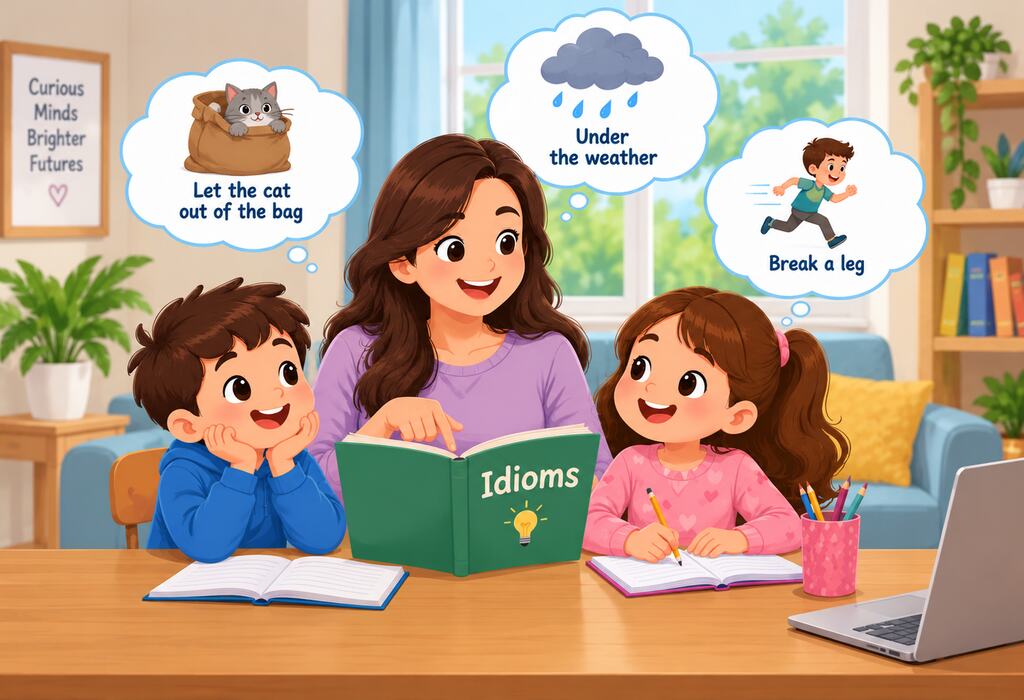
| Under the weather | Feeling slightly unwell | Sam stayed home today because he’s feeling under the weather. |
| Once in a blue moon | Something that happens very rarely | We only visit our grandparents once in a blue moon. |
| Cost an arm and a leg | Something very expensive | That new bicycle costs an arm and a leg. |
| Piece of cake | Something very easy to do | The maths homework was a piece of cake. |
| Let the cat out of the bag | To accidentally reveal a secret | He let the cat out of the bag about the surprise party. |
| Hit the sack | To go to bed | It’s getting late, I think I’ll hit the sack. |
| A blessing in disguise | Something that seems bad but turns out to be good | Missing the bus was a blessing in disguise, since I met an old friend at the station. |
| The ball is in your court | It’s your turn to make a decision or take action | I’ve given you all the information; now the ball is in your court. |
| Bite the bullet | To face a difficult situation with courage | I don’t want to go to the dentist, but I’ll just bite the bullet. |
| Burning the midnight oil | Staying up late to work or study | She was burning the midnight oil to finish her science project. |
| Speak of the devil | Said when someone appears right after being mentioned | Speak of the devil, we were just talking about you! |
| Every cloud has a silver lining | Something good can come out of a bad situation | I lost my pencil, but every cloud has a silver lining; I found a better one in my bag. |
| Keep your fingers crossed | To hope for good luck | Keep your fingers crossed that we win the match tomorrow. |
School Idioms For Kids
| IDIOM | MEANING | EXAMPLE |
| Hit the books | To start studying seriously | I need to hit the books before my exam next week. |
| Pass with flying colours | To succeed with an excellent result | She passed her spelling test with flying colours. |
| Teacher’s pet | A student who is clearly favoured by the teacher | Everyone calls him the teacher’s pet because he always volunteers. |
| Learn something by heart | To memorise something completely | We had to learn the poem by heart for class. |
| Cut corners | To do something most easily, often skipping important steps | Don’t cut corners on your homework; take your time. |
| Ace a test | To score extremely well on a test | I studied all week and managed to ace the test. |
| Back to square one | Starting something over from the beginning | I made a mistake in my project, so now I’m back to square one. |
| Burn the midnight oil | Staying up late to study or finish work | He was burning the midnight oil before his final exams. |
| Show your true colours | To reveal your real character or feelings | She showed her true colours when she helped clean up without being asked. |
| Get the ball rolling | To start something, like a project or task | Let’s get the ball rolling on our group presentation. |
| Play truant | To skip school without permission | He got into trouble for playing truant last Friday. |
| A for effort | Recognition for trying hard, even without a perfect result | The project wasn’t perfect, but she gets an A for effort. |
| Cram for an exam | To study intensively in a short period before a test | I stayed up cramming for the exam the night before. |
| Read between the lines | To understand a deeper meaning that isn’t directly stated | The teacher asked us to read between the lines of the poem. |
| Raise the bar | To set a higher standard for others to reach | His excellent essay really raised the bar for the whole class. |
Number Idioms For Children
| IDIOM | MEANING | EXAMPLE |
| Once in a blue moon | Something that happens very rarely | We only eat out once in a blue moon. |
| Two peas in a pod | Two people who are very similar or always together | My sister and I are like two peas in a pod. |
| Third time’s the charm | Success is expected after two failed attempts | I missed the goal twice, but third time’s the charm! |
| At sixes and sevens | Feeling confused or disorganised | The classroom was at sixes and sevens after the party. |
| Nine times out of ten | Something that happens almost always | Nine times out of ten, he finishes his homework before dinner. |
| Back to square one | Starting over from the beginning | Our plan didn’t work, so we’re back to square one. |
| Two heads are better than one | Working together produces better results than working alone | Let’s solve this puzzle together; two heads are better than one. |
| Give a hundred per cent | To try as hard as possible | She always gives a hundred per cent in every match. |
| In seventh heaven | Feeling extremely happy | He was in seventh heaven when he got his new bicycle. |
| One in a million | Someone or something truly special or rare | My best friend is one in a million. |
Food Idioms For Kids
| IDIOM | MEANING | EXAMPLE |
| Piece of cake | Something very easy to do | The puzzle was a piece of cake for her. |
| Spill the beans | To accidentally reveal a secret | He spilled the beans about the surprise party. |
| Cool as a cucumber | Calm and relaxed, even under pressure | She stayed cool as a cucumber during the exam. |
| Bring home the bacon | To earn money to support a family | Both parents work hard to bring home the bacon. |
| Full of beans | Full of energy and enthusiasm | The puppy was full of beans after breakfast. |
| Have a lot on your plate | To have many tasks or responsibilities at once | I can’t help right now; I have a lot on my plate this week. |
| Sell like hot cakes | To sell very quickly and in large numbers | The new toys were selling like hot cakes at the store. |
| Not my cup of tea | Something you don’t particularly enjoy | Horror movies are not my cup of tea. |
| The apple of my eye | Someone who is dearly loved | My little sister is the apple of my eye. |
| Butter someone up | To flatter someone in order to get something | He tried to butter up his teacher before asking for extra time. |
| Icing on the cake | An extra good thing added to an already good situation | Winning the match was great, and the trophy was just icing on the cake. |
| Go bananas | To become very excited or angry | The kids went bananas when they saw the fireworks. |
| Bad egg | A person who behaves badly or dishonestly | He turned out to be a bad egg after all. |
| Egg someone on | To encourage someone to do something, often risky | His friends egged him on to try the tallest slide. |
| Easy as pie | Something very simple to do | Solving that maths problem was as easy as pie. |
Animal Idioms For Children
| IDIOM | MEANING | EXAMPLE |
| Let the cat out of the bag | To accidentally reveal a secret | She let the cat out of the bag about the surprise trip. |
| It’s raining cats and dogs | It is raining very heavily | We stayed inside because it was raining cats and dogs. |
| A little bird told me | To know something without revealing the source | A little bird told me it’s your birthday today! |
| Kill two birds with one stone | To achieve two things with a single action | I walked to school and returned my library book, killing two birds with one stone. |
| The elephant in the room | An obvious problem that no one wants to talk about | Nobody mentioned the broken vase, it was the elephant in the room. |
| Hold your horses | To wait or slow down | Hold your horses, we still need to pack our bags! |
| Crocodile tears | Fake sadness or sympathy | He cried crocodile tears when he got caught cheating. |
| Early bird catches the worm | Those who act early gain an advantage | I woke up early to study, the early bird catches the worm. |
| Let sleeping dogs lie | To avoid bringing up a problem that has already settled | We decided to let sleeping dogs lie and not mention the argument again. |
| Wolf in sheep’s clothing | Someone who seems harmless but is actually dangerous | Be careful of him; he’s a wolf in sheep’s clothing. |
| Straight from the horse’s mouth | Information from a reliable, first-hand source | I heard it straight from the horse’s mouth; she’s moving schools. |
| Monkey business | Silly or mischievous behaviour | The teacher told the students to stop their monkey business. |
| Busy as a bee | Very busy and hardworking | She’s been as busy as a bee preparing for the school fair. |
| Fish out of water | Feeling uncomfortable in an unfamiliar situation | He felt like a fish out of water on his first day at the new school. |
| A dog’s life | A difficult or unpleasant way of living | Working two jobs and studying felt like leading a dog’s life. |
Body Part Idioms For Kids
| IDIOM | MEANING | EXAMPLE |
| All ears | Fully listening and paying attention | Tell me what happened, I’m all ears. |
| Keep an eye on | To watch something or someone carefully | Please keep an eye on your little brother while I cook. |
| Cost an arm and a leg | Something very expensive | That new gaming console cost an arm and a leg. |
| Put your foot down | To firmly refuse or insist on something | Mum put her foot down and said no more sweets before dinner. |
| Get cold feet | To become nervous before doing something | He got cold feet right before his speech. |
| Have a change of heart | To change your opinion or decision | She had a change of heart and decided to join the team after all. |
| Pull someone’s leg | To playfully tease or joke with someone | Relax, I’m just pulling your leg! |
| Give someone a hand | To help someone with a task | Can you give me a hand with these boxes? |
| Keep your chin up | To stay positive during a difficult time | Keep your chin up, you’ll do better on the next test. |
| Bite your tongue | To stop yourself from saying something | I had to bite my tongue when he took the last cookie. |
| Head in the clouds | Daydreaming or not paying attention to reality | He always has his head in the clouds during maths class. |
| Elbow grease | Hard physical effort | Cleaning the garage took a lot of elbow grease. |
| Rule of thumb | A general guideline based on experience | As a rule of thumb, finish your homework before watching TV. |
| Get something off your chest | To share something that has been bothering you | She finally got it off her chest and told her friend the truth. |
| Have a good ear for something | To be naturally good at noticing or understanding something, like music | My brother has a good ear for music and learns songs quickly. |
When Should We Not Use Idioms?
While idioms can make language more colourful and expressive, there are certain situations where it’s best to avoid them altogether. Here are a few times when using idioms may not be the right choice.
1. In Formal Writing
Idioms can come across as too casual for formal documents, official letters, or academic essays, where clear, straightforward language is usually expected instead.
2. When Speaking With Non-Native English Speakers
Idioms often don’t translate well and can confuse someone who is still learning English, since their meaning isn’t obvious from the individual words used.
3. During Important Instructions
Using idioms while giving clear directions or instructions, especially to young children, can lead to misunderstandings if the literal meaning is taken instead of the intended one.
4. In Professional Or Workplace Communication
Idioms can sometimes sound unprofessional or be misunderstood in workplace emails, presentations, or meetings, particularly with international colleagues from different cultural backgrounds.
5. When Precision Is Required
In situations like giving medical advice, legal information, or safety instructions, idioms should be avoided entirely, since clarity and accuracy matter far more than expressive language.
Activities That Will Help Your Child Learn Idioms
Given below are some engaging activities that will help your child learn popular idioms in English through play, creativity, and everyday practice.
1. Idiom Challenge
Ask children to guess the meaning of popular idioms within a set time limit. The child with the highest number of correct answers within the time given wins the game, making it a fun way to test recall under a bit of friendly pressure.
2. Idiom Hunt
Give your child a short story to read, filled with common English idioms woven naturally into the text. Ask them to note down every idiom they spot, encouraging closer reading and better recognition over time.
3. Draw It Out
Ask your child to draw both the literal and figurative meanings of a simple idiom side by side. This visual comparison often makes the humour and logic behind idioms click much faster than explanation alone.
4. Match It
If your child can read confidently, prepare a set of idioms on one side and their meanings on the other, then ask them to match each pair correctly. This works well as a quick, repeatable exercise for reinforcing memory.
5. Note Down The Idioms About Learning
Find a handful of idioms related to learning and studying, and ask your child to write them down in a notebook along with their meanings and example sentences. Introducing just one new idiom a day keeps the pace manageable and easy to retain.
6. Idiom Rhymes And Songs
Many idiom-based songs and rhymes are available online, designed specifically to help children learn through rhythm and repetition. Playing these regularly makes idioms easier to remember, almost without your child realising they’re learning.
7. Tell A Story
Challenge your child to invent a short story built entirely around a simple idiom, using it naturally within the plot. This encourages creative thinking while reinforcing how the idiom might actually be used in context.
8. Flashcards
Draw a simple picture representing the meaning of an idiom on a flashcard, then show it to your child and see if they can guess the idiom it represents. This turns learning into a quick, visual guessing game.
9. Circle The Idioms
Prepare a worksheet with a mix of real idioms and random, unrelated phrases jumbled together. Ask your child to read through carefully and circle only the genuine idioms, sharpening their ability to recognise them in everyday text.
10. Act It Out
Choose a simple idiom and ask your child to act out its literal meaning through gestures or a short skit, then explain what it actually means. This blends movement and humour with learning, making the idiom far more memorable.
FAQs
1. Do All Languages Have Idioms, Or Are They Unique To English?
Most languages have their own idioms, though the exact phrases and imagery differ, since idioms often reflect a culture’s history, environment, and everyday experiences.
2. Can New Idioms Be Created Over Time?
Yes, idioms evolve constantly, with new ones emerging from popular culture, technology, and everyday slang, while some older idioms gradually fall out of common use.
3. Why Do Idioms Often Not Make Sense When Translated Into Another Language?
Idioms are tied closely to the culture and history of the language they come from, so translating them word for word usually loses their intended meaning entirely.
4. Is It Okay To Use Idioms In Creative Writing Like Stories Or Poems?
Yes, idioms can add colour, humour, and personality to creative writing, making dialogue and descriptions feel more natural and relatable to readers.
Idioms may seem tricky at first, but with regular exposure through stories, games, and everyday conversation, children can learn to use them naturally and confidently. Understanding idioms not only strengthens a child’s grasp of English but also helps them better understand humour, tone, and the way people truly communicate in daily life.
Also Read:
Learn Describing Words for Children
Compound Words for Kids with Types and Activities
Vocabulary Words for Children to Improve their Language Skill