


- What Are Modal Verbs?
- Why Are Modal Verbs Important For Kids?
- At What Age Should Children Learn About Modal Verbs?
- Golden Rules Of Modal Verbs
- Uses Of Modal Verbs
- What Are Some Different Types Of Modal Verbs?
- How To Use Modal Verbs In Sentences?
- How To Identify And Recognise Modal Verbs?
- Activities That Will Help Your Child Learn About Modal Verbs
- Exercise To Practice Modal Verbs
- Practice Modal Verb Worksheet For Kids
- FAQs
Last Updated on September 16, 2026
Understanding modal verbs for kids is an important step in helping them speak and write English more confidently, since these small words play a big role in expressing ability, permission, possibility, and necessity. Words like “can,” “could,” “should,” and “must” show up constantly in everyday conversation, making them essential building blocks for clear communication.
Thank you for reading this post, don't forget to subscribe!
This article breaks down the definition of modal verbs, along with simple examples and rules to help children understand exactly how and when to use them. Unlike regular verbs, these words follow their own unique set of grammar rules, which can feel a little tricky at first without the right explanation. Whether your child is just starting to learn grammar or looking to strengthen their existing skills, this guide offers a clear, easy-to-follow breakdown of modal verbs in English, helping them speak and write with confidence.
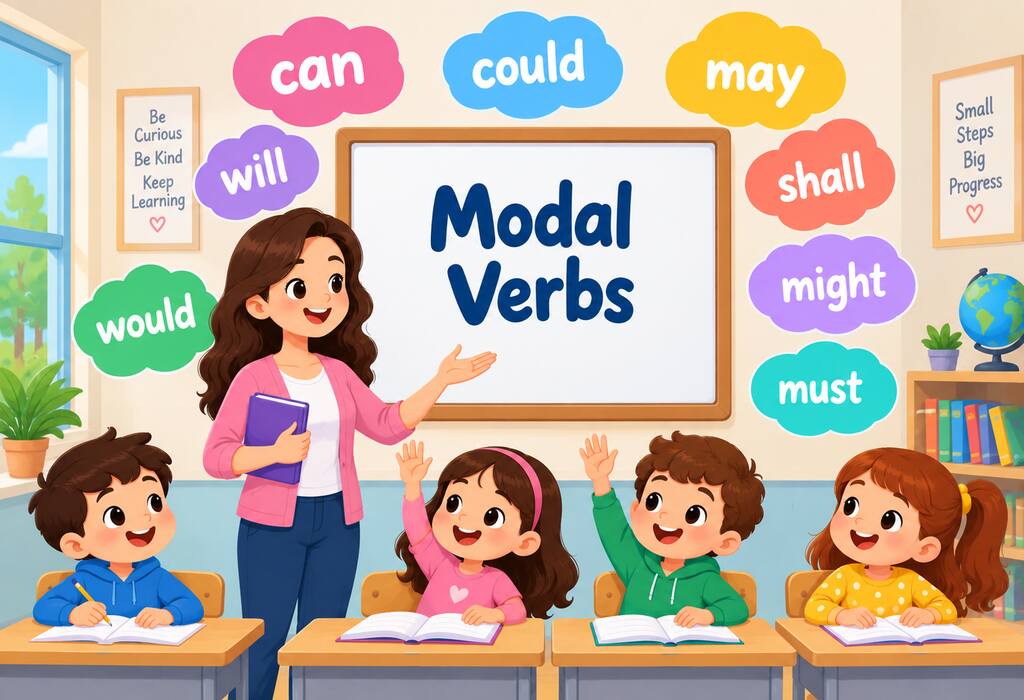
What Are Modal Verbs?
Every modal verb example below helps make the modal verb meaning easier to grasp, since each one plays a distinct role in showing ability, permission, possibility, or necessity. Here’s a simple breakdown of the most common ones.
| MODAL VERB | USAGE | EXAMPLE |
| Can | Ability or permission | She can ride a bicycle. |
| Could | Past ability or a polite request | Could you help me, please? |
| May | Permission or possibility | You may go outside to play. |
| Might | A weaker possibility | It might rain later today. |
| Must | Strong necessity or obligation | You must wear your seatbelt. |
| Should | Advice or recommendation | You should finish your homework first. |
| Will | Future action or willingness | We will visit the zoo tomorrow. |
| Would | A polite offer or request | Would you like some juice? |
| Shall | A suggestion, often formal | Shall we begin the class? |
Why Are Modal Verbs Important For Kids?
Understanding different modal verb types helps children express themselves with far more nuance than basic sentences allow, whether they’re asking for permission, giving advice, or talking about possibilities. Learning modal verbs in grammar early on also builds a stronger foundation for more advanced language skills down the line, since these words appear constantly in everyday conversation, schoolwork, and written communication. Beyond just grammar rules, modal verbs teach kids to think about tone and intention; understanding the difference between saying “I must finish this” and “I should finish this” helps them communicate more precisely and confidently as they grow.
At What Age Should Children Learn About Modal Verbs?
There’s no strict age at which children must start learning modal verbs, though most begin picking up simple ones naturally through everyday conversation well before they can name them as a grammar concept. Words like “can” and “will” often appear in a child’s vocabulary as early as age 3 or 4, simply through hearing them used at home and in stories.
Formal learning, such as being introduced to a list of modal verbs and understanding their specific rules, usually begins around ages 6 to 8, once children are more comfortable with basic sentence structure and grammar concepts in school. That said, every child develops at their own pace, so it’s best to introduce modal verbs gradually, starting with the most common ones like “can,” “should,” and “must,” before moving on to trickier ones like “might” and “shall.”
Golden Rules Of Modal Verbs
Modal verbs may seem simple, but they follow a few strict grammar rules that set them apart from regular verbs. Here are the key rules every child should know.
1. Modal Verbs Are Always Followed By The Base Form Of A Verb
Modal verbs never take “to” or a conjugated verb form after them; they’re always followed by the plain base form.
Example: “She can swim” (not “She can to swim” or “She can swims”).
2. Modal Verbs Do Not Change Form For Different Subjects
Unlike regular verbs, modal verbs stay exactly the same whether the subject is I, you, he, she, or they.
Example: “He must go” and “They must go” both use “must,” with no added “s.”
3. Modal Verbs Do Not Have A Traditional Past Tense
Most modal verbs don’t change to show past tense the way regular verbs do; alternative words are used instead.
Example: “Must” becomes “had to” in the past, as in “Yesterday, I had to finish my homework.”
4. Negatives Are Formed By Adding “Not” Directly After The Modal
No extra helping verb like “do” or “does” is needed to make a modal verb negative.
Example: “You should not shout” (not “You do not should shout”).
5. Questions Are Formed By Placing The Modal Before The Subject
To ask a question, the modal verb simply moves to the front of the sentence, before the subject.
Example: “Can you help me?” (not “Do you can help me?”).
Uses Of Modal Verbs
Modal verbs serve several different purposes depending on the context, from giving instructions to expressing possibility. Here’s a closer look at their key uses.
1. Modal Verbs Of Obligation And Necessity
These modal verbs convey obligation, necessity, or a strong requirement, giving clear guidance on what needs to be done in a given situation.
Example: “You must do your homework tonight.”
2. Modal Verbs Of Suggestion And Advice
These are used to offer advice or gently suggest an action, making them useful in situations where a direct command might feel too harsh or rude.
Example: “You should stay at home if it’s raining.”
3. Modal Verbs Of Possibility And Promise
Modal verbs can express how likely something is to happen or serve as a firm commitment to do something in the future.
Example of possibility: “I could meet up on Friday.”
Example of promise: “I will meet up on Friday.”
4. Modal Verbs Of Permission
These modal verbs are used to ask for or grant permission to do something, often politely or formally.
Example: “May I leave the room, please?”
5. Inverting Modal Verbs To Form Questions
Modal verbs can be inverted, swapped with the subject of a sentence, to turn a statement into a question.
Example: “We could go to the bookstore tomorrow” becomes “Could we go to the bookstore tomorrow?”
What Are Some Different Types Of Modal Verbs?
Looking at a few example sentences of modal verbs makes it much easier to understand how each type is used in everyday speech. Modal verbs can be grouped based on the specific idea they express, making it simpler for kids to know when and why to use each one. Here are the main categories to know.
1. Ability
Used to show that someone is capable of doing something, whether it’s a physical skill or a learned talent.
Example: “She can play the piano beautifully.”
2. Advice
Used to gently suggest what someone should do, often to guide their decisions without sounding too forceful.
Example: “You should drink more water every day.”
3. Obligation
Used to show that something is necessary or required, often carrying more weight than simple advice.
Example: “Students must submit their assignments on time.”
4. Permission
Used to ask for or grant approval to do something, often in a polite or respectful way.
Example: “May I borrow your pencil?”
5. Prohibition
Used to set clear boundaries or rules, showing that something is not allowed.
Example: “You must not run near the swimming pool.”
6. Possibility
Used to show how likely or unlikely something is to happen, without stating it as a certainty.
Example: “It might snow later this evening.”
How To Use Modal Verbs In Sentences?
Each modal verb carries its own distinct shade of meaning, and the best way to see these differences clearly is through sentences using modal verbs in real, everyday contexts. Below is a closer look at each one, along with its negative form and a set of examples to show exactly how it’s used.
1. Can
Negative Form: Can’t
Used to express ability or possibility, make a request, ask for permission, or offer a suggestion.
Examples:
- Can you come to play today?
- Can you help me with this?
- I can call you after some time.
- Alex can’t fix the phone.
- Mark and Joey can jump very high.
- Mary can play the piano; she’s been playing since she was 5 years old.
- Lucy can come early if you want; she doesn’t have homework today.
2. Could
Negative Form: Couldn’t
Used to make polite requests, suggestions, or offers, and to talk about past ability or general possibility.
Examples:
- I could go to the store with you if you’d like.
- Could you pass me the pepper, please?
- Krish was free at the moment, so he could go to the movies with her.
- Could I go and play with Mary?
- I couldn’t jump very high when I was little.
- It could be sunny tomorrow.
- I could help you with French.
3. May
Negative Form: May not
Used to talk about permission in the present, make suggestions, and discuss possibilities.
Examples:
- May I go to the washroom, please?
- Alex may go to your party later.
- May I help you with the task?
- I can’t help you with the project, but your friend may be able to.
- It may be a good idea to go for a walk early.
- Mary may not stay out of the house late.
- May I borrow a pencil?
4. Might
Negative Form: Might not
Used to express possibility in the present or future, though with less certainty than “may.”
Examples:
- I heard that it might rain today.
- Don’t call Ryan right now; he might not be in the office.
- Baby Elizabeth has a new dance teacher that you might like.
- Jenny might need your help later.
- Ben might go to Europe this summer.
- This cooking class looks interesting; I might take it.
- I might be a few minutes late.
5. Will
Negative Form: Won’t
Used to talk about wishes, requests, and demands; make predictions and assumptions; form promises; describe spontaneous decisions; and talk about habits.
Examples:
- I won’t be far away.
- Do you need help? I will help you!
- Look at the sky; it will rain later.
- Betty thinks her team will win the championship.
- I don’t have my phone here, but I will call Sam as soon as possible.
- Will you turn off the light, Peter?
- I won’t tell your secret to anyone.
6. Would
Negative Form: Wouldn’t
Used to make wishes and requests in a polite, considerate manner.
Examples:
- I wish I would stay awake all night listening to music.
- Would you open the jar, please?
- I would love to dance, thanks!
- Would you like to play football with me on Sunday?
- I would rather have milk, please.
- Would you prefer sweet or salty lemonade?
- She wouldn’t take her coat off.
7. Shall
Negative Form: Shall not
Used to make polite offers and suggestions, talk about options, and ask what should be done.
Examples:
- Shall I help you with your project?
- Great, let’s meet later, shall we say 5 p.m. then?
- I shall have to be at the airport by 3 pm.
- You shall not forget to bring your car.
- She shall be replaced by a new dance teacher.
- Shall we begin the game?
- I shall post it to you tomorrow.
8. Should
Negative Form: Shouldn’t
Used to give advice, express what’s right, and recommend a course of action.
Examples:
- We should arrive on time.
- Len thinks that we should meet on Saturdays.
- Should I stay here with you?
- The children should start studying soon.
- I think you should buy a black car instead of a red one.
- Maybe we should check everything once more.
- Karen should stop eating fast food.
9. Must
Negative Form: Mustn’t
Used to express necessity, strong obligation, or a confident assumption.
Examples:
- We must go; we have a doctor’s appointment soon.
- You mustn’t use Mom’s phone without her permission.
- You must try some of this chocolate pastry.
- Ben has been studying all day; he must be tired.
- The new movie is great; you must see it!
- Alex must be a teacher; he knows a lot about maths.
- You must come and see us soon.
10. Ought To
Negative Form: Ought not to
Used to express advice and a sense of moral obligation.
Examples:
- It’s snowing; you ought to drive carefully when you leave.
- Lizzy ought to help her sister when she moves to her new house.
- Alex, you ought to help your sister with her homework!
- All the players ought to be on the field after snacks.
- You ought to clean up your room.
- We ought to avoid taking my father’s car.
- They ought to have more gardens in the city centre.
How To Identify And Recognise Modal Verbs?
Spotting a modal verb in a sentence becomes much easier once you know what to look for, since they behave quite differently from regular verbs. Here are a few simple ways to recognise them.
- Check If It’s Followed By A Base Verb — Modal verbs are always followed by the plain form of another verb, without “to” in between. If you see words like “can go,” “must try,” or “should eat,” the first word is likely a modal verb.
- Look For Words That Don’t Change With The Subject — Unlike regular verbs, modal verbs stay exactly the same no matter who is doing the action. “She can,” “they can,” and “I can” all use the same form, with no added “s” or change in spelling.
- See If It Expresses Ability, Permission, Possibility, Or Obligation — Modal verbs almost always add meaning related to what someone is able to do, allowed to do, likely to do, or required to do, rather than simply describing an action on its own.
- Notice That It Has No “-ing” Or Past Participle Form — Modal verbs don’t have continuous or perfect tense forms like regular verbs do; you won’t find “canning” or “musted,” which helps set them apart immediately.
- Remember The Common Modal Verbs — Memorising the core list, can, could, may, might, will, would, shall, should, must, and ought to, makes it much easier to spot them quickly in a sentence.
Activities That Will Help Your Child Learn About Modal Verbs
Modal verb rules and examples are easy enough to explain to children, but real understanding often comes through practice rather than memorisation. Here are a few simple, engaging activities to help reinforce the concept.
1. Fill In The Blanks
Write out a few example sentences using modal verbs, then create similar sentences with the modal verb missing. Ask your child to fill in the correct word based on the context.
2. Teach With Pictures
Show your child a picture with a clear message, such as a “no running” sign, and ask them what it means. Encourage them to explain it in a full sentence, which should naturally lead to something like “you can’t run” or “you must not run.”
3. Circle The Modals
Hand your child a newspaper or short article and ask them to read through it, circling every modal verb they spot along the way. Follow up by asking them to explain what each circled sentence means.
4. Role Play
Set up a simple scenario, like being a shopkeeper or a teacher, and ask your child to build their own dialogue using modal verbs. This gives them a chance to use what they’ve learned in a more natural, conversational way.
5. Modal Verb Story Chain
Start a short story with one sentence containing a modal verb, then have your child add the next sentence, also using a modal verb, and continue building the story together. This encourages creative thinking while reinforcing correct usage in context.
Exercise To Practice Modal Verbs
Practising with real sentences is one of the best ways to make modal verbs stick. Try these five exercises for modal verbs to test what you’ve learned so far.
1. Fill In The Blank With The Correct Modal Verb
Choose the most suitable modal verb (can, must, should) to complete each sentence: “You ___ brush your teeth before bed,” “He ___ speak three languages,” and “We ___ finish our project by Friday.”
2. Rewrite The Sentence As A Question
Turn each of these statements into a question by moving the modal verb to the front: “She could join us for lunch” and “They will arrive on time.”
3. Identify The Modal Verb’s Meaning
Read each sentence and decide whether the modal verb shows ability, permission, or possibility: “It might snow tonight,” “May I use your pen?” and “My brother can swim very fast.”
4. Correct The Mistake
Each sentence below has an error involving a modal verb; rewrite it correctly: “She musts finish her homework,” and “He can to ride a bicycle.”
5. Write Your Own Sentences
Using the modal verbs “should,” “must,” and “could,” write one original sentence for each, describing something from your own daily routine.
Practice Modal Verb Worksheet For Kids
This section has a printable worksheet to help kids practise identifying and using modal verbs correctly. It’s a simple way to reinforce what they’ve learned through hands-on, independent practice.
FAQs
1. Can A Sentence Have More Than One Modal Verb?
No, standard English sentences typically use only one modal verb at a time, since combining two, like “can must,” doesn’t follow correct grammar rules.
2. Is “Need” Ever Used As A Modal Verb?
Yes, in certain formal or negative sentences, “need” can act like a modal verb, such as in “You needn’t worry,” though it’s more commonly used as a regular verb.
3. Why Doesn’t “Must” Have A Simple Past Tense Form?
Modal verbs like “must” don’t change into a past tense version the way regular verbs do, so “had to” is used instead to express the same meaning in the past.
4. Can Modal Verbs Be Used In Formal Writing Like Essays?
Yes, modal verbs are commonly used in formal writing to express possibility, necessity, or recommendations, making sentences sound more precise and thoughtful.
Modal verbs may be small words, but they carry real weight in shaping how a sentence sounds, whether it’s a firm rule, a gentle suggestion, or a simple possibility. With consistent practice through examples, activities, and exercises, children can learn to use words like “can,” “should,” and “must” naturally and confidently in their everyday speech and writing.
Also Read:
Descriptive Words for Kids to Learn
Compound Words for Children in English with Examples
Vocabulary Words for Children to Improve Language Skills