



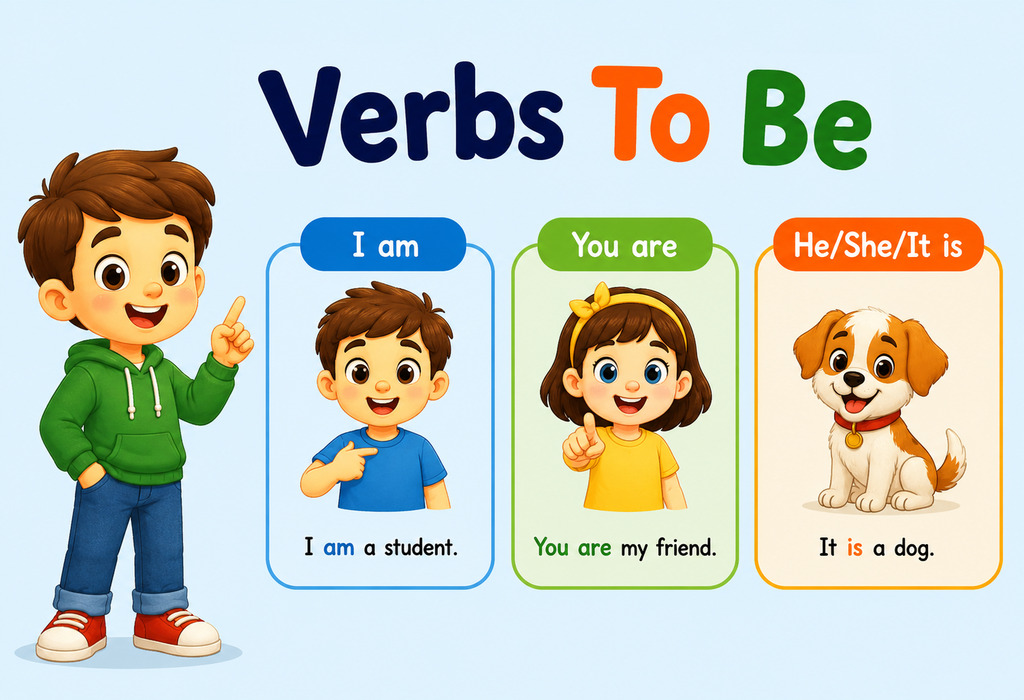
In any sentence, verbs play a very important role in communicating what is going on. It is the most essential part of a sentence. Most sentences would be grammatically incomplete without a verb, with some exceptions like nominal sentences and some exclamatory sentences.
Thank you for reading this post, don't forget to subscribe!
The verb “to be” in English is a verb where the action talked about is not a big one, but a rather common one. The action is ‘to be’. It can have many contexts, such as to be someone (I am Pooja), to be something (This is a pen), to be feeling something (She is upset), to be somewhere (They are in Kerala), to be in a certain state (You are wet) and many more states.
Let us understand what the verb “to be” means, with examples of its uses in all its different forms.
What Is The Verb “To Be”?
The meaning of the verb to be is to exist, or to be in a certain state, or to possess certain traits. It is one of the shortest verbs in English. It is the most important, yet oddest, verb in the English language. It’s an irregular verb, because it completely changes its form in each tense, and in the singular and plural forms of the first, second and third person.
To be” verbs are: are, am, is, was, were, been and being. They are used to describe or indicate the condition of people, things, places, and ideas. For example, they could tell us the subject’s age, nationality, job or other traits.
Examples Of The Verb “To Be”
Here are some examples of the verb ‘to be’ words and how to use them:
1. Hello! I am Shraddha. I am from Mumbai.
2. I was a writer.
3. I am a teacher by profession now.
4. My students are in Class 1.
5. They are good at English Grammar, especially Ravi.
6. He is the class topper. Today, there will be a surprise test.
7. It is difficult, but I am sure that all the students will score well.
8. I will be proud of them.”
In the above paragraph, you can notice several examples of the use of the verb To Be. Notice that all sentences have at least one form of the verb. Let us break it down and understand this better:
Uses Of The Verb “To Be”
The verb “to be” has several uses: it expresses existence, states, and traits, and introduces many details about a person, an object, or even a feeling or state. Here are some verb ‘to be’ definitions and examples:
1. For Names
When you want to tell someone your name or introduce someone, you make use of the To Be verb in the appropriate form. Here are some examples.
Examples
- I am Madhu.
- You are Raju.
- We are Mishras.
- She is Shailaja.
- They are the Hingoranis.
2. For Ages
When you want to tell someone your age, you use the verb ‘to be’. You can even use it in this form to talk about how old, young or new an object or a monument is.
Examples
- I will be ten years old.
- He is 6 years old.
- This building is 100 years old.
- My grandparents are very old.
3. For Feelings
When you want to express your feelings, you use the verb “to be” before naming the feeling.
Examples
- We are happy.
- They were sad.
- He will be thrilled.
- She has been worried.
4. For Nationalities
When you talk about where you are from, you will use the word to be before your nationality in its adjective form, or use the word “from” followed by the name of the place.
Examples
- We are from Thailand.
- He is Indian.
- This is an Italian dish.
5. For Professions
An important part of introducing yourself is stating your profession. Here are some examples of how you can use the verb to be:
Examples
- You aren’t a painter.
- She was a singer.
- They are builders.
- I am a scientist.
- You will be a photographer.
- He is a doctor.
6. For Descriptions
To describe the state or traits of a particular person or object, you must use the verb to be before the descriptive word.
Examples
- The bottle of water is cold.
- They are wet.
- It is dry.
- She is tall.
- He is kind.
- The blanket is soft.
- The toy is broken.
Ways Of Forming Sentences With The Verb ‘To Be’
Learning how to form sentences with the verb ‘to be’ is an essential part of mastering the English language. Here are some simple and effective ways to help children understand and practise correctly forming sentences with this important verb.
- Affirmative Sentences – These are positive statements formed by placing the verb ‘to be’ between the subject and the rest of the sentence. For example, “I am a student” or “They are happy.”
- Negative Sentences – To form a negative sentence, add ‘not’ after the verb ‘to be.’ For example, “She is not ready” or “We are not late.”
- Interrogative Sentences – To form a question, place the verb ‘to be’ before the subject. For example, “Is he coming?” or “Are they at home?”
- Short Answer Sentences – The verb ‘to be’ is often used to give short and direct answers to questions. For example, “Yes, I am” or “No, she is not.”
- Continuous Tense Sentences – The verb ‘to be’ is used alongside a present participle to form continuous tense sentences. For example, “He is running” or “They are playing in the garden.”
Different Forms Of The Verb “To Be”
In the above examples, you must have taken a look at the verb ‘to be’ in all tenses.
Present Tense: To Be
As with any verb, the present tense of the verb to be can take several forms: the indicative or simple present, the present perfect, and the present continuous. The tables below show how to conjugate to be in these forms:
| Singular | Plural |
| I am | We are |
| You are | You are |
| He/She/It is | They are |
Here are some examples of the verb ‘to be’ in the simple present tense”
- I am Savita.
- You are brave.
- They are our neighbours.
Negative Form in Simple Present Tense
The negative forms of “to be” are made by adding “not.”
| Singular | Plural |
| I am not | We are not/ aren’t |
| You are not/ aren’t | You are not/ aren’t |
| He/ she/ it is not/ isn’t | They are not/ aren’t |
Here are the present tense forms:
- I am not happy. We are not happy.
- You are not happy. You are not happy.
- He/she/it is not happy. They are not happy.
Present Perfect: To Be
The verb to be in the present perfect is formed by combining has or have with the past participle of ” to be”, i.e., been. It indicates a completed action or one that has happened in the present.
| Singular | Plural |
| I have been | We have been |
| You have been | You have been |
| He/She/It has been | They have been |
Here are some examples of the present perfect tense of to be:
- I have been unwell.
- He has been to Australia twice.
- They have been here for a long time.
Present Continuous: To Be
The present continuous, also known as the present progressive, is generally used to express something happening at the moment.
| Singular | Plural |
| I am being | We are being |
| You are being | You are being |
| He/She/It is being | They are being |
Here are some sentences with the present continuous form of to be
- You are being unfair.
- He is being nice to you.
- They are being very helpful.
Simple Past: To Be
Past simple indicates that something happened at a specific time in the past, as in: “Her house was built in 1987.”
| Singular | Plural |
| I was | We were |
| You were | You were |
| He/She/It was | They were |
Here are some sentences with the simple past form of to be
- I was in a meeting.
- It was a good day.
- They were not at home.
Past Perfect: To Be
The past perfect indicates actions or events that occurred in the past and were completed.
| Singular | Plural |
| I had been | We had been |
| You had been | You had been |
| He/She/It had been | They had been |
Let’s use the verb to be in the past perfect tense in sentences:
- I had been there many times.
- You had been a hardworking student.
- He had been the good guy all along.
Past Continuous: To Be
The past continuous is usually used to refer to events happening at the same time as something important.
| Singular | Plural |
| I was being | We had beenWe were being |
| You were being | You were being |
| He/She/It was being | They were being |
Here are examples of the past continuous forms of the verb to be
- I was being frank with you.
- We were being completely honest.
- She was being unjust.
“To Be” Verb Questions
When you write an interrogative sentence with the verb To Be, The sentence must start with the verb form, followed by the subject. It is useful for enquiring about someone or something, including their state, characteristics, and details. Here are a few questions that employ the verb “To Be” as the main verb.
- Was I here on time?
- Are you an architect?
- Will we be comfortable in the car?
- Is he alright?
- Has she been late for school every day?
- Are they being unreasonable?
Interesting Ways To Teach “To Be” Verbs To Kids
The most effective way to teach the verb to be to kindergarten children is to engage them in fun activities. With interesting activities, the verb to be becomes easier to understand.
1. Write An Essay Titled “Myself”.
Ask your child to write 5 lines about themselves. They will use sentences like “My name is___.” and “I am ___ years old” which use the verb to be. It will give them practice in using the verb in various contexts. With this activity, you will enjoy teaching the verb to be in a fun way.
2. To Be or NOT To Be!
The verb ” to be ” can be confused with the auxiliary verb. Give your child sentences and let them guess whether the verb in the sentence is a primary verb or an auxiliary verb. Example, I am dancing (auxiliary verb)/ I am a dancer (primary verb). Guide them to look for other verbs in the sentence. If the “to be” verb goes along with it, it is an auxiliary verb, also known as a helping verb.
3. Play True Or False
This is a fun game to practice using the verb ” to be ” and general knowledge. Keep some GK facts ready, and write them down in the simple present tense. You can change the details in a few of these facts. Now, ask your child to guess whether the statements are true or false. Eg, Mumbai is the capital of India- (False). The Sun is a star. (True). Keep the facts simple for teaching the verb to be for kindergarten students.
FAQs
1. How Can I Remember When To Use Am, Is, Or Are?
A simple way to remember is that ‘am’ is used with ‘I’, ‘is’ is used with singular subjects like ‘he’, ‘she’, and ‘it’, and ‘are’ is used with plural subjects like ‘we’, ‘they’, and ‘you’. Practising with simple sentences every day will help you remember this easily.
2. How Can Worksheets Help Me Learn The Verb ‘To Be’ Better?
Worksheets allow you to practise filling in the correct form of the verb ‘to be’ in different sentences. Regular practice with worksheets helps reinforce what you have learned and builds confidence in using the verb correctly.
3. How Can I Practise Using The Verb ‘To Be’ In My Daily Life?
Try using the verb ‘to be’ in your everyday conversations and writing. You can also keep a small notebook and write a few sentences each day using ‘am’, ‘is’, and ‘are’ to strengthen your understanding.
4. Are There Any Fun Ways To Practise The Verb ‘To Be’?
Absolutely! You can play word games, write short stories, or create sentences about your favourite things using the verb ‘to be’. Turning practice into a fun activity makes learning much more enjoyable and effective.
Introduce your child to this list of verbs that mean ‘to be’, examples of how to use them in sentences and conduct the suggested activities for teaching the verb ‘to be’ in a fun way. This will ensure that whenever your child uses the verb to be in the future, they will be confident in their knowledge of the grammatical rules that apply.
Also Read:
Verb ‘To Have’ for Kids
Modal Verb ‘Can’ for Children
Modal Verbs for Kids with Types and Examples