



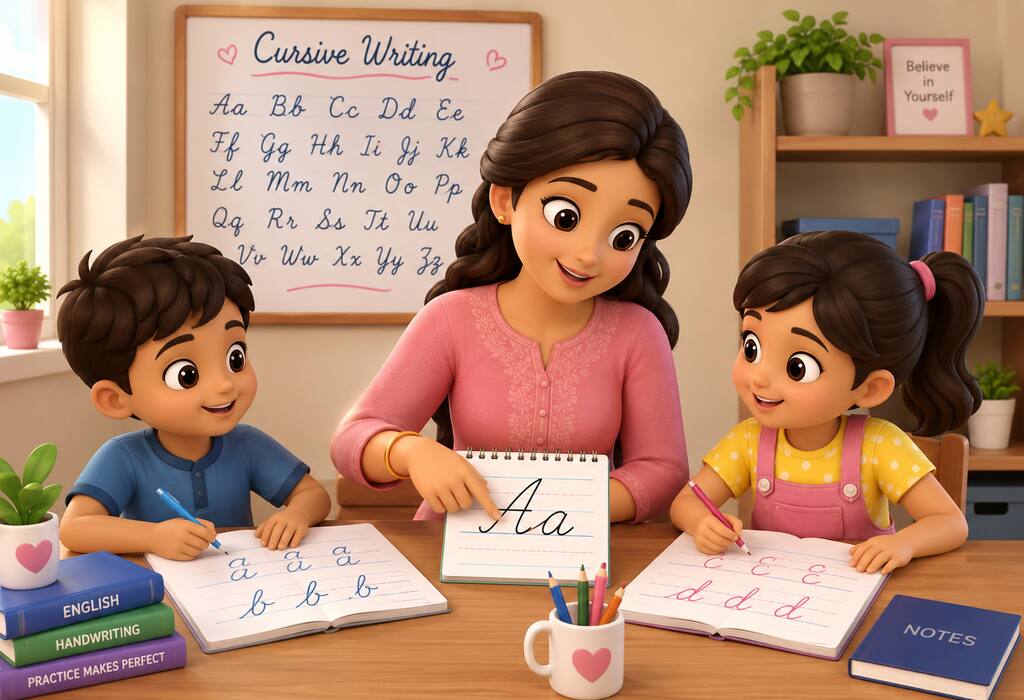
- What Is Cursive Writing?
- When Should Children Learn Cursive Writing?
- Benefits Of Learning Cursive Writing
- Types Of Cursive Writing Styles
- Rules of How To Write Cursive Writing
- How To Teach Cursive Stroke Step By Step?
- Is There Any Order For Writing Cursive?
- How Long Does It Take To Learn Cursive Writing?
- Are There Any Techniques For Left-Handed Kids?
- Practice Cursive Writing Worksheet
- FAQs
Learning cursive handwriting for kids is a milestone that blends artistry with essential communication skills. Whilst many schools have shifted focus towards digital literacy, the ability to write in flowing, connected script remains a valuable and timeless skill that supports cognitive development, fine motor coordination, and literacy in equal measure.
Thank you for reading this post, don't forget to subscribe!
This comprehensive guide to cursive for kids breaks the learning journey into manageable, confidence-building steps—from mastering individual letter formations to joining letters into words and sentences. Whether your child is just starting out or looking to refine their technique, you’ll find clear instruction and plenty of opportunities for practice throughout.
To make alphabet cursive writing for kids as engaging as possible, we’ve included free printable worksheets that children can work through at their own pace. By the end of this guide, your little one will have the foundations to write beautifully in cursive — and actually enjoy doing it.
What Is Cursive Writing?
Cursive writing is a style of penmanship in which letters are joined together in a flowing, continuous stroke, rather than written separately as in printed script. The word “cursive” derives from the Latin currere, meaning “to run” — a fitting description for the way the pen moves fluidly across the page without lifting between letters.
Cursive letter writing for kids introduces this elegant form of written communication at a stage when children are developing their fine motor skills and growing in confidence with language. Unlike print writing, cursive encourages a natural, rhythmic hand movement that can improve writing speed and legibility over time. It also has well-documented benefits for brain development, helping to strengthen memory, reinforce spelling patterns, and support reading comprehension. In short, cursive is far more than a decorative skill — it is a foundational tool for lifelong written communication.
When Should Children Learn Cursive Writing?
Most children are ready to begin learning cursive writing between the ages of seven and nine, typically in Years 2 to 4 of primary school. At this stage, they will have already developed a solid foundation in print writing and possess the fine motor control needed to form joined letters consistently. That said, every child progresses at their own pace — some may show readiness earlier, whilst others may benefit from waiting a little longer before making the transition.
The key indicators to look out for include the ability to write print letters neatly and confidently, a comfortable pencil grip, and a general eagerness to learn. Starting too early can lead to frustration, so it is always best to follow the child’s lead and introduce cursive writing when they feel genuinely prepared.
Benefits Of Learning Cursive Writing
Cursive practice for kids offers far more than simply learning a new way to write — it delivers a wide range of cognitive, developmental, and academic benefits. Read on to discover why encouraging your child to learn cursive writing could be one of the best investments you make in their education.
- Strengthens Fine Motor Skills – Cursive requires smooth, controlled movements that exercise the small muscles in the hand and wrist, building the dexterity and coordination essential for writing and a wide range of everyday tasks.
- Boosts Brain Development – Writing in cursive activates areas of the brain linked to memory, language, and thinking skills, helping children process and retain information more effectively than typing or printing alone.
- Improves Writing Speed And Legibility – Joined, continuous letterforms allow children to write more quickly and efficiently, whilst encouraging greater consistency in letter size and spacing for neater, more legible handwriting overall.
- Reinforces Spelling And Reading Skills – Writing words in a single, unbroken movement helps children internalise letter sequences and spelling patterns, whilst deepening their familiarity with the visual shape of words, supporting reading comprehension.
- Builds Confidence And A Sense Of Achievement – Mastering cursive gives children a tangible sense of accomplishment that positively influences their broader attitude towards learning, encouraging them to take genuine pride in their written work.
Types Of Cursive Writing Styles
Cursive writing is not a one-size-fits-all skill — there are several distinct styles to be aware of. Here is a look at the most common types taught to children today.
- D’Nealian Cursive — A simplified style commonly taught in primary schools, D’Nealian cursive uses gentle, flowing strokes that make the transition from print to cursive relatively straightforward for young learners.
- Spencerian Script — An elegant, ornate style popular in the 19th century, Spencerian script features fine, oval-based letterforms with varying line weights. Whilst less commonly taught today, it remains admired for its artistic beauty.
- Palmer Method — Developed as a practical alternative to Spencerian script, the Palmer Method emphasises speed and consistency, using rhythmic arm movements rather than finger movements to produce uniform, efficient handwriting.
- Getty-Dubay Italic — A clean, legible style that bridges the gap between print and cursive, Getty-Dubay italic uses simple, upright letterforms with minimal joins — making it a popular choice for children who find traditional cursive challenging.
- Zaner-Bloser Cursive — One of the most widely taught cursive styles in schools, Zaner-Bloser cursive features rounded, upright letters with clear, consistent joins — making it an accessible and practical choice for children learning cursive for the first time.
Rules of How To Write Cursive Writing
Before picking up a pencil, it helps to familiarise children with a few fundamental rules that underpin good cursive writing. Following these guidelines from the outset will ensure they develop healthy habits and a strong, consistent technique.
- Maintain a Consistent Slant — All cursive letters should lean at a consistent angle — typically slightly to the right — giving the handwriting a uniform, polished appearance. Encourage children to keep this slant steady throughout a word, line, and page.
- Use the Correct Pencil Grip — A relaxed, tripod grip — where the pencil rests between the thumb, index, and middle fingers — allows for smooth, fluid movement across the page. Gripping the pencil too tightly will restrict movement and lead to uneven, laboured letterforms.
- Keep Letter Size Uniform — Letters should be consistently sized, with ascenders and descenders — the tall and dropped portions of letters such as ‘b’, ‘f’, and ‘g’ — reaching the correct lines on the page. Consistent sizing is key to neat, readable cursive handwriting.
- Join Letters Correctly — Cursive is defined by its connected letterforms, so children should practise the correct entry and exit strokes for each letter to ensure smooth, accurate joins. Poorly formed joins can disrupt the flow of writing and affect overall legibility.
- Position the Paper Correctly — The angle at which the paper is positioned plays an important role in producing comfortable, well-formed cursive. Right-handed writers should tilt the page slightly to the left, whilst left-handed writers should tilt it to the right, allowing the hand to move naturally across the page.
How To Teach Cursive Stroke Step By Step?
Easy cursive writing for kids begins by breaking the learning process into small, manageable steps that build on one another. Follow this simple step-by-step approach to help your child develop a strong, confident cursive technique from the very beginning.
- Hold The Pencil And Position The Paper — Hold the pencil with a relaxed tripod grip between the thumb, index, and middle fingers. Tilt the paper slightly to the left for right-handed writers and to the right for left-handed writers to allow the hand to move freely.
- Begin with Basic Strokes — Practise the foundational strokes that make up cursive letters — upstrokes, downstrokes, loops, and curves. Repeat these until the hand moves smoothly and consistently across the page.
- Form Individual Lowercase Letters — Using the basic strokes as a guide, form individual lowercase cursive letters in groups based on similar formations, ensuring each letter starts and ends on the correct stroke.
- Form Uppercase Letters — Move on to uppercase cursive letters one at a time, paying close attention to the entry and exit strokes of each letter in preparation for joining.
- Join Letters to Form Words — Connect letters using the correct entry and exit strokes, starting with simple two and three-letter words. Focus on keeping joins smooth, with an even slant and uniform letter size throughout.
- Write Short Phrases and Sentences — Progress to writing short phrases and complete sentences in full cursive, aiming for a steady, rhythmic pace that keeps the handwriting neat, consistent, and legible.
Is There Any Order For Writing Cursive?
Whilst there is no single universally agreed order for teaching cursive letters, most educators recommend beginning with lowercase letters before progressing to uppercase, as lowercase forms are simpler and appear far more frequently in everyday writing. Within lowercase letters, it is generally best to introduce them in groups based on similar stroke patterns — for example, the curl letters ‘c’, ‘a’, ‘o’, and ‘d’ before moving on to bridge letters or loop letters.
This stroke-based approach helps children recognise shared movements across letters, making the learning process more intuitive and efficient. Once all letters are comfortably formed, joins and words naturally follow.
How Long Does It Take To Learn Cursive Writing?
The time it takes to learn cursive writing varies from child to child, depending on factors such as age, fine motor development, and practice frequency. Most children can grasp the basics within a few weeks, whilst developing true fluency and confidence typically takes several months of regular practice. As a general rule, short daily sessions of 10 to 15 minutes are far more effective than occasional longer practice, as consistency is key to building muscle memory and a natural, flowing style. With patience and encouragement, most children will be writing comfortably in cursive within an academic year.
Are There Any Techniques For Left-Handed Kids?
Learning cursive can pose additional challenges for left-handed children, but with the right techniques and adjustments, they can develop a writing style just as fluid and confident as their right-handed peers. Here are some helpful techniques to support left-handed kids on their cursive writing journey.
- Adjust the Paper Position — Left-handed writers should tilt the paper to the right rather than the left, which allows the hand and arm to move naturally across the page without smudging freshly written letters.
- Use the Correct Pencil Grip — Encourage left-handed children to hold the pencil slightly further from the tip than right-handed writers — around 3 to 4 centimetres up the shaft. This improves visibility of the letters being formed and helps prevent the dreaded “hooked” wrist position.
- Push Rather Than Pull the Pen — Unlike right-handed writers who pull the pen across the page, left-handed writers naturally push it. Teaching children to embrace this motion rather than fight it will result in smoother, more comfortable letterforms.
- Choose the Right Writing Tools — Opt for quick-drying ink pens or harder pencils to minimise smudging, which is a common frustration for left-handed writers. A smudge guard or writing glove can also be a practical and inexpensive solution.
- Position the Writing Hand Below the Line — Encourage left-handed children to keep their writing hand below the line of text rather than hooking it above. This under-hand position feels more natural, reduces smudging, and makes it far easier to maintain a consistent slant throughout.
Practice Cursive Writing Worksheet
These free printable cursive writing worksheets are designed to provide regular, structured practice for children at every stage of their learning journey. Simply download and print to get started.
FAQs
1. How Much Should Children Practise Cursive Writing Each Day?
Short, focused sessions of ten to fifteen minutes daily are ideal for building cursive skills. Little and often is far more effective than longer, infrequent practice, as regular repetition is what builds the muscle memory needed for fluid, natural handwriting.
2. Does It Matter Which Pen Or Pencil A Child Uses To Practise Cursive?
Yes — the right writing tool can make a noticeable difference. A well-sharpened pencil or a smooth-tipped pen with a comfortable grip is ideal for beginners. Avoid felt-tip pens in the early stages, as they lack the resistance needed to develop good pencil control.
3. How Can Parents Support Their Child’s Cursive Writing Practice At Home?
Parents can support their child by setting aside a quiet, consistent time for daily practice, providing the right tools, and offering plenty of encouragement. Using free printable worksheets, writing shopping lists together, or encouraging children to write notes and cards by hand are simple and effective ways to build cursive skills naturally.
4. Is Cursive Writing Still Relevant In Today’s Digital World?
Absolutely — despite the rise of digital communication, cursive writing remains a valuable skill that supports brain development, fine motor coordination, and academic performance. Many educators and researchers continue to advocate for its place in the classroom alongside digital literacy.
Cursive writing is a timeless skill that offers children far more than a beautiful hand — it supports cognitive development, builds fine motor strength, and instils a genuine sense of pride in young learners. Whilst it takes time and patience to master, the rewards are well worth the effort.
By following the step-by-step guidance in this article and making regular use of the free printable worksheets provided, your child will have everything they need to develop a fluid, confident cursive style at their own pace. Every bit of practice brings them one step closer to writing beautifully in cursive.
Also Read:
Dictation Words for Kids
Importance of Books for Children
Pre Writing Strokes for Kindergarten