



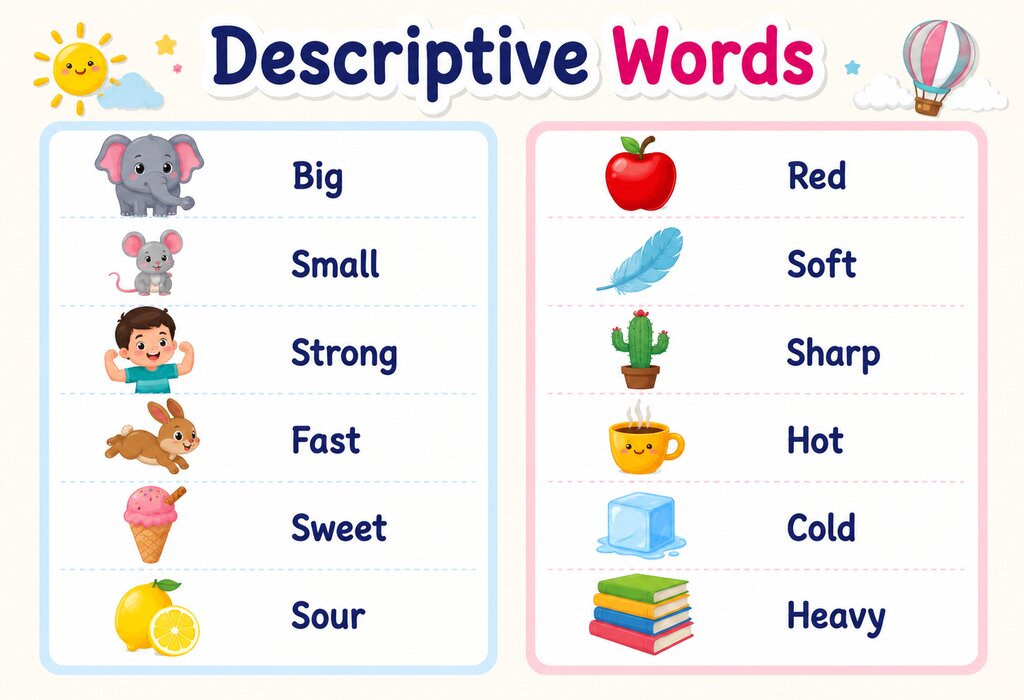
- What are Describing Words?
- What are The Types of Describing Words?
- Descriptive Words Table
- List of Describing Words for Kids
- Descriptive Words That Begin With Letter ‘A’ To ‘Z’
- Examples of Descriptive Words in Sentences
- Common Mistakes and Corrections while Using Descriptive Words
- How to Use Descriptive Words?
- How You Can Help Your Child Learn Describing Words Easily?
- FAQs
Much of our communication involves describing things, shapes, sizes, feelings, events and other things. Having precise words for describing helps us communicate better. Children need to learn the meaning of describing words as early as possible to develop good communication skills. By learning to use describing words, they can explain things better or communicate their feelings well. In this article, we go through describing words for classes 1, 2 and 3. Use these words frequently and with the intent to build a habit of using the right describing word for the right thing in your child.
Thank you for reading this post, don't forget to subscribe!
Describing words, or adjectives, add colour and depth to a child’s everyday speech and writing. Looking at descriptive word examples such as “big,” “tiny,” “friendly” or “scary” shows how one word can completely change what a sentence means. Introducing these words through stories, picture books and daily conversation helps children become more expressive and observant, so their communication grows clearer and more vivid over time.
What are Describing Words?
Descriptive words are used to describe something or to intensify the meaning of words. Describing words can be used to describe everything from a person to a place, situation, things, feelings and thoughts, etc. The use of the right descriptive words paints the right picture of what you are trying to convey. Describing words can also be used to intensify or dilute the meaning of other describing words. For example, when you talk about a person, you describe their height, expressions and other features. When you describe a place, you use a combination of describing words that convey both the nature of the place and your feelings about it.
What are The Types of Describing Words?
In English, there are two ways to write descriptive words: adjectives and adverbs.
1. Adjectives
Adjectives are words used to describe nouns and pronouns acting as “subject” or “object” in a sentence. They give additional information about nouns or pronouns, such as shape, size, colour or other attributes. Examples include:
- He is tall.
- She is pretty.
- The car is blue.
- The food was spicy.
- She is an intelligent girl.
2. Adverbs
Adverbs are words that describe verbs. They describe things other than nouns and pronouns. They can also modify adjectives and other adverbs. Examples of describing words include:
- He quickly climbed the wall.
- The stars were shining brightly.
- He is a quick learner.
- She behaved strangely at the party.
- She can sing melodiously.
Descriptive Words Table
Below is a handy table of small descriptive words your child can start using right away. This simple list makes it easy to pick the right word for the right object, feeling or situation.
| DESCRIBING WORD | TYPE | EXAMPLE |
| active | adjective | an active child |
| adventurous | adjective | an adventurous trip |
| amazing | adjective | an amazing story |
| angry | adjective | an angry face |
| brave | adjective | a brave soldier |
| bright | adjective | a bright star |
| careful | adjective | a careful driver |
| cheerful | adjective | a cheerful smile |
| clever | adjective | a clever idea |
| curious | adjective | a curious mind |
| daring | adjective | a daring climb |
| delightful | adjective | a delightful surprise |
| eager | adjective | an eager student |
| elegant | adjective | an elegant dress |
| energetic | adjective | an energetic dog |
| excited | adjective | an excited child |
| friendly | adjective | a friendly neighbour |
| funny | adjective | a funny joke |
| gentle | adjective | a gentle touch |
| generous | adjective | a generous act |
| happy | adjective | a happy face |
| helpful | adjective | a helpful friend |
| honest | adjective | an honest answer |
| kind | adjective | a kind teacher |
| lively | adjective | a lively class |
| lovely | adjective | a lovely flower |
| neat | adjective | a neat notebook |
| noisy | adjective | a noisy street |
| polite | adjective | a polite request |
| proud | adjective | a proud parent |
| quick | adjective | a quick runner |
| quiet | adjective | a quiet library |
| rich | adjective | a rich colour |
| shy | adjective | a shy child |
| sleepy | adjective | a sleepy kitten |
| smart | adjective | a smart student |
| soft | adjective | a soft pillow |
| strong | adjective | a strong wall |
| tiny | adjective | a tiny insect |
| warm | adjective | a warm blanket |
| witty | adjective | a witty reply |
| young | adjective | a young learner |
List of Describing Words for Kids
Describing words and examples need to be studied to learn adjectives and adverbs. Here, we present a list of describing words for classes 1, 2 and 3:
Commonly Used Describing Words
Commonly used describing words are adverbs that give us a measure of time, place, degree, manner and circumstances. They are part of our everyday conversation. Here are 20 of the most commonly used words that children need to learn to build good communication skills:
| Amazing | Kindly | Usually | Terribly |
| Absolutely | Interesting | Sincerely | Commonly |
| Remarkably | Happy | Charming | Lovingly |
| Normally | Significantly | Delightful | Pleasurable |
| Quickly | Generally | Tremendously | Pleasing |
Describing Words to Describe Personality & Feelings
Every time we describe people, we use personality describing words that hint at one or more qualities of the person. The same idea applies to feelings- we often use more than one descriptive word about someone, what we are feeling, and going through. Here are some of the good and cool descriptive words for personality and feelings:
| Personality | Feelings |
| Creative | Happy |
| Kind | Joyful |
| Cheerful | Ecstatic |
| Adventurous | Glad |
| Brave | Serene |
| Funny | Angry |
| Honest | Sad |
| Calm | Gloomy |
| Silly | Respectful |
| Loyal | Miserable |
| Proud | Moody |
| Nervous | Selfish |
| Clumsy | Grumpy |
| Friendly | Merry |
| Nice | Helpful |
| Inventive | Wise |
| Lively | Strong |
| Caring |
Describing Words to Describe Food & Colours
Children love eating different types of food and need to learn a variety of words to describe their taste and texture. The same applies to colours, as they are related to learning, painting, segregating and playing. Here are descriptive adjective words for food and colours:
| Food | Colours |
| Sweet | Red |
| Spicy | Yellow |
| Tart | Blue |
| Sour | Green |
| Bitter | Orange |
| Sharp | Purple |
| Pungent | Violet |
| Delicious | Pink |
| Yummy | Colourful |
| Peppery | Bright |
| Salty | Vivid |
| Savoury | Brilliant |
| Tangy | Vibrant |
| Bland | Colourless |
| Buttery | Opaque |
| Fresh | Dim |
| Fruity | Nutty |
Describing Words to Describe Smell & Sounds
Smells are closely related to taste and have similar-sounding meanings in a few descriptive words. Sounds produce an entirely different sensation and have some words to describe the same. Here are frequently used descriptive words for smells and sounds:
| Sound | Smell |
| Loud | Aromatic |
| Noisy | Fishy |
| Quiet | Odorous |
| Silent | Piquant |
| Raspy | Scented |
| Melodious | Rosy |
| Stinky | Flowery |
Positive Describing Words For Children
It’s important to regularly use good descriptive words to elicit positive thoughts and feelings in children. These words will later become a part of their inner voice that shapes their personalities. Here is a list of positive words your children should regularly use:
| Affectionate | Charming |
| Generous | Creative |
| Determined | Imaginative |
| Likeable | Diplomatic |
| Sincere | Helpful |
| Capable | Glittering |
| Productive | Motivated |
Descriptive Words That Begin With Letter ‘A’ To ‘Z’
Now that we know the essential descriptive words, we can go deeper into words children can learn over time. Descriptive words help us precisely express our thoughts, ideas or feelings. Children need to be aware of many such words to construct and communicate complex concepts as they grow older. Here are descriptive words from A to Z.
| LETTER | DESCRIPTIVE WORDS |
| A | Abandoned, Ambitious, Alert, Affordable, Arrogant, Amused, Adaptable |
| B | Beautiful, Brilliant, Baffling, Basic, Blushing, Busy, Bossy |
| C | Calm, Cunning, Clever, Captivating, Crisp, Casual, Creative |
| D | Daring, Dangerous, Dominating, Decent, Diverse, Divine, Deep |
| E | Eagerly, Effortless, Easily, Energetic, Exciting, Eccentric, Empty |
| F | Frequently, Flawless, Fabulous, Fine, Fancy, Fashionable, Fantastic |
| G | Good, Great, Giant, Glamorous, Grieving, Gentle, Glad |
| H | Heartfelt, Healthy, Hurry, Harmful, Hard, Humane, High-spirited |
| I | Idolise, Impossible, Idle, Improper, Illegal, Intriguing, Immoral |
| J | Jolly, Jovial, Joyous, Jarring, Jealous, Juvenile, Judicious |
| K | Kind, Known, Kinetic, Keen, Knowledgeable, Kingly, Kindred |
| L | Lovingly, Large, Lately, Lonely, Lucky, Legendary, Liberated |
| M | Majestic, Magnificent, Massive, Marginal, Merry, Moderate, Malicious |
| N | Nearby, Noble, Naughty, Native, Neutral, Natural, Needy, Nowhere |
| O | Ordinary, Outstanding, Organic, Orthodox, Overrated, Overhang, Omniscient |
| P | Protective, Periodically, Playfully, Precise, Peaceful, Productive, Popular |
| Q | Queer, Quickly, Quietly, Quirky, Quarrelsome, Qualified |
| R | Radiant, Reliable, Rare, Remarkable, Romantic, Rampant, Reluctant |
| S | Striking, Speedy, Spirited, Sophisticated, Sleepy, Sly, Stylish |
| T | Tactical, Terrific, Talkative, Tempting, Tight, Tough, Tempt |
| U | Urgent, Unique, Unfriendly, Ugly, Unaffected, Unusual, Universal |
| V | Versatile, Virtuous, Vulnerable, Verifiable, Vigilant, Valuable, Voluntary, Valiant, Villainous |
| W | Wise, Whimsical, Wicked, Witty, Warm, Wealthy, Whole-heartedly, Wanted |
| X | Xenodochial, Xeric |
| Y | Young, Youthful, Yawning, Yummy |
| Z | Zealous, Zestful, Zoological |
Examples of Descriptive Words in Sentences
Seeing describing words used in real sentences helps children understand how to apply them correctly. Here are some simple examples that show these words in action.
- The fluffy kitten curled up on the warm blanket.
- She wore a bright yellow dress to the party.
- The tall giraffe reached the leaves at the top of the tree.
- He felt happy when he saw his best friend.
- The crunchy biscuit tasted delicious with milk.
- Their new puppy is playful and full of energy.
- The cold wind made everyone shiver outside.
- Grandma baked a sweet cake for the birthday party.
- The loud thunder scared the little boy.
- We saw a shiny red car parked outside the school.
Common Mistakes and Corrections while Using Descriptive Words
Children often mix up describing words or use them incorrectly while forming sentences. Here are some common mistakes along with their corrections to help your child use these words the right way.
| MISTAKES | CORRECTIONS |
| Using the same describing word again and again. | Choose different describing words to make writing more interesting. |
| Using too many describing words in one sentence. | Keep only the words that add clear meaning. |
| Using a describing word that does not match the noun. | Pick a word that suits the person, place, animal, or thing. |
| Using describing words in the wrong order. | Arrange them in a natural and sensible order. |
| Using weak describing words too often. | Replace them with stronger, more exact words. |
| Choosing a word that is too vague. | Use a more specific describing word. |
| Adding unnecessary descriptive words. | Remove words that do not improve the sentence. |
| Using a describing word that sounds unnatural. | Read the sentence aloud and adjust the wording. |
How to Use Descriptive Words?
Knowing a descriptive word is only half the job; using it correctly in a sentence is what truly helps a child communicate well. Here are some simple ways to guide your child in using descriptive words effectively.
- Place the Word Before the Noun – A describing word usually comes right before the noun it describes, such as “a furry rabbit” or “a noisy classroom.”
- Use One Word at a Time When Starting – Young learners should begin with a single describing word per sentence, like “The dog is big,” before combining two or more.
- Encourage Comparison to Build Understanding – Asking children to compare two objects, such as “Which ball is bigger?” helps them see how describing words change during comparison.
- Relate Words to the Five Senses – Teaching children to describe what they see, hear, touch, smell and taste makes it easier to pick the right word, such as “a loud noise.”
- Practise with Real Objects and Pictures – Pointing at everyday objects and asking children to describe them, such as a “round plate,” makes learning more hands-on.
- Read Stories with Descriptive Language – Story books are full of descriptive words used in context, helping children see how they naturally fit into sentences.
- Correct Gently and Explain Why – If a child uses a word incorrectly, such as “a happy table,” gently correct them and explain why it doesn’t fit.
- Encourage Daily Usage in Conversation – Prompting children to describe their day, toys or feelings using describing words helps reinforce the habit over time.
How You Can Help Your Child Learn Describing Words Easily?
Language develops slowly over the years as it takes time for children to add words to their vocabulary. While some describing words are best learnt through practice via adjective games, most can be used in everyday conversations. To make it easy for them to remember the words, you can introduce them in the form of games such as “describe yourself” in one word or sentence that uses a new describing word. You can also ask them to describe different flavours and sounds when the opportunity presents itself. Feelings and emotions take longer to recognise and label. However, they can learn through stories and experiences.
Practice makes perfect when it comes to learning new words. This worksheet gives your child fun exercises to use describing words correctly and confidently.
FAQs
1. How Can I Practise Descriptive Words at Home?
You can practise by looking around your room and picking three objects, then writing one descriptive word for each. You can also ask a family member to describe an object while you guess what it is.
2. What Is a Fun Way to Learn New Descriptive Words?
Playing word games like “I Spy” using describing words, or making flashcards with pictures and their matching words, can make learning feel like play rather than study.
3. How Do I Choose the Best Describing Word for Something?
Think about how the object looks, feels, sounds, smells or tastes, and pick the word that matches that feeling the closest, such as choosing “crunchy” over “hard” for a biscuit.
4. Can I Use More Than One Describing Word in a Sentence?
Yes, you can use two or more describing words together, such as “a small, fluffy kitten,” as long as the sentence still makes sense and flows smoothly.
When it comes to learning descriptive words, practice and variety are key. While it is impossible to learn all the words in a short time, frequent use of words makes it easy for kids to grasp the meaning of words and use them in sentences. Over the years, your child will add dozens of new words to their vocabulary as their communication refines.
Also Read:
Dictation Words for Kids
Vocabulary Words for Kids
Types of Sight Words for Kids
High Frequency Words for Children