


- What Are Vegetables?
- Why Should Young Kids Learn About Vegetables?
- Vegetable Names – Chart For Kids
- List Of Common Vegetable Names In English With Pictures
- Other Vegetable Names That Kids Should Know
- Different Types Of Vegetables
- Games And Activities That Will Help Your Child Learn Vegetable Names
- Fun And Interesting Facts about Vegetables
- True Or False Questions For Kids
- Fill In the Blanks With The Correct Vegetable Names From The List
- Important Points To Remember
Parents often complain that their little ones do not eat vegetables. Do you know that teaching about vegetables to kids from an early age can encourage children to eat them and enjoy the amazing benefits of these healthy vegetables? This is one of the reasons we learn the names of vegetables in nursery class and kindergarten.
Thank you for reading this post, don't forget to subscribe!
Learning the names of vegetables in English helps children recognise, pronounce, and connect with foods from around the world, building both language skills and healthy eating habits that last a lifetime.
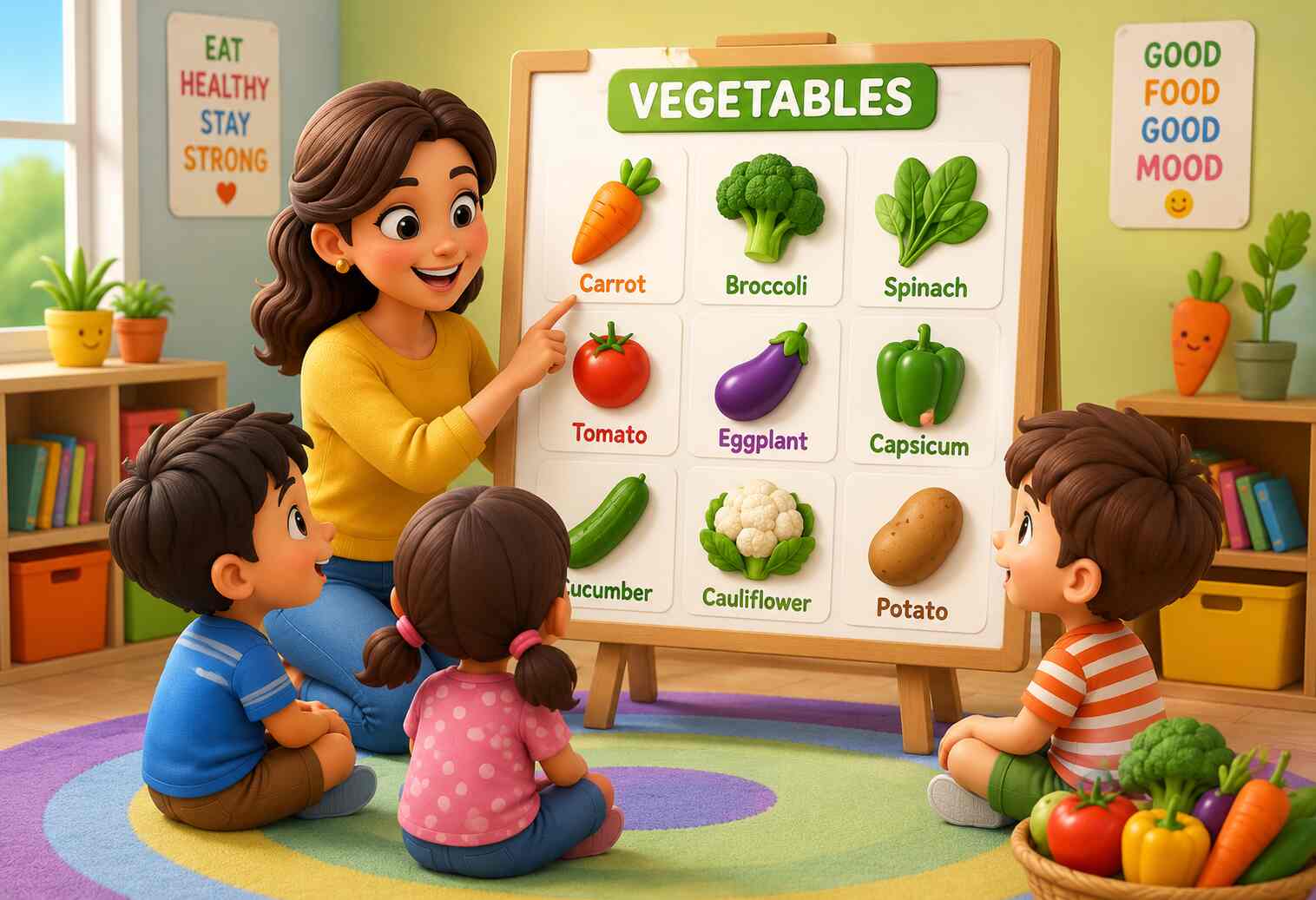
What Are Vegetables?
The term vegetable refers to any edible portion of certain herbaceous plants that are either eaten fresh or prepared in several ways to be eaten. Vegetables are available in a wide variety of colours, flavours, shapes, and textures. They are not just a good source of vitamins and nutrients, but also a good meal choice for kids and adults to maintain a strong, healthy lifestyle. Let’s look at some of the benefits of eating vegetables for children.
Why Should Young Kids Learn About Vegetables?
Introducing vegetables to young children early on shapes their eating habits and overall well-being. Here are some key reasons why learning about vegetables matters for kids:
- Encourages Healthy Eating – Children who learn about vegetables from a young age are more likely to include them willingly in their diet.
- Builds Vocabulary – Learning the names and types of vegetables improves language and communication skills in young learners.
- Boosts Nutritional Awareness – Kids develop an understanding of how vegetables keep them strong, healthy, and full of energy.
- Sparks Curiosity – Exploring the different colours, shapes, and textures of vegetables nurtures a child’s natural curiosity.
- Supports Academic Learning – Vegetables are commonly used in early education to teach colours, counting, and categorisation skills.
- Develops Lifelong Habits – Early exposure to vegetables helps children form positive food habits that carry well into adulthood.
Vegetable Names – Chart For Kids
List Of Common Vegetable Names In English With Pictures
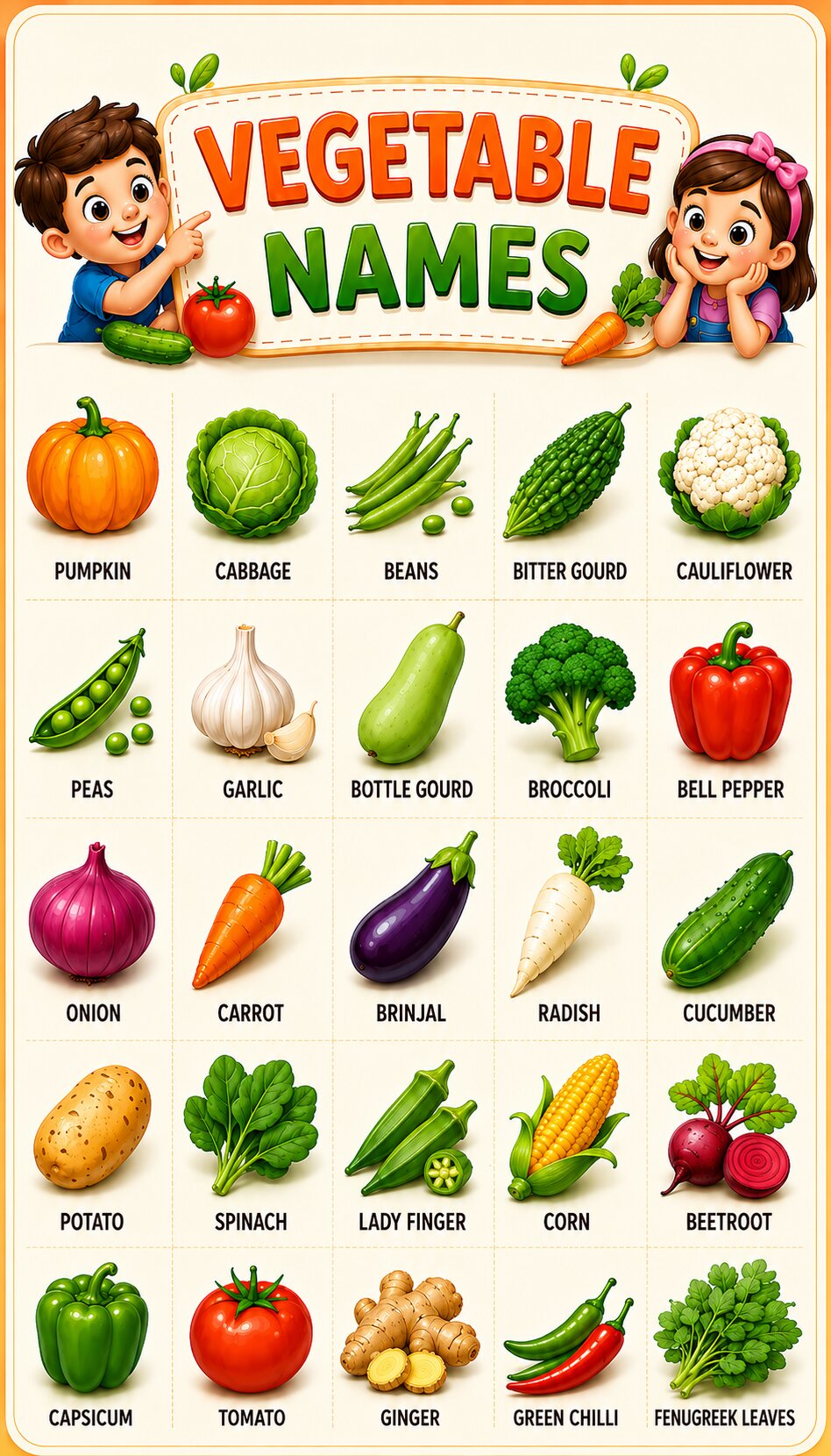
There are vegetables that we see and eat every day. If you go to a market to buy some vegetables, the chances of finding these vegetables are quite high. Here are the names and pictures of such vegetables:
1. Peas
Peas are one of the most popular green vegetables enjoyed by children and adults alike. Packed with goodness, peas contain a good amount of fibre and antioxidants and are an excellent source of Vitamins A, K, C, and Manganese, making them a fantastic addition to any meal.
2. Potato
The most loved vegetable by children and adults alike, potatoes are a versatile root vegetable found in kitchens across the world. Children particularly love to eat crispy French fries and mashed potatoes made from this humble yet delicious vegetable.
3. Cabbage
Cabbage is a leafy vegetable that comes in a variety of colours, including white, green, and purple, though green cabbage is most commonly used. It is an amazing source of Vitamins K, C, and B6, supporting strong bones and a healthy immune system.
4. Onion
An onion is a bulbous vegetable that grows underground and is used in cuisines worldwide. Despite its strong flavour, this vegetable is low in calories yet high in calcium and Vitamin C, making it both tasty and nutritious.
5. Capsicum
Also known as bell peppers, capsicum is a vibrant, crunchy vegetable that comes in green, yellow, and red varieties. Capsicums are rich in Vitamins A and C, helping to boost immunity and promote healthy skin and eyesight.
6. Cauliflower
Cauliflower is a white vegetable that contains a cluster of flowers, also known as the curd, which is the part we eat. This powerhouse vegetable helps fight cancer, improves cardiovascular health, and supports healthy brain function, making it an excellent choice for growing children.
7. Beetroot
Beetroot is a striking, deep purple vegetable that is highly nutritious and widely used in salads, juices, and cooked dishes. It is an excellent source of carbohydrates and has a very high water content, keeping the body hydrated and energised.
8. Spinach
Spinach is a leafy green vegetable with large, dark leaves that is widely eaten worldwide. This nutritious vegetable helps decrease oxidative stress, improve eye health, and prevent heart disease and cancer, making it one of the most beneficial vegetables for children.
9. Broccoli
Broccoli is a green-coloured vegetable that can be eaten boiled, steamed, or cooked and is often called a superfood for its incredible health benefits. This vegetable is packed with essential vitamins and minerals and also helps protect against certain types of cancer.
10. Corn
Corn is a bright, cheerful vegetable rich in fibre, vitamins, and minerals. It is considered both a vegetable and a cereal grain and is usually white or yellow, making it one of the most recognisable foods for young children.
11. Pumpkin
A pumpkin is a round vegetable with smooth, slightly ribbed skin and is generally deep yellow to orange in colour. Widely used in soups, curries, and desserts, pumpkin is a nutrient-rich vegetable that is both delicious and visually appealing to children.
12. Bottle Gourd
Bottle gourd, also referred to as calabash, is a commonly cultivated gourd with a variably shaped fruit and a hard outer shell. This light, easily digestible vegetable is widely used in Asian cooking for its cooling properties and high water content.
13. Eggplant
Eggplant, also known as brinjal, is a purple-hued vegetable high in nutrients and widely consumed worldwide. This vegetable supports healthy heart circulation through essential components such as bioactive compounds, potassium, fibre, and Vitamin B6.
14. Carrot
A carrot is a crunchy root vegetable that is usually red or orange in colour and loved by children for its natural sweetness. This vegetable is rich in protein, iron, Vitamin C, and potassium, making it one of the best vegetables for promoting healthy growth in kids.
15. Lotus Stem
Lotus stems are the edible parts of the lotus flower, found underwater, and are a unique and interesting vegetable for children to discover. They are usually crunchy, fairly sweet, and flavoured much like a water chestnut, making them a delightful addition to stir-fries and salads.
Other Vegetable Names That Kids Should Know
Here is a table with additional vegetable names and details that kids should know, helping them explore a wider variety of healthy, nutritious vegetables beyond the ones they see every day.
| Apple Gourd | Cluster Beans | Drumsticks |
| Bitter Gourd | Coriander Leaves | Fennel |
| Black Carrot | Curry Leaves | Green Beans |
| Green Onion | Jack Fruit | Lady Finger |
| Mushroom | Peppermint | Pointed Gourd |
| Red Cabbage | Sweet Potato | Turnip |
| Kale | Ginger | Banana Flower |
| Garlic | Elephant Yam | Taro Root |
| Leek | Water Chestnut | Black Beans |
| Arrow Root | Amla | Shallot |
Different Types Of Vegetables
Do you know that vegetables can be divided into different types? Yes! Let’s look at some types of vegetables and expand our little one’s knowledge.
1. Flower Vegetables
- Cauliflower
- Broccoli
- Artichokes
2. Leafy Vegetables
- Cabbage
- Spinach
- Lettuce
- Coriander
- Mint
- Kale
- Fenugreek
- Dill
3. Root Vegetables
- Carrot
- Turnip
- Radish
- Beetroot
- Tuber Vegetables
- Potato
- Ginger
- Turmeric
5. Fruit Vegetables
- Cucumber
- Pumpkin
- Tomato
- Capsicum
- Corn
- Beans
6. Bulb Vegetables
- Onion
- Leek
- Garlic
- Fennel
- Stem Vegetables
- Asparagus
- Lemon grass
- Celery
- Swiss chard
Games And Activities That Will Help Your Child Learn Vegetable Names
Are you looking for activities and games to teach your child the names of vegetables? Here are some fun activities your little one will surely love.
1. Flashcards
Take out a print of commonly used vegetables and paste them on a card. Now show these flashcards to your child, one by one, and let them guess the name of the vegetable.
2. What’s In My Plate
Serve your child a variety of vegetables daily and ask them to guess what’s on their plate today. This game will improve your child’s conversational skills and encourage them to learn the names of vegetables.
3. Play-Doh Vegetable
Children love playing with Play-Doh. Use this opportunity and ask your child to make a vegetable using their Play-Doh. You can simply keep a real-life vegetable, like a potato or a tomato, in front of them and ask them to copy its shape with Play-Doh.
4. Pick Up The Vegetable
Take a big tray or a basket and keep different vegetables available at home in it. Now, sit with your child and say the name of one vegetable present in the basket. Your child needs to pick up the right vegetable.
5. Vegetable Painting
Your little one is going to love this activity. Take a plain sheet, some paint colours, and a few vegetables, such as a potato, lady’s finger, carrot, etc. Cut the vegetables from the middle, ask your child to dip them in paint, then press them onto the paper to make beautiful vegetable patterns.
6. Vegetable Sensory Bin
Get some small plastic fruits and vegetables. Take a bucket and add flour. Mix the plastic fruits and vegetables in the flour. Ask your child to take out only vegetables from this sensory bin, not fruits. You can also ask them to name each vegetable they take out of the sensory bin.
Fun And Interesting Facts about Vegetables
Vegetables are far more fascinating than most people realise, with some surprising secrets hidden in every bite. Here are some fun and interesting facts about vegetables that will surely amaze and delight young minds.
- Carrots Were Originally Purple – The orange carrots we see today were developed by Dutch farmers in the 17th century. Originally, carrots were purple, white, and yellow.
- Tomatoes Are Technically a Fruit – Tomatoes are botanically classified as a fruit since they grow from a flower and contain seeds, not a vegetable.
- Broccoli Contains More Protein Than Steak – Calorie for calorie, broccoli contains more protein than steak, making it one of the most protein-rich vegetables.
- Potatoes Were the First Vegetable Grown in Space – In 1995, NASA made history by growing potatoes in space, making it the first vegetable cultivated outside of Earth.
- Onions Make You Cry for a Scientific Reason – When cut, onions release a chemical called syn-propanethial-S-oxide, which irritates the eyes and triggers tears.
- Cucumbers Are 96% Water – Cucumbers have one of the highest water contents of any vegetable, making them an excellent snack for staying hydrated.
- Spinach Has Less Iron Than We Think – Contrary to popular belief, spinach does not contain extraordinarily high levels of iron. The claim originated from a decimal point error in an 1870s study.
- Pumpkins Are Almost Entirely Water – Despite their firm appearance, pumpkins are made up of about 90% water, making them surprisingly low in calories.
- Bell Peppers Have More Vitamin C Than Oranges – Red bell peppers contain nearly three times more Vitamin C than oranges, making them one of the richest natural sources of this nutrient.
- Cauliflower Comes in Four Colours – Cauliflower naturally grows in white, orange, purple, and green varieties, each with slightly different nutritional benefits.
- Garlic Was Used as Currency in Ancient Egypt – Garlic was so highly valued in ancient Egypt that it was used as currency and was even found inside the tombs of pharaohs.
- A Peanut Is Not Actually a Nut – Peanuts are classified as a legume, belonging to the same family as peas and beans, rather than true nuts.
- Artichokes Are Actually Flowers – The part of the artichoke we eat is the flower bud of the plant. If left unharvested, it blooms into a beautiful purple flower.
- Sweet Potatoes and Potatoes Are Not Related – Despite sharing a name, sweet potatoes and regular potatoes belong to entirely different plant families.
- Celery Is a Negative-Calorie Food – The body burns more energy digesting celery than the number of calories it actually provides.
True Or False Questions For Kids
Here is a set of true or false questions about vegetables to test how much your little one has learned so far. These simple, fun questions are a great way to keep kids engaged while reinforcing their knowledge of vegetables.
Questions
- Carrots were originally orange in colour. True or False
- Tomatoes are botanically classified as a vegetable. True or False
- Potatoes were the first vegetables to be grown in space. True or False
- Cucumbers are 96% water. True or False
- Broccoli contains less protein than steak. True or False
- Red bell peppers contain less Vitamin C than oranges. True or False
- Spinach is extraordinarily high in iron. True or False
- Pumpkins are made up of about 90% water. True or False
- Cauliflower only grows in white. True or False
- Garlic was used as a form of currency in ancient Egypt. True or False
- A peanut is classified as a nut. True or False
- The part of the artichoke we eat is its root. True or False
- Sweet potatoes and regular potatoes are closely related. True or False
- Celery is considered a negative-calorie food. True or False
- Onions make you cry because of a chemical reaction when cut. True or False
Answers
- False – Carrots were originally purple, white, and yellow. The orange variety was developed by Dutch farmers in the 17th century.
- False – Tomatoes are botanically a fruit as they grow from a flower and contain seeds inside.
- True – NASA made history in 1995 by successfully growing potatoes in space for the very first time.
- True – Cucumbers have one of the highest water contents of any vegetable, making them great for hydration.
- False – Calorie for calorie, broccoli actually contains more protein than steak, making it a protein-rich vegetable.
- False – Red bell peppers contain nearly three times more Vitamin C than oranges, making them a superior source.
- False – This is a popular myth that originated from a decimal point error made in an 1870s nutritional study.
- True – Despite their thick and firm appearance, pumpkins are made up of approximately 90% water.
- False – Cauliflower also naturally grows in orange, purple, and green varieties, each with different nutritional benefits.
- True – Garlic was so highly valued in ancient Egypt that it was used as currency and found inside pharaohs’ tombs.
- False – Peanuts are technically a legume, belonging to the same plant family as peas, lentils, and beans.
- False – The edible part of an artichoke is its flower bud, not its root. If left unharvested, it blooms into a purple flower.
- False – Despite sharing a name, sweet potatoes and regular potatoes belong to entirely different plant families.
- True – The body burns more energy digesting celery than the number of calories the vegetable actually provides.
- True – Cutting an onion releases a chemical called syn-propanethial-S-oxide, which irritates the eyes and causes tears.
Fill In the Blanks With The Correct Vegetable Names From The List
Here is a fun and easy fill-in-the-blanks activity to test how well your child knows their vegetables. Read each sentence carefully and fill in the correct vegetable name from the list provided below.
| Peas | Carrots |
| Onions | Cucumbers |
| Lettuce | Tomatoes |
| Potatoes | Spinach |
| Cauliflowers | Capsicums |
Questions
- I like orange crunchy __________.
- Leafy greens that go in salad: __________.
- Red round vegetables often used in salads: __________.
- Small green balls that come in a pod: __________.
- Long green vegetables that you slice for salad: __________.
- Yellow or brown tubers we mash: __________.
- Green bell-shaped vegetables: __________.
- White or purple bulbs that make food tasty: __________.
- Green leafy plants used in sandwiches: __________.
- White vegetables with many small florets: __________.
Answers
- Carrots
- Spinach
- Tomatoes
- Peas
- Cucumbers
- Potatoes
- Capsicums
- Onions
- Lettuce
- Cauliflowers
Important Points To Remember
Vegetables are an important part of a healthy diet. Learning their names helps kids recognize different vegetables and make healthy food choices.
1. Start With Common Vegetables First
Encourage children to begin by learning the names of vegetables they see and eat every day, such as carrots, potatoes, and spinach.
2. Use Pictures To Learn Vegetable Names
Pairing vegetable names with colourful pictures makes it easier for young children to remember and quickly recognise them.
3. Practice Vegetable Names During Meal Times
Mealtime is a great opportunity to teach kids the names of the vegetables on their plates in a fun and natural way.
4. Learn Both Local And English Vegetable Names
Teaching children the names of vegetables in English alongside their local names helps build stronger vocabulary and language skills.
5. Group Vegetables By Colour Or Type
Grouping vegetables by colour, shape, or type makes it easier for kids to organise and remember their names.
6. Use Flashcards To Practise Vegetable Names
Flashcards with vegetable names and images are a simple and effective tool to help children memorise and revise at their own pace.
7. Take Kids To The Market
Visiting a vegetable market with children gives them a hands-on opportunity to see, touch, and learn the names of a wide variety of vegetables.
8. Encourage Kids To Spell Vegetable Names
Once children can recognise a vegetable, encouraging them to spell its name helps reinforce both their vocabulary and writing skills.
9. Read Books And Watch Videos About Vegetables
Storybooks and educational videos about vegetables make learning vegetable names engaging, entertaining, and memorable for young children.
10. Reward Children For Learning New Vegetable Names
Celebrating small milestones, such as learning five new vegetable names, keeps children motivated and enthusiastic about continuing to learn.
Learning vegetable names is a simple yet powerful step towards raising healthy and knowledgeable children. This guide, covering all vegetable names in English, has been designed to make the learning journey fun, engaging, and easy for young minds. Encourage your child to practise regularly and watch their vocabulary and healthy eating habits grow together.
Also Read:
Number Names for Children
Fruit Names in English for Kids
Food Names in English for Kids to Learn