



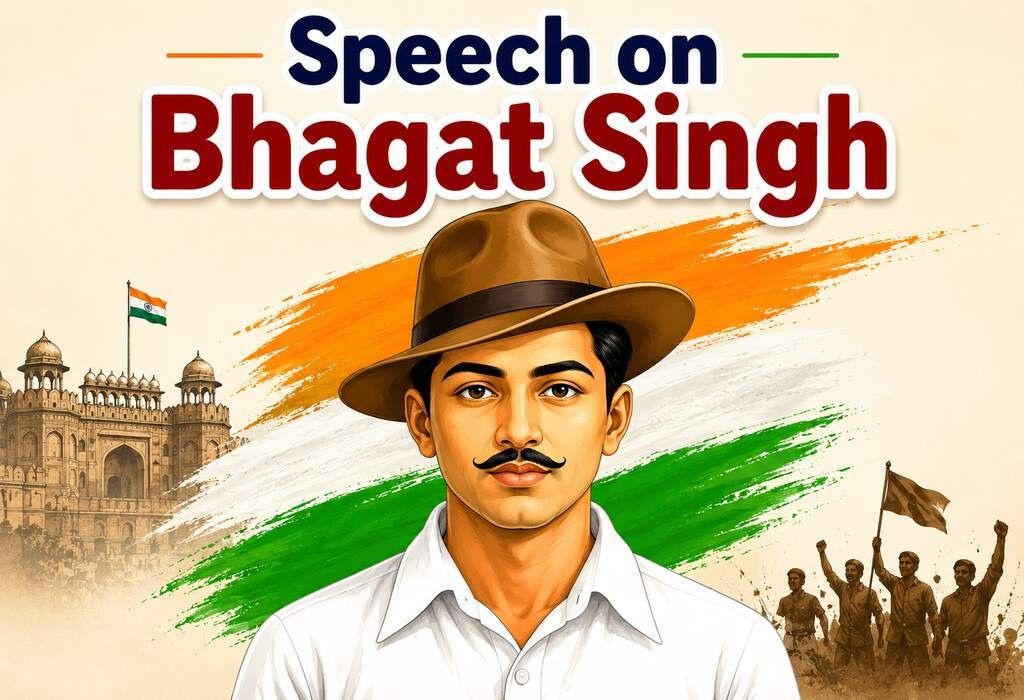
Bhagat Singh remains one of the most revered freedom fighters in the history of the Indian subcontinent — a young revolutionary whose courage and conviction continue to inspire generations. Whether you are preparing a Bhagat Singh speech in English for a school assembly, a college event, or a national celebration, understanding his life and legacy is essential to delivering words that truly resonate.
Thank you for reading this post, don't forget to subscribe!
Born on 28th September 1907, Bhagat Singh gave his life to the cause of Indian independence at the tender age of 23. A speech on Bhagat Singh is not merely an academic exercise; it is a tribute to a man who chose martyrdom over compromise. The name Shaheed Bhagat Singh — Shaheed meaning “martyr” — is etched into the conscience of every Indian.
In this article, you will find a thoughtful selection of speeches suited to students and children of all ages.
Points To Remember When Preparing a Speech on Bhagat Singh
A ‘Freedom Fighter Bhagat Singh’ speech should reflect his values, not just his history. Keep these points in mind for an impactful delivery.
- Know Your Audience – Tailor the language and depth of your speech to suit your audience – primary school children, senior students, or a general audience.
- Start With a Strong Opening – Begin with a powerful quote, a historical fact, or a brief anecdote about Bhagat Singh to capture your audience’s attention from the outset.
- Focus on Key Themes – Highlight the core themes of his life, such as patriotism, sacrifice, and the fight against colonial rule, rather than simply listing events.
- Keep the Language Simple – Avoid overly complex vocabulary, especially if the speech is intended for younger children, so that the message is clear and easy to follow.
- Review and Refine – Once your speech is written, read it carefully to check for clarity, flow, and accuracy, and make any necessary adjustments before finalising.
- Practise Your Delivery – Rehearse your speech multiple times to ensure confident, fluent delivery on the day.
- End on an Inspiring Note – Close with a memorable line or rallying message that leaves your audience feeling moved and motivated.
10 Line Speech on Bhagat Singh
A 10-line speech on Bhagat Singh is ideal for young children and early primary students who need something short and easy to memorise. The lines below cover the key highlights of his life in simple, accessible language.
- Good morning to all my teachers and friends gathered here today.
- I stand before you to speak about one of India’s greatest freedom fighters — Bhagat Singh.
- Bhagat Singh was born on 28th September 1907 in Lyallpur, Punjab, in present-day Pakistan.
- From a very young age, he was deeply inspired by the struggle for Indian independence.
- He joined the revolutionary movement and fought fearlessly against British colonial rule.
- In 1929, he threw a bomb in the Central Legislative Assembly to protest against unjust laws, ensuring no one was harmed.
- He was arrested, tried, and sentenced to death alongside his fellow revolutionaries Rajguru and Sukhdev.
- On 23rd March 1931, Bhagat Singh was hanged at the age of just 23, becoming a martyr for the nation.
- His bravery and sacrifice continue to inspire millions of Indians to this day.
- Thank you for listening — let us always remember and honour the legacy of Shaheed Bhagat Singh.
1 Minute Speech on Bhagat Singh
For those with limited time on stage, a one-minute speech can still deliver a powerful and lasting message. The example below strikes a balance between historical detail and emotional resonance, making it suitable for students of all ages.
Good morning to everyone present here today.
It is a great honour to speak about a man whose name is synonymous with courage, sacrifice, and patriotism — Shaheed Bhagat Singh.
Born on 28th September 1907 in Punjab, Bhagat Singh witnessed the brutal realities of British colonial rule from a very young age. Rather than accepting oppression, he chose to fight back — not merely with anger, but with ideology, intellect, and an unshakeable belief in a free India.
As a member of the Hindustan Socialist Republican Association, he carried out several daring acts of resistance to awaken the nation. Arrested and sentenced to death, he faced the gallows on 23rd March 1931 with remarkable composure and dignity, refusing all appeals for clemency.
He was just 23 years old. Yet in those few years, he lived a life that continues to echo through history. Thank you.
2 Minute Speech On Bhagat Singh
A two-minute speech allows for greater depth in exploring Bhagat Singh’s life and ideology whilst remaining concise enough to hold an audience’s attention. The speech below is well-suited to senior primary and secondary school students.
Good morning to my respected teachers and dear friends.
Today, I stand before you to speak about a revolutionary whose life, though brief, changed the course of Indian history — Shaheed Bhagat Singh.
Born on 28th September 1907 in Lyallpur, Punjab, Bhagat Singh grew up in a family deeply rooted in the freedom struggle. The massacre at Jallianwala Bagh in 1919, which he witnessed as a young boy, left a profound mark on him and strengthened his resolve to fight against British rule.
He joined the Hindustan Socialist Republican Association and became one of its most prominent voices, advocating not just for independence but for a just and equal society. In 1929, he and Batukeshwar Dutt threw leaflets in the Central Legislative Assembly to protest oppressive legislation, deliberately courting arrest to use the courtroom as a platform for their cause.
Sentenced to death alongside Rajguru and Sukhdev, he refused to seek mercy from the British government. On 23rd March 1931, all three were hanged — calm, resolute, and unafraid.
Bhagat Singh did not just die for India; he lived for it with every breath. His legacy is a reminder that true patriotism demands both courage and conscience. Thank you.
Short Speech on Bhagat Singh
A short speech on Bhagat Singh in English is a practical choice for school events, morning assemblies, and competition rounds with limited time. This speech conveys the essence of his life and legacy in a few focused, well-structured paragraphs.
Respected teachers, honoured guests, and my dear friends — a very warm good morning to you all.
Today, I rise to speak about a name that needs no introduction, yet deserves to be spoken aloud time and again — Shaheed Bhagat Singh.
Born on 28th September 1907 in Lyallpur, Punjab, Bhagat Singh was no ordinary young man. Raised in a household that breathed resistance against colonial rule, he absorbed the spirit of the freedom struggle early in life. The horrific Jallianwala Bagh massacre of 1919 only deepened his determination to see India free from British oppression.
Unlike many of his contemporaries, Bhagat Singh was not only a fighter — he was a thinker. He read extensively, questioned authority, and believed that true independence meant freedom from social inequality and economic exploitation as much as political liberation. He envisioned an India where every citizen, regardless of caste or class, could live with dignity.
As a leading member of the Hindustan Socialist Republican Association, he carried out several bold acts of resistance. In 1929, alongside Batukeshwar Dutt, he threw leaflets inside the Central Legislative Assembly to protest the Public Safety Bill, choosing to remain at the scene and face arrest rather than flee.
His trial became a stage from which he addressed the nation. Even in prison, he continued to write, think, and inspire. When sentenced to death, he did not appeal for clemency and expressed no fear.
On 23rd March 1931, Bhagat Singh was hanged alongside Rajguru and Sukhdev. He was just 23 years old — yet he left behind a legacy that generations have drawn strength from ever since.
His life teaches us that conviction, when paired with courage, can move mountains.
I thank you sincerely for your time and attention.
Long Speech on Bhagat Singh
For senior students and formal occasions, a longer address offers the space to go beyond the facts and truly examine what Bhagat Singh stood for. The speech below does exactly that.
Respected principal, devoted teachers, and my dear fellow students — a very good morning to you all. It is both a privilege and a responsibility to stand before you today and speak about a man who gave everything he had so that we might live in a free nation — Shaheed Bhagat Singh.
Role Of Bhagat Singh In India’s Freedom
Bhagat Singh was born on 28th September 1907 in Lyallpur, Punjab, into a family already deeply committed to the cause of Indian independence. From his earliest years, he was shaped by the political climate around him. The Jallianwala Bagh massacre of 1919, in which British forces killed hundreds of unarmed civilians, left an indelible mark on his young mind and set the course of his life.
He joined the Hindustan Socialist Republican Association and quickly emerged as one of its most influential voices. His vision, however, extended beyond merely driving out the British. He sought a complete transformation of Indian society — one rooted in equality, justice, and the dismantling of all forms of oppression. He studied Marxist thought extensively and believed that political independence without social and economic liberation was incomplete.
Bhagat Singh’s Bravery
Bhagat Singh’s courage was not reckless — it was deliberate and principled. In 1928, following the death of Lala Lajpat Rai, who had been injured during a protest against the Simon Commission, Bhagat Singh and his associates took decisive action to avenge his passing. This act, whilst controversial, demonstrated the depth of his commitment to his comrades and his cause.
In 1929, he and Batukeshwar Dutt threw leaflets inside the Central Legislative Assembly to protest the Public Safety Bill. They did not attempt to flee. Instead, they welcomed arrest, choosing to use the courtroom as a platform to address the nation. Throughout his trial, he remained composed, articulate, and unwavering.
Sentenced to death, he refused to file a mercy petition, stating that to do so would be to acknowledge the legitimacy of a system he fundamentally opposed. On 23rd March 1931, he was hanged alongside Rajguru and Sukhdev. He was 23 years old.
Slogans By Bhagat Singh
Bhagat Singh understood the power of words as much as the power of action. Several of his declarations have endured as rallying calls across generations. “Inquilab Zindabad,” meaning “Long Live the Revolution,” became the defining slogan of the independence movement. He also proclaimed, “They may kill me, but they cannot kill my ideas,” a testament to his belief that ideology outlasts individuals. These words were not mere rhetoric — they were the distilled conviction of a man who had thought deeply about freedom, sacrifice, and justice.
Lessons We Can Learn From Bhagat Singh’s Life
Bhagat Singh’s life offers lessons that remain profoundly relevant today. He teaches us that courage is not the absence of fear but the decision to act despite it. He reminds us that true patriotism goes beyond sentiment — it requires critical thinking, a commitment to justice, and a willingness to challenge what is wrong. He also demonstrates that age is no barrier to impact; one does not need decades to leave a meaningful mark on the world.
Bhagat Singh lived briefly but immeasurably. His sacrifice was not the end of his story — it was the moment his story became immortal. As we go about our lives in the free nation he helped build, let us honour his memory not merely with words, but with the values he embodied.
Thank you sincerely for listening so attentively.
FAQs
1. Should I Memorise My Speech Or Read From A Paper?
Wherever possible, memorise your speech or at least know it well enough to maintain eye contact with your audience. Reading directly from a paper can reduce your confidence and connection with listeners. If needed, use small cue cards with key points rather than writing out the full speech.
2. How Many Times Should I Practice Before Delivering My Speech?
Practise at least five to seven times before the actual event. Begin by reading it aloud slowly, then gradually work on your pace, tone, and pauses. Practising in front of a mirror or a family member can help you identify areas of your delivery that need improvement.
3. What Tone Should I Use When Delivering A Speech On Bhagat Singh?
The tone should be respectful, passionate, and confident. Since Bhagat Singh’s story is one of sacrifice and conviction, a flat or monotonous delivery will not do it justice. Vary your pace — slow down at emotional moments and speak with energy when discussing his acts of bravery.
4. Are There Any Common Mistakes To Avoid When Writing This Speech?
The most common mistakes include cramming in too many facts, using overly complex language, neglecting a strong opening and closing, and failing to connect Bhagat Singh’s story to a broader message. A good speech tells a story with a clear beginning, middle, and end rather than simply listing historical events.
Bhagat Singh’s life is a story that deserves to be told, retold, and remembered. Whether you are delivering a Bhagat Singh speech in English for students at a school assembly or a formal college event, the most important thing is to speak with sincerity and an understanding of what he truly stood for.
Use the speeches and guidance in this article as a foundation, and do not hesitate to add your own voice to them. The best tribute you can pay to Shaheed Bhagat Singh is not a perfectly recited speech, but one delivered with genuine conviction.
Also Read:
Essay on Bhagat Singh
Speech on Freedom Fighters
Essay on Chandrashekhar Azad