

- What Are Living Things?
- Examples of Living Things
- What Are The Characteristics Of Living Things?
- What Are Non-Living Things, And What Are Their Types?
- What Are The Characteristics Of Non-Living Things?
- Difference Between Living Things And Non-Living Things
- Importance of Teaching Kids about Living & Non-Living Things
- How Can You Teach Kids About Living And Non-Living Things?
- List Of Living And Non-Living Things
- Quiz about Living and Non-Living Things
- Living And Non-Living Things Chart
- FAQs
Last Updated on April 21, 2026
We live in a very peculiar world. We are surrounded by so many living things & non-living things; some move, and some don’t. Some are born naturally, while others are invented or constructed by us humans. When we are born, we have no sense of the world around us. However, we learn more about it as we grow older. The more we learn about it, the more we understand how intertwined our lives are with this majestic place we call home. Everything we do is directly or indirectly connected to our surroundings.
Thank you for reading this post, don't forget to subscribe!
From the air we breathe to the road we walk on, each element plays an important role in our lives. As children, we are taught to differentiate and group things to better understand and identify them. One such point of differentiation is whether an object or thing is living or non-living. This is one of the most basic forms of differentiation we are taught. Read on further to know some names of living and non-living things.
What Are Living Things?
Understanding the meaning of living things helps us identify what qualifies as a living organism. Living things are organisms around us that are alive and breathing. Anything that follows a fixed life cycle—from birth, through growth and reproduction, to death—can be considered a living thing.
All the ‘Living’ things are nothing but organisms that interact with their environment to sustain themselves! Any organism that eats, grows, reproduces, and then eventually dies is called a living thing. Natural living things cannot live forever and must eventually perish.
Examples of Living Things
Classifying living things into clear groups, such as animals, plants, and humans, allows us to better study and appreciate the diversity of life. This section provides examples and explanations to illustrate how living things are classified.
Living things encompass a wide variety of organisms found in our environment. Some common examples of living things include:
- Animals – from domestic pets like dogs and cats to wild animals such as lions and elephants.
- Plants – including trees, shrubs, flowers, and grasses that produce oxygen and provide food.
- Germs – microscopic organisms like viruses and fungi that can cause diseases.
- Fishes – aquatic animals ranging from tiny goldfish to large sharks.
- Birds – creatures with feathers and wings, such as sparrows, eagles, and parrots.
- Bacteria – single-celled microorganisms that play important roles in processes like decomposition and digestion.
What Are The Characteristics Of Living Things?
Teaching living and non-living things to kindergarten students can be tricky. The best way to approach it is to create a checklist of characteristics to compare objects against, then decide whether each object is living or non-living.
Below are some characteristics of living things:
1. Organisation
Living things are made up of ‘cells’, which are called the building blocks of life. These ‘cells’ are properly and systematically organised in a living organism. All living beings are made up of one or more cells.
2. Reproduction
A living thing must be able to reproduce. They should be able to create offspring. This can be through both sexual and asexual reproduction. An organism passes on its genetic information to its offspring through reproduction.
3. Growth
All living things grow. We are born a different size, and we die a different size. Other living things, such as plants and fish, grow too!
4. Adjustability
All living things interact and adjust to their environment. We have warm-blooded and cold-blooded organisms; both have unique ways of regulating their body temperatures in response to their environments. Living beings also respond to stimuli in their environment.
5. Require Nutrition
All living organisms require nutrition in some form or another. They require nutrition for growth and survival. For us humans, this means eating food and drinking water; for plants, it entails making their own food through photosynthesis.
6. Adaptability
All living things must adapt to their environments to increase their chances of survival. One good example of this is how giraffes have really long necks so they can reach the tops of trees where the fresh leaves are. Even plants adapt to their environment. One such example is cacti. They are usually found in deserts where water is scarce. Hence, they have developed roots that grow long and deep to find water.
7. Excrete Waste
All living animals excrete waste. As we know, energy can’t be destroyed and is merely passed on from one form to another; excretion is also a form of release of energy from a living organism’s body.
What Are Non-Living Things, And What Are Their Types?
Non-living things refer to all objects in our surroundings that do not possess life. Unlike living things, they do not grow, breathe, reproduce, or require food and energy. Non-living things simply exist and occupy space in the world, playing a crucial role in shaping our environment and supporting various life processes.
Non-living things can be broadly categorised into two groups: natural and man-made (or artificial).
1. Natural Things
Natural non-living things are those that have formed through natural processes, existing independently of human intervention for millions of years.
Examples
- Rivers
- Oceans
- Mountains
- Hills
- Planets and Stars
2. Man-Made Things
Man-made non-living things are objects created by humans to fulfil various needs and purposes. Their existence is a result of human creativity and ingenuity.
Examples
- Tables
- Chairs
- Gadgets
- Cars
- Clothes
What Are The Characteristics Of Non-Living Things?
Non-living things, too, have their own characteristics, which help us identify them. Some basic characteristics of non-living things are:
- Non-living things are lifeless objects that lack life. They are not made up of living cells and do not perform metabolic activities.
- They cannot travel from one place to another without the help of an external force. Hence, they do not show locomotion.
- They don’t require nutrition. They simply exist without the need for any life-supporting processes, such as respiration or metabolism.
- They do not reproduce, and there is no reproductive process in their life cycle.
- They do not die. They need to be destroyed by external force or consumed to produce other items.
Difference Between Living Things And Non-Living Things
Below are the differences between living and non-living things –
| Living Things | Non-Living Things |
| 1. Living things possess life. | 1. They do not possess life. |
| 2. Made up of living cells which are also called the building blocks of life. | 2. Made up of non-living cells of different materials. |
| 3. Carry out metabolic activities in their bodies to generate energy. | 3. Don’t generate energy and do not carry out any metabolic activities in their body. |
| 4. They reproduce to keep the population going. | 4. They do not reproduce. |
| 5. They are sensitive and respond to stimuli. | 5. They do not respond to stimuli. |
| 6. Living things respire. | 6. Non-living things do not respire. |
| 7. Living things age and eventually die from disease or cell death. | 7. Non-living things can’t cease to exist without any external forces destroying them. |
| 8. They need nutrients and water to survive. | 8. They do not need such things to survive. |
| 9. Most express emotions and feelings. | 9. They do not have or express emotions. |
| 10. They show signs of growth from within and often change their shape and size throughout their life. | 10. They do not show signs of any form of growth. |
Importance of Teaching Kids about Living & Non-Living Things
This section covers why teaching kids about living and non-living things is important for early learning. It explains how this knowledge helps them understand nature and science.
1. Builds Observation Skills
Kids develop keen observation skills by closely monitoring how plants grow taller over time or how rocks remain unchanged. They learn to identify important characteristics such as breathing, movement, or reproduction, sharpening their ability to notice scientific details.
2. Teaches Basic Science
They grasp that living things require food, water, air, and sunlight to survive and thrive. In contrast, non-living things like chairs or clouds do not eat or grow, helping children understand fundamental life principles.
3. Encourages Questions
Children begin to ask insightful questions, such as why dogs chase balls while tables remain stationary. This curiosity transforms playtime into learning opportunities and prepares them to tackle more complex concepts in school.
4. Sorts Real From Make-Believe
They quickly distinguish real animals that bark or purr from toy ones that remain silent. This clear thinking reduces confusion and helps them trust their everyday observations.
5. Prepares For School Lessons
Early understanding connects to topics such as animal habitats, plant parts, or weather. A solid foundation makes reading science books or creating charts in primary school much easier and more enjoyable.
How Can You Teach Kids About Living And Non-Living Things?
This section offers simple ways to teach kids about living and non-living things at home or at school. Parents and teachers can use games and objects they see every day.
1. Sort The Room
Collect a variety of objects—such as toys, plants, books, and pets—and have children sort them into ‘living’ and ‘non-living’ groups. This hands-on activity encourages kids to notice signs of movement and growth immediately.
2. Nature Walk
Take a walk in a park or garden, pointing out trees, birds, stones, and benches. Discuss with children why birds eat and move, while stones do not, helping them connect classroom concepts to the real world.
3. Breathing Test
Hold a mirror near a pet fish, a flower, or a cup to observe any fogging from breath. This simple experiment helps children understand that breathing is a quick way to identify living things.
4. Grow A Seed
Plant a bean seed in a cup with soil and water, and place it next to a rock. Let children observe daily changes, highlighting that only living things, like the bean, grow over time.
5. Puppet Show
Use animal toys and dollhouse items to role-play actions such as eating or sleeping. This playful approach helps children understand the needs of living things while making learning enjoyable.
List Of Living And Non-Living Things
This list shows everyday living and non-living things kids know. Use it to play sorting games or draw charts at home or school.
| LIVING THINGS | NON-LIVING THINGS |
| Dog | Table |
| Tree | Chair |
| Flower | Book |
| Bird | Pencil |
| Fish | Ball |
| Cat | Car |
| Cow | Window |
| Grass | Rock |
| Butterfly | Bottle |
| Human | Shoe |
| Ant | Clock |
| Snake | Lamp |
| Rabbit | Toy |
| Plant | Bridge |
| Bee | Coin |
| Frog | Paper |
| Horse | Door |
| Squirrel | Bag |
| Mushroom | Road |
| Worm | Cloud |
Quiz about Living and Non-Living Things
Test your knowledge with this fun quiz on living and non-living things. Answer easy questions to see if you can spot the differences correctly.
1. Which of these is a living thing?
a) Rock
b) Dog
c) Chair
d) Book
Answer: b) Dog
2. Which of these is a non‑living thing?
a) Tree
b) Bird
c) Flower
d) Car
Answer: d) Car
3. Which one can move on its own?
a) House
b) Snake
c) Table
d) Road
Answer: b) Snake
4. Which one cannot grow?
a) Plant
b) Butterfly
c) Pencil
d) Child
Answer: c) Pencil
5. Which of these needs food to stay alive?
a) Chair
b) Cat
c) Stone
d) Bottle
Answer: b) Cat
6. Which one is a living thing found in soil?
a) Worm
b) Paper
c) Shoe
d) Window
Answer: a) Worm
7. Which object does not breathe?
a) Fish
b) Frog
c) Book
d) Human
Answer: c) Book
8. Which of these is a non‑living thing used for sitting?
a) Chair
b) Horse
c) Bird
d) Flower
Answer: a) Chair
9. Which one can reproduce?
a) Car
b) Stone
c) Rabbit
d) Road
Answer: c) Rabbit
10. Which one is a living plant that makes flowers?
a) Tree
b) Bottle
c) Rock
d) Chair
Answer: a) Tree
Living And Non-Living Things Chart
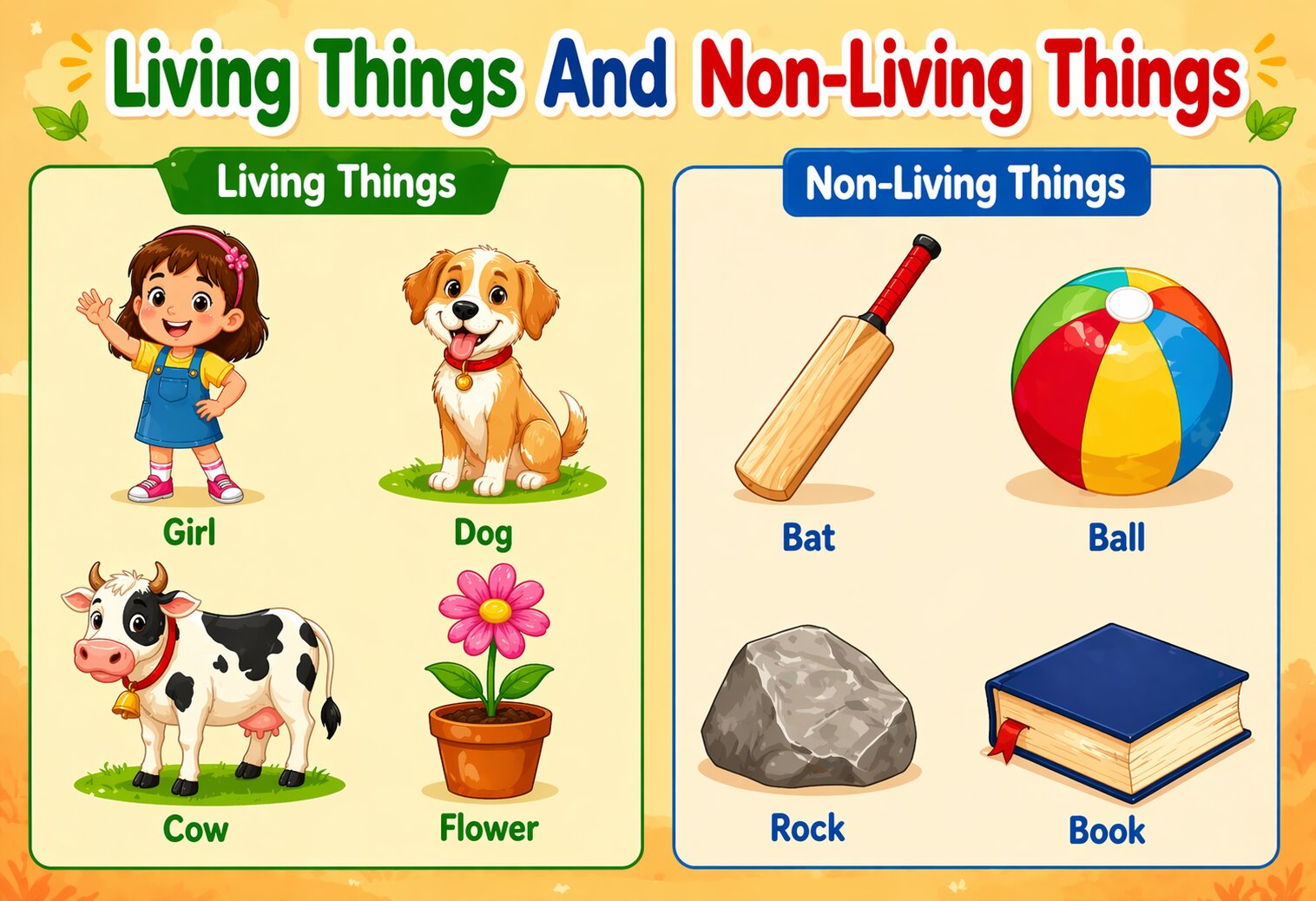
This chart helps children clearly see the difference between living and non‑living things at a glance. Use it on the wall, in notebooks, or as a worksheet for fun sorting and learning activities.
FAQs
1. How Can Parents Support Learning About Living And Non‑Living Things At Home?
Parents can support learning by asking simple questions, doing sorting games with toys and household items, looking at plants and pets together, and encouraging children to explain their thinking in their own words.
2. What Role Do Stories And Poems Play In Learning About Living And Non‑Living Things?
Stories and poems use simple language and characters—like talking trees or clever animals—to show how living things behave, which helps young learners connect emotionally and remember the ideas more easily.
3. How Do Charts And Posters Help Children Understand Living And Non‑Living Things?
Charts and posters display clear pictures and labels side by side, so children can see many examples at once and use them as visual reminders during class discussions, worksheets, or revision.
4. How Do Outdoor Activities Help Children Learn About Living Things?
Outdoor walks, garden visits, or trips to a park let children see real plants, insects, and animals in action, helping them connect classroom ideas to real‑life experiences and making learning more meaningful.
5. Why Are Plants Classified As Living Things When They Cannot Move?
Plants are classified as living things because they are made up of living cells and do show signs of growth. In fact, some plants even move!
6. Why Is Water A Non-Living Thing?
Water is considered a non-living thing because it does not have life on its own. It is a habitat for other life forms but is not an organism in its own right. However, other life forms, such as fish and whales, do call it their home!
7. How Do Living And Non-Living Things Interact With One Another In Different Habitats?
Living and non-living things interact with each other in every habitat! Air helps birds fly, while the water in the oceans helps aquatic organisms swim and sustain their lives. We humans constantly interact with natural non-living things for sustenance. Both non-living and living things are equally important!
Understanding living and non‑living things helps children build a strong foundation in science by noticing how objects around them behave, grow, and change. By exploring examples and the characteristics of a living organism — such as growth, movement, breathing, and the need for food and water — kids learn to think critically, compare, and classify the natural world in a simple, meaningful way.
Also Read:
Teaching Your Child How to Read
Diamond Shape Lesson for Children
Number Names for Children to Improve Their Math Skills